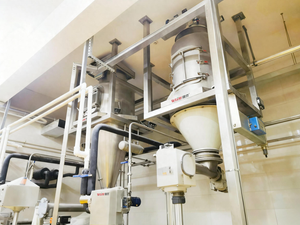
Metal contamination doesn’t announce itself. A fragment of tramp metal — a broken tool tip, a worn conveyor part, a stray fastener — enters the material stream upstream of your process, and unless something is specifically designed to catch it, it travels straight through your pneumatic conveying system undetected. Best case, it wears a hole through a rotary valve or shreds a filter bag on its way past. Worst case, it makes it all the way into finished product, and the plant is looking at a recall investigation instead of a maintenance ticket.
For processors in food, pharmaceutical, chemical, tire and rubber, coatings, and battery-material manufacturing, that risk isn’t hypothetical — it’s a structural feature of handling bulk powder and granular material sourced, milled, and transported through steel equipment. Every stage of upstream handling is a potential source of ferrous contamination, and a pneumatic conveying system that moves material efficiently but doesn’t remove metal along the way is only solving half the problem.
Magnetic separation exists to close that gap. The issue is that a lot of plants treat it as an accessory bolted onto an existing line rather than a component engineered into the conveying system from the start — and that distinction shows up directly in how long the equipment lasts and how well it actually protects the product.

Why Generic Magnet Placement Fails in Real Production
Abrasive Material Wears Through Protective Surfaces Fast
Magnetic separators placed in an abrasive material stream face a specific failure mode: the protective surface covering the magnet wears down under constant material contact, and once that surface is compromised, the magnetic core itself starts to degrade — cracking, corroding, and losing separation strength. This isn’t a slow, predictable process on highly abrasive material. One processor working with a highly abrasive product replaced a competitor’s magnetic separator after it failed within six weeks of installation, precisely because the unit wasn’t engineered for that material’s wear profile.
Product type, particle size, and density all affect how material flows across a magnet’s surface, and a separator specified without accounting for those variables is a separator that fails early — not because magnetic separation itself doesn’t work, but because it wasn’t engineered for the material actually running through it.
Transition Points in Piping Create Their Own Wear Concentration
Any transition or fitting change inside a conveying line creates an additional point where abrasive material concentrates wear, independent of the magnet itself. A magnetic separator design that introduces unnecessary transitions into the flow path doesn’t just reduce its own service life — it also creates buildup points that restrict flow and quietly erode conveying efficiency over time.
Difficult Access Turns Cleaning Into Downtime
A magnet that’s hard to open and inspect doesn’t get cleaned as often as it should, and captured metal that isn’t cleared out reduces the separator’s effective capture rate over time. Every cleaning cycle that requires extended access or partial disassembly adds unplanned downtime to a maintenance schedule that plants are already trying to shrink, not grow.
Fixed Installations Don’t Fit Multi-Site or Multi-Point Operations
Plants handling bulk material across multiple unloading points — rail cars, trucks, or silo transfer stations — often need magnetic separation at each location, but installing a dedicated fixed unit at every point adds capital cost that’s hard to justify when the actual contamination risk moves between locations rather than staying fixed in one place.
What a Properly Engineered Magnetic Separation Solution Requires
Based on how these failure modes actually play out in production, an effective magnetic separation approach needs to solve four things simultaneously — and a generic, off-the-shelf magnet rarely addresses more than one or two:
- Wear resistance matched to the specific material’s abrasiveness, not a standard housing applied universally
- A straight-through flow path that avoids introducing new transition points and wear concentration
- Fast, unobstructed access for inspection and cleanout without extended downtime
- Capture geometry — magnet placement and strength — engineered for the actual particle behavior of the material, not a generic single-pass configuration
How Magnetic Separation Fits Into a Properly Engineered Pneumatic Conveying System
Exposed-Pole, Straight-Through Magnet Configuration for Abrasive Materials
For highly abrasive material streams, the most durable configuration places magnet segments on either side of the product flow in an exposed-pole arrangement, rather than embedding the magnet inside a housing that itself becomes a wear point. This positioning keeps metal contaminants within reach of a magnetic field strong enough to capture them, while the straight-through flow path — with no internal transitions — removes the concentrated wear points that shorten a standard magnet’s service life. Full-opening access doors let maintenance staff wipe down the entire capture surface in minutes rather than partially disassembling the unit, which is the difference between a five-minute cleaning cycle and an hour of unplanned downtime.
Portable Configurations for Multi-Point Operations
For plants that need magnetic separation at multiple unloading or transfer points — rail, truck, or silo — a magnetic housing built into a mobile cart eliminates the need to install and maintain a fixed unit at every location. The same separation capability moves to wherever the material transfer is happening that day, which reduces both capital cost and the number of fixed assets a maintenance team has to track.
Combined Magnetic and Screening Capture for Non-Ferrous Contaminants
Magnetic separation only addresses ferrous and weakly magnetic contaminants — it does nothing for non-metallic foreign material. Pairing a magnetic separator with a removable screen in the same housing extends protection to non-magnetic contaminants as well, giving a single point in the line comprehensive product purification rather than requiring a separate screening step elsewhere in the process.
Staggered High-Strength Magnetic Tube Arrangement for Higher Capture Rates
Rather than relying on a single-pass, center-flow magnet configuration, arranging high-strength rare-earth magnetic tubes in a staggered pattern forces the material stream into repeated contact with magnetic surfaces as it moves through the housing. That repeated exposure meaningfully improves capture rates for both strongly ferrous material and weakly magnetic contaminants like stainless steel fragments — a distinction that matters because weakly magnetic stainless steel is exactly the kind of contaminant a basic single-pass magnet tends to miss.

Why This Belongs in the Conveying System Design, Not an Afterthought
Every one of these engineering considerations only pays off if magnetic separation is specified as part of the conveying system design from the beginning — matched to the actual material’s abrasiveness, particle behavior, and the plant’s physical layout — rather than added later as a generic component bolted onto an existing line. WIJAY Systems designs pneumatic conveying systems with contamination control integrated into the process from the start: material-specific engineering for the powders and granular products actually running through the line, straight-through flow paths that minimize wear concentration, and equipment access built for fast, low-downtime maintenance rather than extended teardown.
For processors in food, pharmaceutical, chemical, tire and rubber, coatings, and battery-material manufacturing, the cost of getting this wrong isn’t limited to a damaged magnet — it’s contaminated product, damaged downstream equipment, and the kind of quality incident that costs far more than the separator itself. Building magnetic separation into the conveying system’s design, rather than treating it as an accessory, is what actually protects product purity, equipment life, and uptime over the long run.
FAQ
Why does magnetic separation matter in a pneumatic conveying system if the material already looks clean? Tramp metal — from worn upstream equipment, broken tooling, or stray fasteners — is rarely visible in bulk powder or granular material, and without magnetic separation it travels through the conveying system undetected until it damages equipment or contaminates finished product.
Why do generic magnetic separators fail quickly on abrasive materials? A standard magnet housing not matched to the material’s abrasiveness wears through its protective surface under constant contact, which then allows the magnetic core itself to degrade, crack, or corrode — sometimes within weeks on highly abrasive products.
Can one magnetic separator handle multiple unloading or transfer points in a facility? Yes, if it’s built into a portable housing. A mobile magnetic separation cart can move between rail, truck, and silo transfer points, removing the need for a fixed unit at every location.
Does magnetic separation protect against non-metallic contaminants too? Not on its own. Magnetic separation only captures ferrous and weakly magnetic material. Pairing it with a removable screen in the same housing extends protection to non-magnetic foreign material as well.
How does magnet arrangement affect capture rate for weakly magnetic contaminants like stainless steel? A staggered arrangement of high-strength magnetic tubes forces repeated contact between the material stream and the magnetic field, which significantly improves capture of weakly magnetic contaminants that a single-pass, center-flow configuration tends to miss.