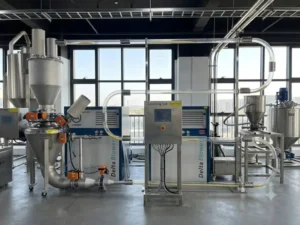
Plenty of automatic feeding equipment is, at heart, a transfer machine. It moves material from A to B, and on a short run with a forgiving pellet it does that fine. Then the plant gives it a long conveying distance, an ultra-fine powder, or a material that cakes. The line plugs repeatedly, batch weights drift, air pressure can’t adjust when conditions change, and when something does go wrong the system simply stops. Nobody saw it coming, because the equipment had no way to.
This article explains the four engineering features that separate a capable feeding system from a basic transfer machine, what problem each one solves, and what to verify before you accept a proposal.
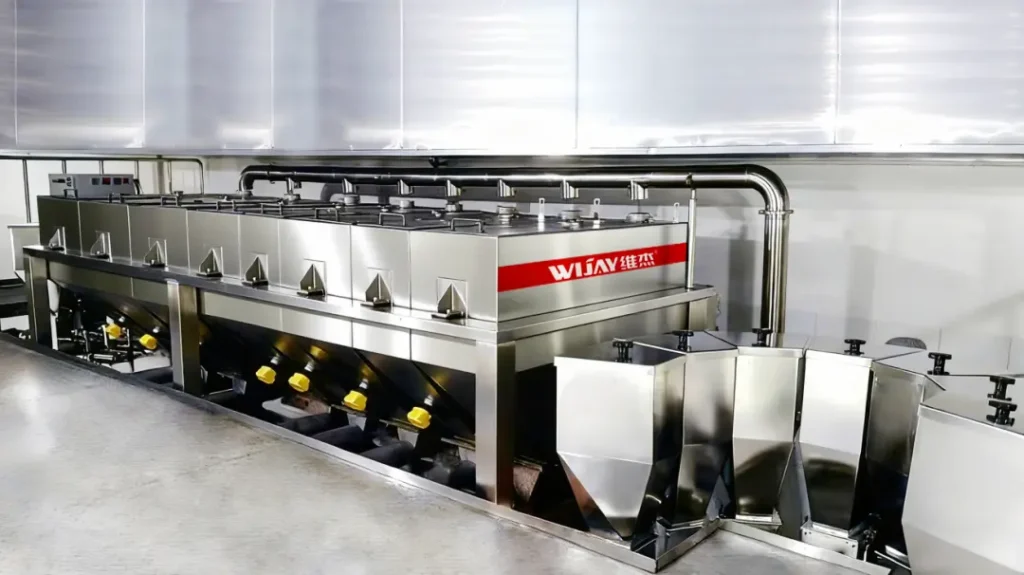
Background: Where Basic Feeding Equipment Falls Short
Basic equipment is largely interchangeable on paper. The gaps appear under demanding conditions.
| Condition | What Basic Equipment Does | Consequence on the Floor |
|---|---|---|
| Long-distance conveying | Fixed pressure and velocity | Frequent plugging |
| Ultra-fine or caking powder | Same settings for every material | Plugging and buildup |
| Fluctuating flow at the scale | Static weighing logic | Weighing results drift |
| Changing process conditions | Air pressure cannot adapt | Inconsistent feed |
| Developing fault | No prediction or early warning | Passive stop, lost production |
Stable, continuous feeding needs targeted engineering in four areas: air-pressure regulation, weighing, line self-cleaning, and safety protection.
Core Technical Explanation: Four Features and the Problems They Solve
1. Adaptive Air-Pressure Regulation
The system adjusts air pressure and velocity dynamically based on material type, conveying distance, and instantaneous flow, and it distinguishes between dilute-phase and dense-phase operation. Light powders avoid excessive velocity that breaks the particles. Heavy granules keep enough driving force to stay moving. Fewer plugs result, and one system can handle materials with different properties.
2. Dynamic-Compensation Weighing
A dynamic weighing algorithm compensates in real time for material still in flight when feeding stops and for flow-rate fluctuation. It also separates large main-ingredient weighing from small micro-additive weighing. Accuracy holds even when flowability varies slightly, which matters for modified plastics and food formulations with tight recipes.
3. Pipeline Monitoring and Automatic Purge
Monitoring points on key pipe sections identify buildup trends early. When a trigger condition is met, the system starts a sectional purge that clears deposits from the pipe wall. This reduces manual teardown and cleaning, lowers maintenance workload, and cuts the risk of different materials mixing at changeover.
4. Enclosed Explosion-Proof and Anti-Static Conveying
From the loading station and storage silo to the valves and piping, the system is grounded for anti-static protection, and components match the required explosion-protection class. Material stays enclosed throughout, so powder does not escape. This suits flammable and explosive powders in chemical and lithium battery plants.
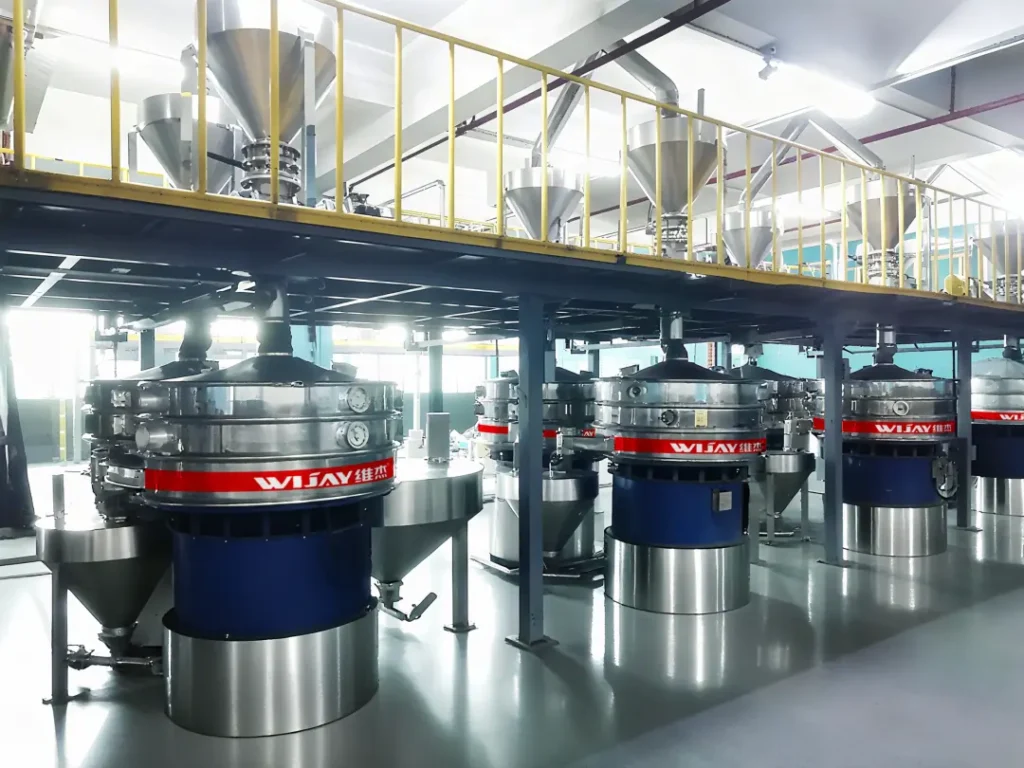
The Control Layer
Data collection, early fault warning, and remote supervision tie the four features together. The system also records conveying flow, run time, and abnormal events, which builds a maintenance log that lets technicians analyze how conditions change over time. Upgrade interfaces left open in hardware and software allow later additions such as remote operation and statistical analysis.
| Feature | Problem It Targets | What to Verify in a Proposal |
|---|---|---|
| Adaptive air pressure | Plugging, particle breakage | Does pressure adjust to material, distance, and flow? |
| Dynamic weighing | Weight drift | Is in-flight and flow fluctuation compensated? |
| Monitoring and purge | Buildup, manual teardown | Where are the monitoring points, and what triggers purge? |
| Explosion-proof, anti-static | Ignition risk, dust release | Is grounding system-wide, and are ratings documented? |
| Control and logging | Surprise stops | Are flow, run time, and events recorded? |
Practical Field Troubleshooting & Decision-Making Guidance
Operating Fix or Capability Gap?
| Symptom | Operating Fix | Points to a Capability Gap |
|---|---|---|
| Plugging after a material or humidity change | Check seals, clear the line, review settings | Pressure and velocity cannot adapt on their own |
| Weight drift when flow changes | Recalibrate the scale | No compensation for flow fluctuation or in-flight material |
| Pipe buildup needing manual teardown | Clean on schedule | No monitoring or automatic purge |
| Unexplained stop with no warning | Review the alarm log | No fault prediction or early warning |
| Mixing of materials at changeover | Extend purge time | No sectional purge function |
| Questions about ignition risk | Check grounding connections | Grounding or ratings are not system-wide |
Questions to Ask Before You Accept a Proposal
- Can you run my material at different flow rates and show that weighing holds?
- Where are the line monitoring points, and how is purge triggered?
- How is explosion-protection class documented for each component?
- What does the system log, and can technicians retrieve it?
A factory acceptance test with your real material, which our team at WIJAY runs as part of turnkey projects, is the practical way to see these features perform before shipment.
Key Design & Operation Best Practices
- Match each feature to a real failure mode. Plugging, drift, buildup, and ignition risk each need a specific answer.
- Use dense-phase or dilute-phase settings based on material behavior, not a single default.
- Separate main and micro-additive weighing so large and small doses each get appropriate resolution.
- Treat monitoring as part of the design, not an add-on, so buildup is caught before it becomes a stop.
- Ground the whole chain from loading station to piping, and document component ratings.
- Keep upgrade interfaces open so remote operation and analytics can be added later.
Common Mistakes & Pitfalls To Avoid
- Judging a system by paper specifications. What matters is stability over long periods under real, messy conditions.
- Assuming extra mechanisms mean extra capability. Each feature should answer a real production problem, and added complexity without one adds risk.
- Relying on reactive maintenance. Waiting for a stop to find a blockage costs production time.
- Weighing everything at one resolution. Micro-additives need their own metering.
- Treating data logging as optional. Without it, technicians cannot analyze how conditions change.
FAQ
Why does a feeding system plug more often on long conveying distances?
Longer runs raise pressure demand and give material more time to deposit. Fixed pressure and velocity settings cannot adjust, so deposits build up. Adaptive pressure control and monitoring address this directly.
How can dynamic compensation improve weighing accuracy in a feeding system?
It corrects in real time for material still in flight when feeding stops and for flow-rate swings. That keeps batch weights stable even when flowability shifts slightly.
What does automatic purge actually do?
When monitoring points detect buildup, the system starts a sectional purge that clears the pipe wall. This reduces manual teardown and lowers the chance of different materials mixing at changeover.
Do all powder feeding systems need explosion-proof design?
No. It is required for flammable or explosive powders, such as many chemical and lithium battery materials. The requirement depends on the material, so confirm the classification first.
Why log conveying flow, run time, and abnormal events?
Logged data forms a maintenance record. Technicians can see how conditions change over time and spot patterns, which turns surprise stops into planned interventions.
Ready to Review the Technology Behind Your Feeding System?
Send your material list, conveying distance, throughput target, and any hazardous-area classification. An engineering team can check these four features against your process before you commit to a design.