A plant manager inherits a powder conveying package that worked well at a sister site in a different industry. It gets installed, and within a month the symptoms start. In a food plant, residue builds in piping nobody can clean between batches. In a battery-materials plant, metallic fines show up in incoming QC. In a coatings plant, static discharges at the hopper. In a compounding plant, additive doses miss by the grams that matter. The conveying itself works. The design was simply built around another industry’s priorities.
This guide lays out what plastics, food, lithium battery materials, and powder coatings or fine chemicals each demand from a powder handling system, which functions every industry shares, and how to check whether a proposed design fits your process.
Background: Why a Single Design Can’t Cover Every Powder Industry
Powders and granules move through plastics, chemicals, battery materials, food, and coatings, but material behavior and process risk differ widely. What counts as good design depends on the industry.
| Industry | Primary Design Priority | Typical Failure With a Generic Design |
|---|---|---|
| Plastics compounding | Mixed pellet and powder handling, micro-dosing accuracy | Additive dose errors, residue at grade changes |
| Food processing | Hygiene and cross-contamination control | Residue pockets, contamination between ingredients |
| Lithium battery materials | Purity, enclosed low-residue handling | Foreign-matter contamination, powder oxidation |
| Powder coatings and fine chemicals | Anti-static and explosion protection, small-batch changeover | Static ignition risk, slow changeovers |
Core Technical Explanation: What Each Industry Needs From the System
Plastics Compounding: Pellets, Powders, and Micro-Additives Together
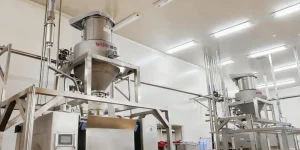
Modified plastics and masterbatch plants handle pellets, inorganic powders, and micro-additives in one flow. The chain runs from bulk bag unloading and enclosed storage through pneumatic conveying and multi-component weighing to the extruder feed points. Two features matter most: a high-precision micro-dosing module for additives, and purge capability in the piping to reduce residue at material changes.
Food Processing: Hygiene First
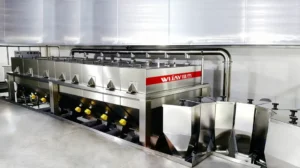
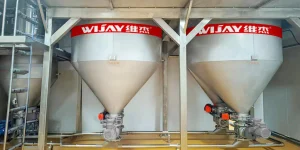
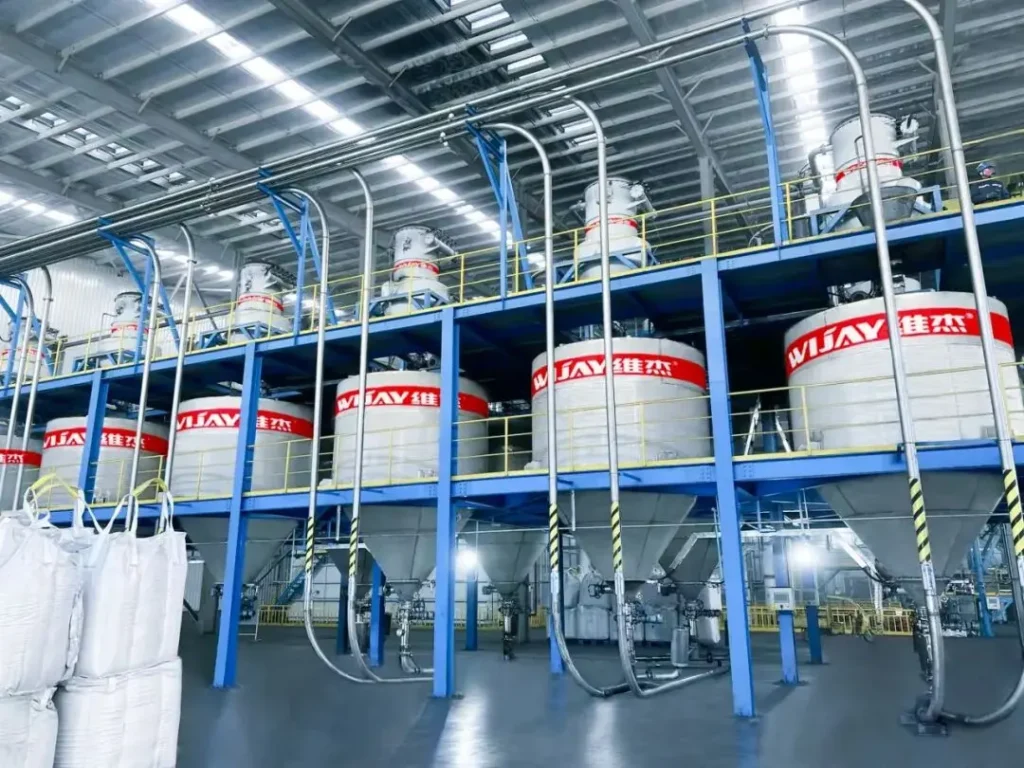
One food-processing project shows the scale: a system rated at 10 t/h serving multiple mixers at once, handling flour, baking powder, and yeast. The configuration combined large storage tanks, loading stations, a screener, buffer tanks, and weigh tanks feeding several production stations, with long horizontal runs and vertical lift. The design emphasis was hygiene, including CIP cleaning support and measures against cross-contamination between ingredients.
Lithium Battery Materials: Purity and Low Residue
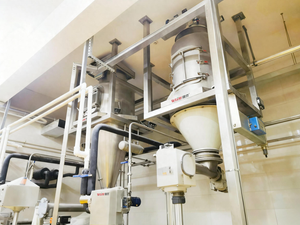
Cathode and anode powders tolerate very little foreign contamination. Piping and tanks receive special material treatment, and the system is enclosed with minimal residue. Screening and magnetic separation units protect purity. Where the material requires it, inert-gas conveying suppresses oxidation.
Powder Coatings and Fine Chemicals: Small Batches, Static, and Density Spread
Powder coating and daily-chemical producers run many small batches with frequent changeovers. The design strengthens anti-static and explosion protection, and the metering module has to handle powders with a wide spread in density.
Functions Every Industry Shares
| Core Function | What It Does | Why It Matters |
|---|---|---|
| Cross-contamination control | Automatic line purge and quick-disassembly structures | Less residue at material changes |
| Digital central control | Records batch-by-batch consumption and recipe parameters | Production can be traced back |
| Flexible production | Modular design for large continuous runs and multi-SKU small batches | One platform serves both order patterns |
| Built-in safety | Explosion protection, anti-static, dust collection, and overpressure warning matched to the industry | Safety is designed in, not bolted on afterward |
Practical Field Troubleshooting & Decision-Making Guidance
Operating Fix or Industry-Fit Gap?
| Symptom | Operating Fix | Points to a Fit Gap |
|---|---|---|
| Residue at a grade change | Extend purge time, check quick-release fittings | Recurs because the piping has no purge function, or a food line lacks CIP support |
| Additive doses drift | Recalibrate the micro-dosing scale | Dosing module was never specified for micro-additives |
| Foreign particles in incoming QC | Service the magnet, replace the screen | No screening or magnetic separation in the line |
| Static discharge at the hopper | Check grounding connections | Anti-static design was not in the specification |
| Metering off on light or heavy powders | Recalibrate per material | Metering module not suited to the density range |
| Batch records incomplete | Tighten the logging procedure | No digital recording of batch consumption |
Industry-Fit Check Before You Specify
| Industry | Ask the Supplier | Red Flag |
|---|---|---|
| Plastics | How are micro-additives dosed, and how is purge handled? | One weighing resolution for all ingredients |
| Food | Is CIP supported, and how is cross-contamination prevented? | No cleaning provision discussed |
| Lithium | Which units protect purity, and what is the residue approach? | Standard piping with no material treatment discussed |
| Coatings / fine chemicals | How are anti-static and explosion protection built in? | Safety offered only as optional add-ons |
Running your real powder through the proposed design before shipment is the cheapest place to find an industry-fit gap. A factory acceptance test with multi-material trials, which our team at WIJAY includes in turnkey projects, does exactly that.
Key Design & Operation Best Practices
- Name the industry’s top risk first (contamination, purity, static, or dosing accuracy) and design around it.
- Specify purge and quick-disassembly for any plant with frequent material changes.
- Build safety in from the start. Match explosion protection, anti-static measures, dust collection, and overpressure warning to the industry.
- Keep the design modular so large continuous runs and small multi-SKU batches share one platform.
- Record every batch, including consumption and recipe parameters, so production can be traced.
- Test your real material before committing to a layout.
Common Mistakes & Pitfalls To Avoid
- Reusing another industry’s design unchanged. Priorities differ, so the failure modes differ too.
- Treating safety as an optional add-on. It belongs in the system architecture.
- Using one metering resolution for bulk ingredients and micro-additives.
- Designing only for the continuous-run case and ignoring changeover.
- Buying isolated machines when the material flow needs redesign. Automation is not swapping people for machines. It means rebuilding the full material path around the process.
FAQ
Can one powder handling system serve multiple industries?
The architecture can be shared, including modules, central control, and purge functions. The configuration cannot. Food needs hygiene, lithium needs purity, coatings need anti-static design, and plastics need micro-dosing, so each build is specified for its own industry.
What makes lithium battery powder handling different from food powder handling?
Lithium prioritizes purity: tight foreign-matter control, special material treatment, screening, magnetic separation, and inert gas where needed. Food prioritizes hygiene: CIP support and cross-contamination control. Both are enclosed, but they protect against different risks.
How are micro-additives handled in a plastics compounding line?
A high-precision small-quantity metering module works separately from bulk weighing, and line purge reduces residue at changeover. This keeps additive doses accurate even when pellets and inorganic powders share the same conveying system.
Why do powder coating and fine chemical lines need extra anti-static and explosion protection?
Fine, dry powders can accumulate static charge, and airborne dust can be combustible. Designing protection into the system from the start is more reliable than adding components afterward, especially in multi-batch operations with frequent changeovers.
Can one system handle large continuous runs and small multi-SKU batches?
Yes, with a modular design. Automatic purge and quick-disassembly structures keep changeovers manageable, so the same platform supports both order patterns without a separate line for each.
Ready to Check Your Powder Handling Design Against Your Industry?
Send your material list, throughput targets, changeover frequency, and site layout. An engineering team can review which industry-specific features your process requires before a design is fixed.