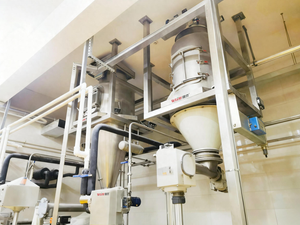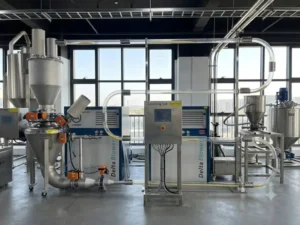

When a dense phase line runs well, it looks almost boring: material moves in short, lazy slugs, pressure stays stable, and the pipe lasts for years. When it runs poorly, it plugs, surges, and turns maintenance into a weekly event. The difference is often not the pipe diameter or the blower. It is how the system manages air along the line. That is why custom dense phase pneumatic conveying systems with boosters are so valuable for fragile, abrasive, or difficult materials. Boosters, also called air savers or air assist devices, keep material moving without pushing it to destructive speeds.
Dense phase conveying is a high-pressure, low-velocity method. Compressed air at roughly 100 to 125 psig (7 to 8 BarG) pushes a dense slug of material through the pipeline. Compared with dilute phase, the air-to-material ratio is lower, velocity is lower, and energy use per ton is often better. The trade-off is that dense phase needs careful pressure management. If the line is long, the layout complex, or the material prone to forming long slugs, a system without boosters can hit a wall.
Dense Phase With and Without Boosters: A Clear Contrast
A dense phase system without boosters relies on the initial air supply to move the entire slug from the feed point to the discharge. This can work well for short or moderate distances and simple layouts. But as distance increases, pressure drops. As pressure drops, the slug slows. If several small slugs merge into one long slug, the pressure required to keep it moving rises. Eventually, the available pressure may not be enough. The result is a plug, a production stoppage, and an operator who has to clear the line.
A dense phase system with boosters behaves differently. Boosters inject short bursts of compressed air at strategic points along the conveying pipe. Their job is not to blast the material forward. Their job is to break up or prevent the formation of long slugs and to keep the material in motion. This allows the system to deliver useful conveying pressure further down the line, even to the end. The contrast is simple: without boosters, the system fights the material with one air source; with boosters, the system manages the material all the way along the pipe.
How Boosters Work Without Damaging the Product
Boosters are sometimes misunderstood as “more air.” That is not the point. In dense phase, too much air can increase velocity, which increases wear and particle degradation. Boosters are used in small, controlled pulses. They add air where the slug needs a nudge, not where it needs a shove.
The key mechanism is slug control. In a dense phase line, material does not travel as a uniform cloud. It travels as a series of slugs. If those slugs combine, the pressure required to move the combined mass increases. If the pressure is insufficient, the line plugs. Boosters prevent this by introducing air at intervals, keeping slugs separated and mobile. They also help maintain pressure differential along the line, so the system can convey over longer distances and through more complex layouts.
For fragile materials, this controlled approach matters. A pellet that is accelerated too quickly can crack, chip, or create fines. For abrasive materials, the same control matters because wear is not linear with velocity. Pipe wear is often described as proportional to velocity cubed. A small increase in velocity can create a large increase in wear. Boosters help keep velocity in the low, stable range where both product and pipe last longer.
The Benefits of Boosters in Dense Phase Conveying
The benefits can be grouped into four practical areas.
1. Velocity control and efficiency. Boosters allow precise control of conveying velocity along the line. Lower velocity means less pipe wear, less particle degradation, and lower energy consumption. It also reduces the risk of plugging because the system is not relying on high speed to keep material suspended.
2. Overcoming pressure limitations. Every dense phase system has a practical pressure limit. Boosters extend that limit by adding air at strategic points. This is especially useful for long-distance conveying, high-rate conveying, or layouts with multiple bends and vertical lifts.
3. Greater system flexibility. A system with boosters can adapt to more complex routes. Instead of forcing the plant layout to fit the conveying system, the conveying system can be designed around the plant. This is a major advantage in brownfield projects where space is tight and existing structures cannot be moved.
4. Lower operating cost. The initial cost of boosters is usually small compared with the cost of a production stoppage. In many plants, a few hours of lost production can exceed the cost of the entire conveying system. Boosters reduce the risk of plugging and help the system run at peak efficiency, which pays back over time.
Dense Phase vs. Dilute Phase: Why Boosters Belong to Dense Phase
It is useful to compare dense phase with dilute phase. Dilute phase uses high velocity and a low material-to-air ratio. It is simple and effective for short distances and non-abrasive materials. But high velocity is hard on fragile pellets and abrasive powders. Dense phase uses low velocity and high pressure. It is gentler and more wear-resistant, but it needs better pressure management. Boosters are one of the tools that make dense phase practical over longer distances.
A common mistake is to choose dilute phase for a difficult material because it is cheaper up front. The plant then pays for it in breakage, wear, and downtime. A better approach is to compare total cost of ownership. For fragile or abrasive materials, a custom dense phase system with boosters often has a higher initial cost but a much lower operating cost.
What to Consider When Designing with Boosters
Booster selection is not a catalog exercise. Several factors matter:
- System capacity and conveying distance. Longer lines and higher rates usually require more booster points and more careful spacing.
- Material properties. Abrasiveness, particle size, bulk density, moisture, and stickiness all affect how the material forms slugs.
- Layout. Bends, vertical lifts, and transitions create pressure losses. Boosters can be placed to compensate.
- Available pressure and air supply. The system must have enough pressure to move the slug, but not so much that velocity becomes destructive.
- Budget and space. Boosters need access for maintenance. However, the operating savings from an efficient system usually outweigh the cost of adding energy-saving features.
Testing is the best way to remove guesswork. A small-scale test can show how a material behaves in dense phase, how much pressure it needs, and where boosters should be placed. Without testing, design becomes a series of assumptions.
Field Examples: Where Boosters Made the Difference
In one food plant, a dense phase system was conveying cereal pellets over a route with several bends. The line worked at low rates but plugged at higher rates. The material was fragile, so simply increasing air pressure was not an option. After testing, boosters were added at two points along the line. The system was able to run at the higher rate without increasing velocity beyond the safe limit. Product breakage stayed low, and the plugging stopped.
In a mineral processing plant, a dense phase line was conveying an abrasive powder. Wear was acceptable in the first section of pipe but severe near the end. The problem was slug merging: the material arrived in longer, slower slugs that required more pressure. Boosters were installed to keep the slugs separated. The pressure profile became more stable, and the wear rate dropped. The plant did not need a more exotic pipe material. It needed better air management.
These examples are not unusual. They show that boosters are not an add-on. They are part of the conveying strategy.
Five FAQs About Boosters in Dense Phase Pneumatic Conveying
1. What exactly does a booster do in a dense phase system?
A booster injects a short pulse of compressed air into the conveying line. This keeps material slugs separated and moving, prevents slug merging, and helps maintain pressure along the line. It is not designed to increase velocity indiscriminately.
2. Are boosters the same as air savers?
Yes, in many systems the terms are used interchangeably. You may also hear air inlet devices, air fluidizers, or air assist devices. The function is similar: controlled air injection along the conveying pipe.
3. Can boosters help with fragile materials?
Yes. By preventing long slug formation and keeping velocity low, boosters reduce the acceleration and impact that cause breakage. They are particularly useful when a fragile material must be conveyed over a long distance.
4. Do boosters eliminate the need for proper pipeline design?
No. Boosters are part of a well-designed system. Pipe routing, bend radius, material selection, and feed control still matter. Boosters cannot fix a system that is fundamentally oversized or poorly laid out.
5. How do I know if my system needs boosters?
Common signs include plugging at higher rates, pressure spikes, longer conveying times, and excessive wear near the end of the line. A system review and material testing can confirm whether boosters would improve performance.
Conclusion: Boosters Turn Dense Phase from Limited to Reliable
Dense phase conveying is already a smart choice for fragile, abrasive, and difficult materials. But without boosters, its practical range can be limited. With properly placed boosters, the system can maintain slug flow, control velocity, overcome pressure losses, and adapt to complex layouts. The comparison is clear: a dense phase system without boosters may work until distance or rate increases; a dense phase system with boosters is designed to keep working.
If you are evaluating custom dense phase pneumatic conveying systems with boosters, start with a practical engineering review. Wijay Systems helps processors analyze material behavior, test conveying performance, and configure booster placement for real operating conditions. You do not need to accept plugging, breakage, or rapid wear as normal. A better air management strategy can often solve all three. When you are ready to discuss your application, our engineers are here to help.