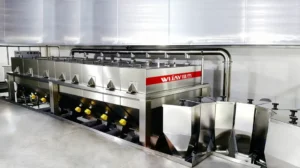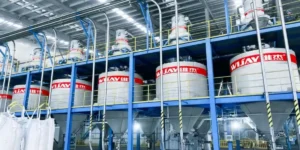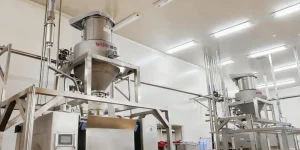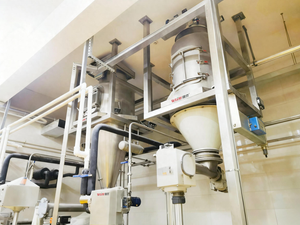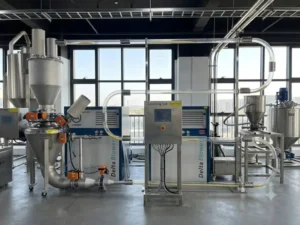
This case study covers a plant-wide material handling upgrade at a large plastics and chemical compounding facility. The plant processes modified plastic pellets, inorganic powders, and functional additives, several of which absorb moisture, cake easily, and build static charge. Rather than adding more standalone loaders, the plant specified a turnkey central feeding system rated at 20 t/h to serve multiple parallel production lines.
| Item | Detail |
| Industry | Plastics / Chemical |
| Customer | Large plastics and chemical manufacturer (anonymous) |
| Materials | Modified pellets, inorganic powders, functional additives |
| Rated capacity | 20 t/h |
| Conveying method | Negative-pressure, enclosed |
Core Operational Challenges
The previous standalone feeding model produced four recurring problems:
| Challenge | Operational Consequence |
|---|---|
| Open-top feeding | Dust buildup, with occupational health exposure and dust-explosion risk |
| Manual multi-component weighing | Operator-dependent errors and batch-to-batch property variation |
| Spillage and pipe residue | Continuous, hard-to-quantify material loss |
| No usage records | No traceable recipe or raw material consumption ledger |
Multiple lines also drew material at staggered and peak times, which manual feeding could not coordinate.
Custom-Engineered Bulk-Material Handling Solution
The design started from site conditions, not a standard package. Wijay’s engineering team surveyed ceiling heights, line and station counts, material properties, peak throughput, explosion-protection class, conveying distance, and lift. The resulting turnkey central feeding system for plastics compounding combines zoned storage, enclosed negative-pressure conveying, multi-station distribution, precision batching, and intelligent control. Compared with a conventional single-unit layout, the design cut piping by about 70% and powered equipment by about 40%.
Delivery covered site survey, simulation-based design, fabrication, installation, and a 72-hour full-load commissioning run. That run simulated peak demand to verify flow, weighing deviation, and pressure stability, and calibrated parameters for each material. Wijay then issued a material-specific operating manual and trained operators and maintenance staff in tiers.
Key System Components
| Module | Function | Configuration Note |
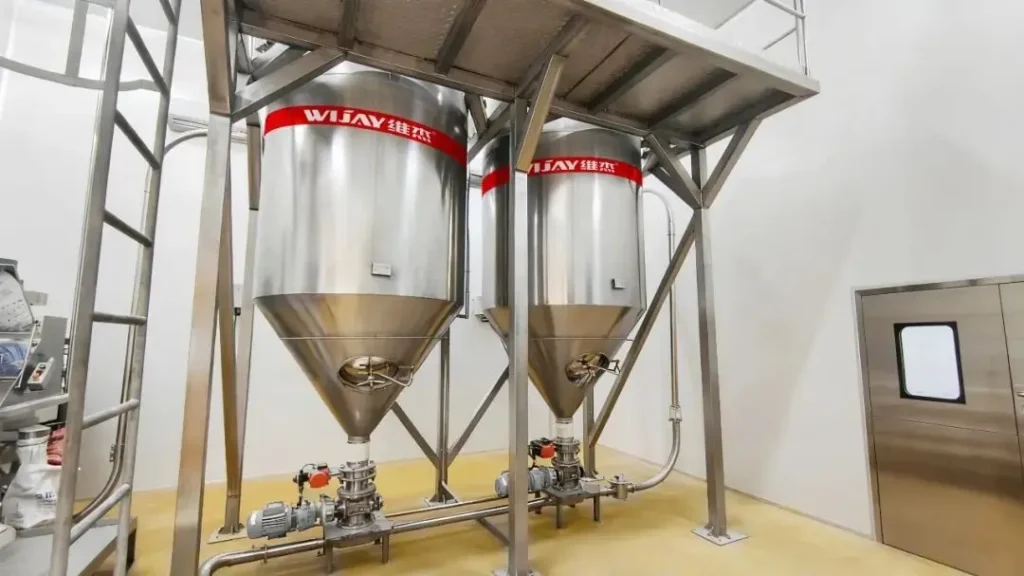
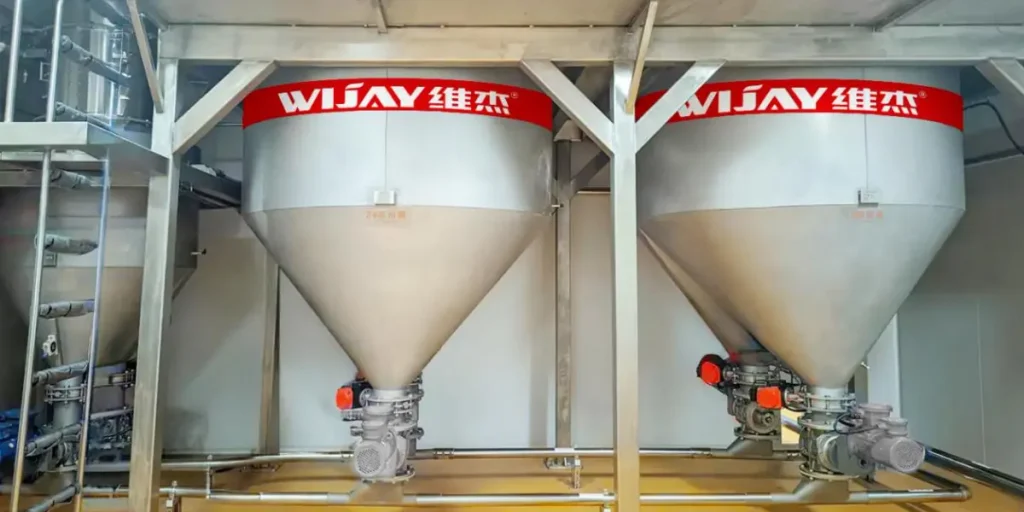
| Centralized storage | Zoned material storage | Outdoor silos with indoor buffer tanks; moisture protection and anti-bridging activation |
| Conveying and distribution | Enclosed transfer to each line | Routing optimized to limit elbows, wall friction, and residue |
| Weighing and batching | Recipe execution | Multiple independent weigh tanks; accuracy tiered for main materials and micro-additives |
| Central control | Monitoring, alarms, data | In-house software; remote supervision; MES/ERP interface |
Project-Specific Engineering Difficulties
- Mixed pellets and powders on one network. Hygroscopic, caking-prone materials required moisture-protected storage and activation devices to prevent bridging.
- Static-sensitive materials with dust-explosion exposure. Enclosed conveying had to meet the surveyed explosion-protection class.
- Staggered, peak-time draw from multiple lines. Distribution had to share supply across stations without starving any line.
- Different accuracy needs. Bulk components and micro-additives needed separate weighing resolution to keep modified formulations consistent.
Measurable Project KPIs & Operational Improvements
| KPI | Baseline | After | Improvement | Measurement Period | Measurement Method |
| Conveying piping count | Conventional single-unit layout | Centralized network | ~70% reduction | Design stage | Layout comparison |
| Powered equipment count | Conventional single-unit layout | Centralized network | ~40% reduction | Design stage | Layout comparison |
Operationally, several stations now draw material at the same time, and dust stays inside enclosed piping within safety and environmental requirements. Reserved hardware and software interfaces let new lines join as added modules rather than a rebuild.
FAQ
Why use a central feeding system instead of standalone loaders for mixed pellet and powder lines?
Standalone loaders each carry their own filter, motor, and hopper, which multiplies maintenance points and leaves weighing decisions to operators. A central system consolidates storage, distribution, and batching, so supply across lines is coordinated and consumption data is recorded in one place.
How does the system keep dust under control?
Material moves through enclosed negative-pressure piping, so dust stays inside the system instead of escaping at open feeding points. This addresses both occupational exposure and dust-explosion risk, within the explosion-protection class confirmed during the site survey.
How can several lines draw material at the same time?
Distribution is engineered around staggered and peak-time demand. During commissioning, peak-load conditions were simulated to verify flow, pressure stability, and weighing deviation, so no line is starved when several draw simultaneously.
What does a 72-hour full-load commissioning run verify?
It verifies conveying flow, weighing deviation, and air-pressure stability under sustained peak load, then calibrates parameters for each material. The outcome is a material-specific operating manual used to train operators and maintenance staff.
Technical Consultation
Primary: If you are planning a plant-wide upgrade, share your materials, throughput targets, and conveying distances with our engineers to request a plant-wide material handling assessment.
Secondary: To compare approaches before you decide, read our guide to central feeding system selection criteria.