Ask any process engineer running fumed or precipitated silica through a pneumatic conveying line what their least trusted instrument is, and the answer is usually the level sensor. Not because the equipment is unreliable in general — because ultra-fine silica is one of the few materials that actively works against most standard sensing technology. It’s fluidized, nearly dust-thin in bulk density, and reflects almost nothing to a sensor designed for a normal powder. When the level reading is wrong, a silo either overfills into a dust event or runs dry mid-process, and either outcome means an unplanned stop on a line that was supposed to be running unattended.
This is a material-specific problem, not a general instrumentation problem. Silica used in paint, plastics, food and pharmaceutical production, and modern insulation materials is often handled in a state most sensors were never designed to measure — airborne, barely settled, and prone to bridging into a hollow cone the moment it starts to discharge. Getting level and point detection right on this material isn’t a matter of buying a more expensive version of a standard sensor; it’s a matter of understanding exactly why the standard approach fails and specifying instrumentation built around silica’s actual physical behavior.
Why Ultra-Fine Silica Defeats Standard Level Sensing
Fluidization Leaves Almost Nothing for a Sensor to Detect
During pneumatic conveying, silica enters a silo in a fluidized state — air-entrained, expanded, and settling far slower than a typical bulk powder. In that state, bulk density can run well under 20 g/l, meaning there’s very little physical mass for a sensor to detect and almost no mechanical resistance for contact-based instrumentation to register. A sensor calibrated against normal powder behavior is effectively reading close to space, even when the silo is filling.
Low Reflectivity Pushes Radar Sensors to Their Limit
Silica’s low dielectric constant means it reflects very little of a radar signal back to the sensor, which is the exact opposite of the high-reflectivity assumption most standard level radar is calibrated around. Combined with the heavy dust load generated during fluidized filling, weak reflectivity is one of the primary reasons standard radar sensors return unstable or false readings on this material.
Conical Piling Creates a Bridging Risk Standard Sensors Miss
Once fluidized silica settles inside a silo and begins discharging under pneumatic assist, it forms a characteristic cone shape rather than settling evenly across the base. That cone geometry creates a real bridging risk — the material can hold a hollow, arched structure that interrupts flow while a level sensor mounted for a flat fill profile continues to report a level that no longer reflects what’s actually happening at the outlet.
Point-Level Detection Fails When Bulk Density Drops Too Low
Standard point-level sensors are built around a minimum detectable bulk density, and fluidized silica routinely falls below it — sometimes under 5 g/l in a suspended state. A sensor without enough surface area or sensitivity margin simply doesn’t register the material as present, which means high-level and low-level alarms can fail silently exactly when they’re needed most.
What Reliable Sensing on a Silica Line Actually Requires
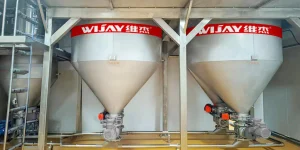
A production case involving a manufacturer of insulation board material illustrates the scope of the problem clearly. Highly dispersed silica was held in a stainless steel silo roughly 25 meters tall ahead of further processing, and the process required three distinct measurement tasks on every silo:
- Continuous level measurement for inventory monitoring
- High-level and low-level point detection to control fill and discharge cycles
- Outlet flow monitoring for early warning of blockage or bridging
The process conditions were demanding by any standard: highly dispersed silica in a pneumatically fluidized state, bulk density under 20 g/l, ambient-to-140°F process temperature, and a hazardous-area classification requiring explosion-protection certification — all inside a tall, narrow stainless steel silo where instrumentation has limited room for error.
Engineering a Sensing Solution That Actually Holds Up
Narrow-Beam Radar for Continuous Level Measurement
For continuous level measurement in fluidized, low-reflectivity material, a high-frequency radar sensor with a narrow beam angle — around 3 degrees, achievable with 80 GHz-class radar technology — concentrates enough signal energy on a small enough target area to produce a usable return even from a weakly reflective, low-density material. That narrow beam matters specifically in tall, narrow silos, where a wider beam angle picks up interference from the silo walls rather than a clean reading from the material surface.
An adjustable, rotating mounting flange — allowing several degrees of deflection — lets the beam be aimed directly at the material cone and extended toward the hopper base, rather than assuming a flat fill profile that doesn’t match how fluidized silica actually piles. Built-in purge air at the sensor lens prevents dust accumulation on the antenna during fill cycles, which is one of the most common causes of measurement drift on dusty fluidized powders. Where the application requires it — food- or pharmaceutical-grade processing, for example — sensor wetted parts specified in stainless steel, PEEK, and FKM meet the sanitary requirements those industries demand.
High-Sensitivity Vibrating Point Sensors for Ultra-Light Powder
For high-level and low-level point detection, vibrating fork-style point sensors with an extended-surface paddle attachment are specifically suited to ultra-light, pneumatically conveyed powders, because the added surface area allows reliable detection even in suspended material with a bulk density below 5 g/l — well outside the range standard point sensors can register.
At the top of the silo, a high-sensitivity version of this sensor detects full conditions even while the material is still airborne and unsettled during fill. Lower in the silo, near the conical discharge zone, a version with a polished, extended fork reliably confirms empty conditions once the fork is exposed, mounted externally through a standard threaded connection for straightforward installation and maintenance access.
Outlet Flow Monitoring to Catch Blockage Before It Stops Production
The same vibrating point-sensor technology, applied at the discharge outlet, provides continuous flow monitoring rather than a single point reading — confirming that material is actually moving through the outlet during pneumatic discharge, and flagging a blockage or bridging condition before it escalates into a full stoppage.
Explosion Protection Is Non-Negotiable
Dry, ultra-fine silica dispersed during pneumatic conveying or spraying can create a combustible dust atmosphere, which means hazardous-area classification is a standing condition on this type of line, not an occasional risk. Any sensor specified for this application needs certified explosion protection rated for the relevant hazardous zone as a baseline requirement, not an optional upgrade.
What This Delivers in Production
Combining continuous radar-based level measurement with point-level and outlet flow monitoring gives full visibility across the fill, storage, and discharge cycle — the same visibility a plant would expect from a normal bulk powder, on a material that behaves nothing like one. In the insulation-board application referenced above, that combination held stable, reliable signal output despite persistent dust, airflow disturbance, and consistently low bulk density, with measurably reduced maintenance requirements and improved process reliability compared to standard instrumentation.
The broader lesson for any plant running pneumatic conveying on fluidized, ultra-light powders — silica or otherwise — is that instrumentation selection has to start from the material’s actual physical behavior, not from a standard sensor catalog. WIJAY Systems specifies conveying and storage instrumentation the same way: matched to the material’s density, reflectivity, and flow behavior, with explosion protection built in wherever hazardous dust conditions apply, rather than defaulting to sensors calibrated for a normal powder and hoping they hold up.
FAQ
Why do standard level sensors give unreliable readings on ultra-fine silica? Fluidized silica has extremely low bulk density and weak radar reflectivity, so sensors calibrated for normal powder behavior often can’t detect enough signal to produce a stable, accurate reading. WIJAY Systems specifies level instrumentation against the material’s actual density and reflectivity profile before a conveying line is built, rather than defaulting to a standard sensor and troubleshooting after installation.
What bulk density can point-level sensors typically miss? Standard point-level sensors often can’t reliably detect material below roughly 5 g/l in a suspended, fluidized state, which is within the normal range for pneumatically conveyed ultra-fine silica. When WIJAY designs a silo and conveying setup for this kind of material, point-level detection is sized with enough sensitivity margin to stay reliable at that density from the start.
Why is a narrow radar beam important for silica silo level measurement? A narrow beam angle, achievable with high-frequency radar, concentrates enough signal on the material surface to produce a usable reading in tall, narrow silos, where a wider beam would pick up interference from the silo walls instead. WIJAY factors silo geometry into instrumentation selection for exactly this reason, since a mismatch between beam angle and silo profile is one of the more common causes of unreliable level data.
Does ultra-fine silica pose an explosion risk during pneumatic conveying? Yes. Dry, ultra-fine silica dispersed during conveying or spraying can create a combustible dust atmosphere, which is why hazardous-area rated, explosion-protected instrumentation is a baseline requirement on these lines. WIJAY treats explosion protection as a non-negotiable design input for any silica or comparably fine-powder conveying system, not an optional add-on.
Can the same sensing technology monitor for blockage at the silo outlet? Yes. Vibrating point-sensor technology applied at the discharge outlet can provide continuous flow monitoring, flagging blockage or bridging conditions before they escalate into a full production stoppage. WIJAY integrates this kind of outlet monitoring directly into the conveying system design, so blockage risk is caught early rather than discovered as a line stoppage.