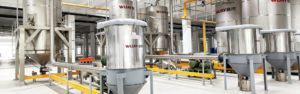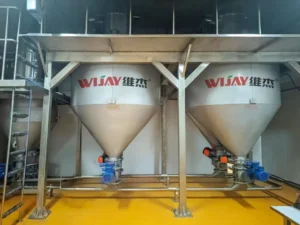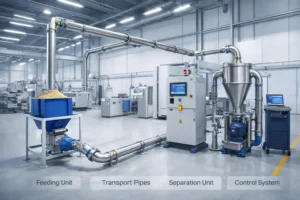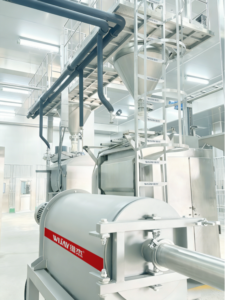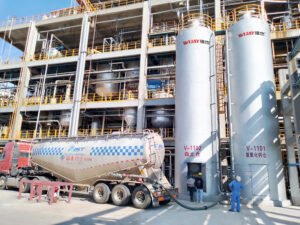
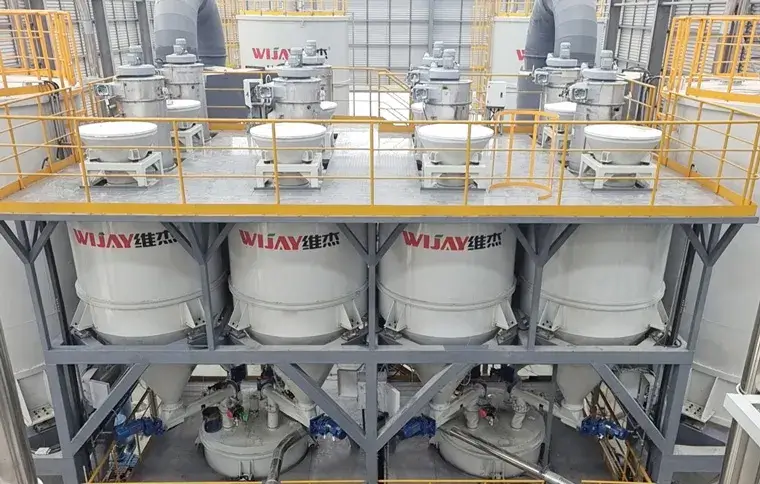
In today’s era of rapid technological development, graphene, as a new material with outstanding performance, is gradually showing enormous application potential in many fields. However, its special physical properties also bring great challenges to material conveying. With its deep technical accumulation and innovative spirit, Guangdong Wijay Material Automation System Co., Ltd. has successfully developed a custom graphene pneumatic conveying system, providing reliable support for the efficient application of graphene materials.
The Unique Charm of Graphene
Exceptional Physical Properties
Graphene has extremely high strength, hundreds of times stronger than steel, while also possessing good flexibility. In terms of electrical properties, its electron mobility is extremely high, far exceeding traditional semiconductor materials, which gives graphene great application prospects in the field of electronic devices. In addition, graphene also has excellent thermal conductivity, with a thermal conductivity coefficient of up to 5300 W/(m·K), more than ten times that of copper.
Wide Application Fields
In the electronics field, graphene can be used to manufacture high-performance transistors and integrated circuits, which is expected to drive electronic products toward smaller sizes and higher performance. In energy storage, graphene-based battery electrode materials can significantly improve battery charge and discharge efficiency and service life. Adding graphene to composite materials can greatly enhance the strength, toughness, and electrical conductivity of the materials, and it is widely used in aerospace, automotive manufacturing, and other industries.
Challenges and Solutions in Graphene Pneumatic Conveying
Because graphene powder has fine particles and a large specific surface area, it is very prone to agglomeration. During pneumatic conveying, this can easily lead to pipeline blockage and affect conveying efficiency. At the same time, its high hardness and strong adsorption can cause significant wear to conveying equipment, and ordinary conveying pipes and components are difficult to meet the requirements for long-term stable operation. In addition, the precious nature of graphene requires that the conveying process must ensure the integrity and purity of the material and avoid contamination and loss.
Wijay’s Innovative Solution
- Unique pipeline design: Wijay uses special inner-wall treatment technology to greatly improve the smoothness of the inner wall of the pipeline, effectively reducing the adhesion and agglomeration of graphene powder inside the pipeline. At the same time, by optimizing the curvature and layout of the pipeline, the resistance of the material during conveying is reduced, ensuring smooth conveying.
- High-performance conveying components: Dedicated wear-resistant fans, valves, and other components have been developed and manufactured from high-strength, wear-resistant materials to extend equipment service life and reduce maintenance costs. For example, fan impellers are made of special alloy materials and undergo surface hardening treatment, enabling them to withstand the high-speed impact of graphene powder.
- Precise pneumatic control: An advanced automatic control system is used to precisely adjust the flow rate, pressure, and temperature of the conveying gas, and to adjust conveying parameters in real time according to the characteristics of graphene and the conveying distance. This ensures that the material is conveyed under optimal conditions and avoids material loss or equipment failure caused by improper air settings.
- Fully enclosed and purified operation: The entire pneumatic conveying system adopts a fully enclosed design to prevent external impurities from entering. It is also equipped with efficient dust removal and purification devices to circulate and purify the conveying gas, ensuring the cleanliness of the conveying environment and meeting graphene’s strict purity requirements.
Wijay’s Industry Strength
Guangdong Wijay Material Automation System Co., Ltd. has been deeply engaged in the field of material automation systems for 15 years and has become a leader in material automation systems for the food industry. As a high-tech enterprise, gazelle enterprise, and specialized, refined, distinctive, and innovative enterprise, Wijay has many inventions and patents and strong technical strength.
The company has a modern production base of more than 20,000 square meters, equipped with advanced production equipment and a strict quality control system to ensure that every set of equipment can meet high-quality standards. Its research and development center of more than 3,000 square meters brings together a group of professional R&D talents who continuously explore new technologies and processes, providing a steady stream of momentum for product innovation.
In addition, Wijay is also actively expanding its global business and has established a Hong Kong international development center and a Poland after-sales service center in Europe, building a complete global service network. With customized solutions and high-quality services, Wijay has established long-term cooperative relationships with many well-known food companies at home and abroad and has won wide praise. This helps Chinese manufacturing emerge on the global stage and leads the material automation system industry to new heights.
Five FAQs
1. Can graphene powder be conveyed pneumatically?
Yes. Graphene powder can be conveyed pneumatically, but it should not be treated like ordinary powder. Because it is very fine, light, and prone to agglomeration, the system needs smooth piping, controlled air velocity, suitable bends, dust control, and wear protection. A custom graphene pneumatic conveying system is usually more reliable than a standard conveyor selected only by capacity.
2. Why does graphene powder often block conveying lines?
The main reason is agglomeration. Fine graphene particles have a large surface area and tend to stick together. If the air velocity is too low, powder settles; if it is too high, wear and dust increase. Long horizontal runs and sharp bends can also create accumulation points. Practical solutions include optimized pipe routing, large-radius bends, pressure monitoring, and automatic purge sequences.
3. What makes a graphene conveying system “custom”?
A custom system is designed around the actual powder, route, and production requirements. That may include powder testing, low-speed conveying parameters, wear-resistant elbows and valves, closed-loop gas return, fine filtration, and controls that adjust to pressure and flow conditions. The goal is stable operation, not simply moving powder from one point to another.
4. How can product purity be protected during conveying?
A fully enclosed system helps prevent outside contamination. Well-sealed transfer points, efficient filtration, easy-cleaning surfaces, and proper inspection access are also important. If the graphene grade is sensitive to moisture or oxygen, inert gas or other protective measures can be considered based on the process and safety assessment.
5. What information should be prepared before requesting a quotation?
Prepare powder properties such as bulk density, particle size, moisture content, and safety data. Also prepare the conveying distance, vertical lift, number of bends, capacity per hour or batch size, product sensitivity, plant space, and safety requirements. Sharing this information early helps engineers propose a realistic custom graphene pneumatic conveying system design.
If you would like to learn more about graphene pneumatic conveying systems or other material automation solutions, please visit www.wijaysystems.com and contact our technical team. Wijay can review your powder data, layout, and capacity target and provide a practical, personalized service plan for your project.