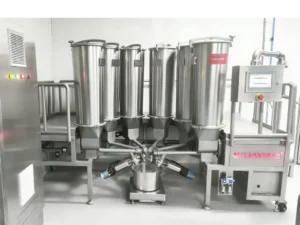
A plant specifies its feeding line around today’s product. A few years later the product mix has changed, a safety review asks questions the layout can’t answer, and the MES project wants material consumption data the equipment never recorded. The system was bought as separate machines, so every one of those requests becomes a rebuild.
This article describes four shifts we see in powder handling projects across chemical compounding, battery and advanced materials, and food processing. For each one, it explains what is changing, what it means for your specification, and how to check whether your current setup is ready.

Background: Why Material Handling Moved From Accessory to Critical System
Material conveying and batching sits at the front of the process chain. For years it was treated as support equipment designed around the main production line. Three pressures have changed that:
| Driver | What It Changes in the Material Section |
|---|---|
| Updated safety rules | Dust, static, and pressure risks must be handled in the system itself |
| Higher batch-consistency demands from downstream customers | Metering accuracy and contamination control affect product yield |
| More multi-SKU, flexible orders | Changeover speed and recipe flexibility decide manufacturing agility |
Material handling now influences yield, compliance level, and manufacturing flexibility. It is a process system, not an accessory.
Core Technical Explanation: Four Shifts
| Shift | From | To |
|---|---|---|
| 1. Project scope | Buying separate machines and integrating on site | Turnkey system responsibility |
| 2. Production mode | Fixed feeding for one material | Flexible changeover and cross-contamination control |
| 3. Safety | Remediation after the equipment is built | Safety designed in at the start |
| 4. Data | Physical conveying only | Material system as a core data source |
Shift 1: From Stacked Machines to Integrated System Engineering
Early material sections were assembled in batches: feeders, silos, and weighing units bought separately and joined on site by the plant. The weaknesses are well known. Pneumatic parameters don’t match between units, piping hasn’t been simulated, and control protocols differ, so plugging, weighing drift, and data islands follow.
The direction is toward turnkey responsibility. One provider with full process capability covers property assessment, pneumatic simulation, system design, equipment integration, and full-load calibration. System-level performance outranks single-unit catalog figures, and one party answers for capacity, accuracy, and safety across the whole material chain. That removes the blurred boundaries that appear when several suppliers must interface.
Shift 2: Flexibility for Multi-SKU Manufacturing
Product cycles are shortening, and small batches with frequent recipe changes are routine. A feeding architecture built for continuous single-material production struggles with frequent changeovers. The capabilities that matter now are:
- Configurable recipe scheduling logic
- Sectional automatic purge to clear residue
- Quick-disassembly isolation components
- Metering ranges that switch automatically
- Hardware and software with expansion margin, so product updates do not force a large line rebuild
The goal is one system that covers multiple material categories.
Shift 3: Safety Designed In, Not Retrofitted
Static buildup, dust escape, and abnormal pressure are major risk sources in powder handling. Many existing lines handled safety as remediation: dust collection, grounding, and alarms added after the equipment was built, limited by the existing layout and rarely reaching the best safety architecture.
For new projects, dust explosion protection, anti-static measures, enclosed dust suppression, and overpressure interlocks are becoming hard inputs at the design stage. Component selection, the grounding network, and interlock logic are designed together against the plant’s hazardous-area classification, so protection is part of the system itself and not an add-on. Requirements differ by jurisdiction, so confirm specifics locally.
Shift 4: Hardware and Software Coupled, Material Data as a Core Source
Digitalization here is not a big dashboard. The core is reliable capture, business integration, and reusable data. Traditional equipment only moves material, so consumption, recipe execution, and equipment condition data never travel upward, leaving a gap in the plant’s manufacturing data.
The direction is tight coupling of hardware and control software: full capture of level, flow, weighing, and fault events, connected through standard industrial interfaces to MES and ERP. The outputs are a consumption ledger, recipe execution records, and equipment maintenance logs, which feed cost accounting, process traceability, and predictive maintenance.

Practical Field Troubleshooting & Decision-Making Guidance
Is Your Current Setup Ready? Operating Fix or Structural Gap
| Symptom | Operating Fix | Points to a Structural Gap (Shift) |
|---|---|---|
| Plugging and weight drift between separately bought units | Retune each unit | Parameters and control protocols were never matched (1) |
| Changeovers slow and contaminated | Extend cleaning steps | Piping has no sectional purge or quick-disassembly parts (2) |
| New recipe forces rework | Adjust settings | No scheduling logic or expansion margin (2) |
| Safety review finds missing grounding or alarms | Add the missing item | Safety was added afterward and cannot reach a complete architecture (3) |
| MES project cannot get material data | Re-enter data by hand | No standard interface or full data capture (4) |
What to Write Into Your Specification
| Shift | Clause to Include |
|---|---|
| 1 | One party responsible for capacity, accuracy, and safety across the full material chain |
| 1 | Property assessment, flow simulation, and full-load calibration in scope |
| 2 | Recipe scheduling, sectional purge, quick-disassembly parts, and expansion margin |
| 3 | Explosion protection, anti-static, enclosure, and overpressure interlocks as design inputs |
| 4 | Full data capture and standard interfaces to MES and ERP |
Some engineering partners, including our team at WIJAY, run simulation first and then test with customer material in a factory acceptance test before shipment, which is a practical way to confirm these clauses are met.
Key Design & Operation Best Practices
- Plan material handling at the top level with process, safety, and digital strategy, not as a labor-saving purchase.
- Evaluate providers on engineering capability: simulation, material testing, and hardware-software integration.
- Reserve flexibility and digital expansion room that matches your capacity and product plans for the next several years.
- Put safety requirements in the design inputs, not the punch list.
- Treat system performance as the metric, not individual unit specifications.
Common Mistakes & Pitfalls To Avoid
- Viewing automation only as a labor-saving tool. It affects yield, compliance, and flexibility.
- Buying machines separately and integrating on site. Responsibility blurs and parameters mismatch.
- Designing for one material when the product mix will change.
- Adding safety parts after construction, when layout limits what is possible.
- Ignoring data capture until the MES project arrives.
FAQ
Why is turnkey system responsibility becoming more common in powder handling?
Separately bought units often have mismatched pneumatic parameters and control protocols, causing plugging, weighing drift, and data islands. One provider responsible for the full chain removes the unclear boundaries between suppliers.
What should a flexible powder handling system include for frequent changeovers?
Configurable recipe scheduling, sectional automatic purge, quick-disassembly isolation components, and metering ranges that switch automatically. Expansion margin in hardware and software lets product updates proceed without a large rebuild.
Why design safety in at the start instead of adding it later?
Retrofitted dust collection, grounding, and alarms are limited by the existing layout and rarely achieve the best safety architecture. Designing them together against the hazardous-area classification builds protection into the system.
What data should the material system provide to MES and ERP?
Level, flow, weighing, and fault events, delivered through standard interfaces as a consumption ledger, recipe execution records, and equipment maintenance logs. These support cost accounting, traceability, and predictive maintenance.
How should I plan a feeding system for product changes over the next few years?
Include material handling in top-level process, safety, and digital planning, and reserve flexibility and digital expansion room matched to your expected capacity and product iterations.
Ready to Test Your Specification Against These Four Shifts?
Send your material list, expected product mix changes, throughput targets, and any hazardous-area classification. An engineering team can review how well your planned or existing setup handles integration, flexibility, safety, and data.