The first sign is usually a QC report: metallic fines in a batch, moisture pickup in a powder that left the silo dry, or batch-to-batch spread that nobody can explain. In battery materials, functional fillers, resin-based composites, and nano powders, the feeding and batching step sits ahead of synthesis, mixing, and coating. What happens there sets the finished product’s foreign-matter content, batch consistency, and safety level.
This article covers what advanced material powders demand from an automatic feeding system, how the system should be built to meet those demands, where project risk concentrates, and what to check when screening suppliers.

Background: Why Manual and Standalone Feeding Struggle With Advanced Materials
These powders tend to be fine, prone to absorbing moisture and clumping, sensitive to static, and in some cases flammable or explosive. Property differences between material types are large. Manual dosing and standalone feeders expose five weaknesses.
| Weakness | Consequence |
|---|---|
| Open handling | Foreign matter enters the material |
| Manual weighing | High dispersion in batch ratios |
| Air exposure of highly active powder | Oxidation and moisture pickup |
| No full-chain status monitoring | Abnormal conditions identified late |
| No standardized digital record of consumption and process parameters | Hard to meet the strict traceability demanded in this industry |
In this setting, the feeding system is no longer a supporting accessory. It is a core unit in the process chain.
Core Technical Explanation: Four Process Constraints and How the System Answers Them
The Four Constraints
| Dimension | Requirement | Design Response |
|---|---|---|
| Foreign-matter control | Keep ferromagnetic and metallic impurities out; some high-end specifications set limits at ppm level | Special surface treatment on piping, valves, and contact media, so worn or flaking parts do not contaminate the powder |
| Material protection | Prevent particle breakage in brittle powders; protect moisture- and oxygen-sensitive powders | Limit conveying velocity and pipe curvature; add nitrogen blanketing and deep-dehumidified air where needed |
| Metering and flexibility | Handle bulk main materials and micro functional additives; switch recipes quickly | Separate metering paths; reduce internal residue at changeover to limit cross-batch contamination |
| Safety and compliance | Some powders are combustible dust | Electrical components, grounding network, and pressure interlock alarms matched to the hazardous-area classification |
System Architecture: Five Coordinated Units
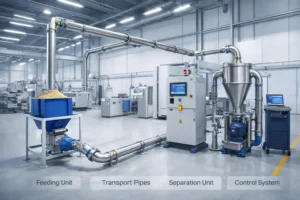
A modular architecture ties five units together instead of joining standalone machines.
| Unit | What It Does |
|---|---|
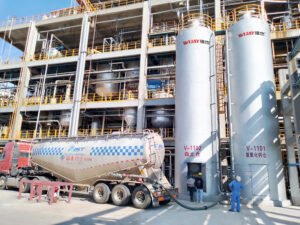
| Receiving and storage | Handles tanker discharge or bulk-bag unpacking; silos with anti-bridging activation and nitrogen sealing and dehumidification to limit caking and moisture ingress |
| Conveying and distribution | Dense- or dilute-phase mode chosen by material; wear-resistant components for hard powders; optimized elbow radius; pressure monitoring and sectional purge ports at key points |
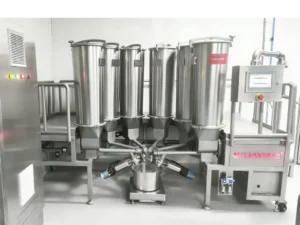
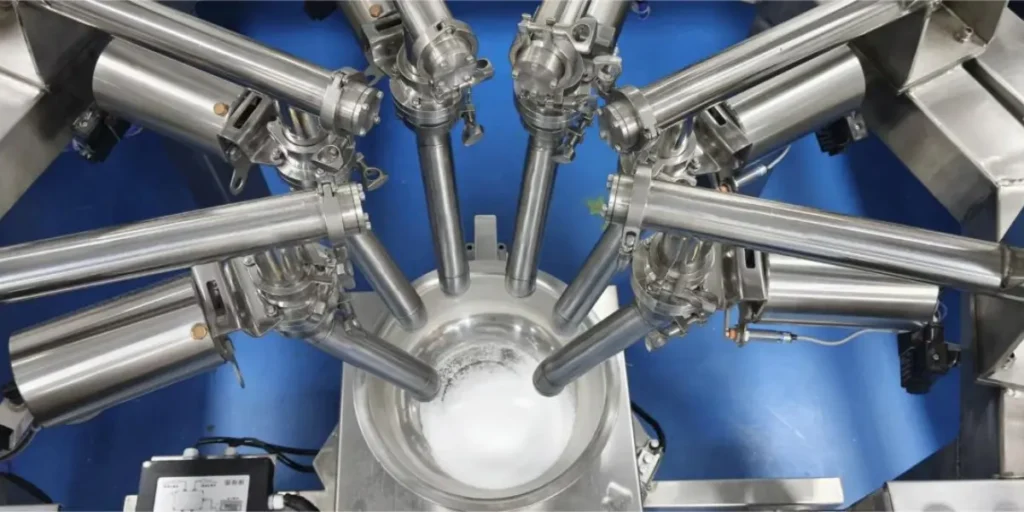
| Graded metering and batching | Separate high-flow main-material weighing and high-precision micro-additive feeding; dynamic compensation for drop-height and flow-rate drift |
| Dust control and safety | Dust collection matched to capacity; full anti-static bonding; interlocks for over-pressure, blockage, and level faults |
| Intelligent control | Full-chain data collection, early fault warning, remote supervision; standard industrial interface to MES; logs of material batch, conveying flow, batching parameters, and alarms |
Practical Field Troubleshooting & Decision-Making Guidance
Where Project Risk Concentrates
Risk clusters in three stages: simulation, property calibration, and full-load commissioning. Reusing a mature template from another industry skips all three.
| Stage | What to Do | Risk If Skipped |
|---|---|---|
| Property assessment and simulation | Test bulk density, angle of repose, moisture content, static behavior, and abrasion index; run gas-solid two-phase flow simulation to set velocity, routing, and vessel structure | Design built on assumptions, not your powder |
| Fabrication and material selection | Choose contact materials by chemistry; polish pipe interiors for high-purity powders; select explosion-proof parts by hazardous-area class | Impurity and compliance problems built in at the source |
| Full-load calibration | Run real material under full load; calibrate air pressure, feed rate, and weighing parameters; simulate changeover and peak load | Stability unverified; no material-specific parameter library |
| Documentation and training | Deliver P&ID drawings, material certificates, and calibration reports; train process and maintenance staff separately | Knowledge stays with the integrator |
Some engineering partners, including our team at WIJAY, run the simulation first, test with customer material before shipment, and then calibrate on site under full load.
Operating Fix or Design Gap?
| Symptom | Operating Fix | Points to a Design Gap |
|---|---|---|
| Metal particles in incoming QC | Service the magnet, inspect for wear | Contact surfaces were never treated against shedding |
| Moisture pickup in storage | Check seals and dryer | No nitrogen sealing or dehumidified air in the design |
| Brittle powder breaking in transit | Reduce air velocity | Pipe curvature and velocity were not engineered for fragile powder |
| Ratio spread between batches | Recalibrate scales | No separate path for micro-additives, or no drift compensation |
| Cross-batch contamination | Extend purge time | Piping retains residue with no sectional purge |
| Audit gaps on combustible dust | Update paperwork | Components do not match the hazardous-area classification |
Four Supplier Capabilities to Check
| Capability | Ask | Red Flag |
|---|---|---|
| Powder property database and simulation | Can you design a custom pneumatic scheme for each powder? | A standard model with minor modification |
| Materials, foreign-matter, explosion, and static experience | Do you have comparable projects? | No similar-condition references |
| Control software and data exchange | Can the system output the full dataset needed for traceability? | A closed interface |
| Full project delivery | Do you cover assessment, simulation, calibration, and handover? | Hardware supply only |
Key Design & Operation Best Practices
- Start from measured material properties, not another industry’s template.
- Control contact surfaces and polishing to stop contamination at the source.
- Limit velocity and curvature for brittle powders, and add nitrogen or dehumidified air for active ones.
- Meter bulk and micro-additives separately, with compensation for drift.
- Match electrical parts and grounding to the hazardous-area class.
- Leave hardware and software expansion room, since formulas and material systems keep changing in this industry.
Common Mistakes & Pitfalls To Avoid
- Judging by catalog specifications. Contact materials, simulation, and calibration decide results.
- Calibrating at no load only. Real material under full load is the real test.
- Skipping simulation because a similar system ran elsewhere.
- Treating documentation as optional. P&IDs, material certificates, and calibration reports let your team maintain the system.
- Ignoring future changes. Without expansion room, a new formula can force a rebuild.
FAQ
What makes advanced material powders harder to feed than ordinary plastics?
They are fine, prone to moisture pickup and clumping, static-sensitive, and sometimes combustible. Foreign matter, oxidation, and ratio dispersion matter more because the feeding step sits ahead of synthesis, mixing, and coating.
How is metallic contamination controlled in a feeding system?
By special surface treatment on piping, valves, and other contact media so worn parts do not shed into the powder, and by polishing pipe interiors for high-purity materials. Where needed, nitrogen or dry air protects active powders from moisture and oxygen.
Why calibrate with real material under full load?
Air pressure, feed rate, and weighing parameters depend on how your powder behaves at real flow. Full-load calibration, including changeover and peak-load scenarios, verifies stability and builds a parameter library for each material.
Do all advanced material powders need explosion-proof design?
No. Only some are combustible dust. Where they are, electrical components, grounding, and pressure interlocks must match the hazardous-area classification, so confirm the material’s classification before specifying.
Why leave expansion room in the design?
Formulas and material systems change quickly in this industry. A system with spare hardware and software capacity adapts to later process changes and avoids rebuild costs.
Ready to Check Your Feeding Design Against Your Powder?
Send your material list with properties, throughput targets, hazardous-area classification, and site layout. An engineering team can review contamination control, moisture protection, metering, and safety requirements before a design is fixed.