The capital request for a central feeding system lands next to a manual feeding line that already works. Operators cut bags, tip material, and the plant ships product. On a spreadsheet, the manual line looks cheap: the equipment is paid off, and the labor is a line item nobody questions. The automation quote looks like pure added cost, so the project gets deferred another budget cycle.
The problem is that the manual line’s real costs are scattered across labor, material loss, rework, PPE, and compliance work, and nobody adds them up. This article shows how to find those costs, how to model benefits in an existing plant without overpromising, and why static payback alone undercounts the return.
Background: The Hidden Costs of Manual and Open Feeding
Four cost lines tend to hide inside a manual material section, and each one compounds over time.
| Hidden Cost | Where It Hides | What to Measure |
|---|---|---|
| Feeding labor | Unpacking, transfer, weighing, and dumping roles, with wages rising each year | Headcount and hours per shift on material tasks |
| Material loss | Spillage during open feeding, residue left on pipe walls | Annual consumption, loss rate, and unit material cost |
| Rework | Batches off-spec from manual batching errors | Rework and scrap volume tied to dosing |
| Dust-related cost | PPE spending, safety and environmental compliance management | PPE budget, inspection findings, housekeeping hours |
Individually these look small. Accumulated over years on an existing line, the total is often substantial. Any ROI evaluation should use the full life cycle of these costs, not just the equipment purchase price.
Core Technical Explanation: Where the Return Comes From
Manual Distributed Feeding vs. Central Feeding Across Five Dimensions
| Dimension | Manual, Distributed Operation | Central Feeding System |
|---|---|---|
| Labor | Several people unpack, transfer, weigh, and feed | Material section runs automatically; staff shift to monitoring and rounds, with much lower physical strain |
| Material loss | Spillage and residue are unavoidable in open handling | Enclosed piping plus self-cleaning purge keeps loss low, which matters most for high-value powders |
| Product quality | Manual weighing varies with operator condition and experience, causing batch differences | Automatic weighing runs a fixed recipe, reducing quality swings, rework, and rejects |
| Safety and environment | Dust spreads; PPE and safety oversight pressure is high | Enclosed system keeps dust inside, supporting dust-explosion and environmental requirements |
| Data | Paper records, easy to lose or mis-enter | Software logs consumption and every batch, so production is traceable |
Actual savings differ between plants. Raw material price, capacity, and material type all shift the result, so the numbers need a calculation built on your real operating conditions.
Why Static Payback Undercounts the Return
A simple payback period leaves out benefits that don’t show up as a line on the current P&L:
- Lower compliance risk. Avoiding remediation ordered by safety or environmental inspectors also avoids the production stoppages that come with it.
- More consistent product quality. Consistency improves competitiveness when bidding for orders.
- A data foundation. Complete material records support process optimization over time.
- Better working conditions. Improving hazardous or unpleasant roles eases recruitment problems.
Brownfield Reality: Limited Space, Existing Equipment, Scattered Stations
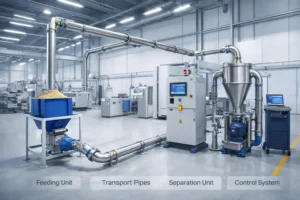
Existing plants usually face tight space, standalone equipment already in place, and scattered stations. A modular central feeding system doesn’t force full demolition. It can connect to existing equipment, and the layout of silos and piping is optimized to fit the building as it stands. The design covers current capacity while leaving room for later expansion.
Practical Field Troubleshooting & Decision-Making Guidance
Building a Defensible ROI Model
| Input | Formula or Source | Note |
|---|---|---|
| Annual loss cost | Annual consumption × measured loss rate × unit material cost | Measure loss over a defined period before quoting |
| Labor cost | Hours on material tasks × loaded labor rate | Include night-shift coverage if applicable |
| Rework cost | Off-spec volume from dosing × cost per batch | Pull from QC records |
| Compliance and PPE cost | Budget lines plus inspection-related downtime | Include avoided rework orders |
| Intangible benefits | Quality consistency, data, working conditions | Report separately rather than forcing a number |
Operating Fix or Structural Cost?
| Symptom | Operating Fix | Points to a Structural Cost |
|---|---|---|
| Spillage at one dumping station | Add containment, tighten housekeeping | Loss recurs at every transfer point across the section |
| Occasional off-spec batch | Retrain, add a double-check | Batch differences persist across shifts and operators |
| One role hard to staff | Adjust schedules or incentives | Turnover on material roles is chronic |
| Dust finding at one inspection | Local fix | Dust is a standing compliance item |
| Records missing for one batch | Tighten logging | Traceability gaps keep recurring in audits |
The return tends to be clearest where material is expensive, handling is open, and several of these structural symptoms appear together. Where loss and labor are small, the case is weaker and the model should show that honestly.
Get a Custom Calculation Before You Commit
Inviting an engineering partner to survey the site, clarify capacity, materials, and building constraints, and return a customized design with a benefit estimate is more reliable than borrowing another plant’s results. Some engineering partners, including our team at WIJAY, do this as part of turnkey projects, with simulation work and a factory acceptance test before shipment.
Key Design & Operation Best Practices
- Measure the baseline first. Track loss, labor hours, and rework for a defined period before quoting.
- Use full life-cycle cost, not just purchase price.
- Model your own plant. Material price, capacity, and material type change the answer.
- Choose a modular architecture so existing equipment can connect and expansion adds modules.
- Reserve capacity for later growth in the design stage.
- Report intangible benefits separately from the hard-cost calculation.
Common Mistakes & Pitfalls To Avoid
- Relying on static payback alone. It ignores compliance, quality, data, and working-condition benefits.
- Copying another plant’s ROI. Material properties and building conditions differ, and so do the gains.
- Counting only headcount. Loss, rework, and compliance often matter as much as labor.
- Skipping the baseline. Without measured loss and rework, any savings estimate is a guess.
- Assuming a retrofit requires full demolition. A modular system can work around existing equipment and building limits.
FAQ
What costs should I include when calculating central feeding system ROI?
Include feeding labor, material loss from spillage and residue, rework from manual batching errors, and dust-related PPE and compliance costs. Then add intangible benefits such as quality consistency, traceable data, and better working conditions, reported separately.
Why is static payback period not enough for a feeding system?
It counts only direct savings. It misses lower compliance risk, more consistent quality, a data foundation for process improvement, and easier hiring for improved roles, all of which carry real value over time.
Can a central feeding system work in an existing plant with limited space?
Yes. A modular design can connect to existing equipment and optimize silo and piping layout within the current building. Expansion room is planned in, so new capacity adds modules instead of a rebuild.
How much material loss will I save?
It depends on your material price, capacity, and current loss rate, so measure your baseline first. Enclosed piping with self-cleaning purge lowers loss, and the savings are most visible with high-value powders.
Should I reuse another plant’s ROI figures?
No. Material properties, capacity, and building conditions differ between plants, so the benefits differ too. A site survey and a customized calculation give a result you can defend internally.
Ready to Build an ROI Case for Your Plant?
Send your material list, annual consumption, current labor and loss data, and site layout. An engineering team can survey your conditions and prepare a customized design with a benefit estimate you can bring to budget review.