Product consistency in frozen steamed buns, mantou, and filled dough products comes down to four variables that never change: flour quality, minor-ingredient batching accuracy, storage conditions, and how cleanly material moves between them. As frozen staple food production scales up in central factories, the manual methods that worked for a single line — bag-breaking by hand, open-air transfer, manual weighing of yeast and baking powder — start working against the plant instead of for it.
This case study looks at how a bulk material conveying system was engineered for a global central frozen-staple food manufacturing plant running multiple parallel mantou, huajuan, and bun lines, where flour and functional minor ingredients had to move through one unified, closed-loop automation backbone.
The Production Pain Points Behind the Project
Plants scaling frozen staple food output typically hit the same wall. Manual weighing of minor ingredients such as yeast, salt, and baking powder introduces batch-to-batch variance — industry benchmarks put manual weighing error in the range of several percentage points per batch, enough to visibly affect dough fermentation and texture consistency. Open bag-breaking stations generate airborne flour dust that settles across the workshop, degrading both housekeeping standards and combustible-dust safety compliance. Humidity-sensitive ingredients like yeast and baking powder lose activity when exposed to open air during transfer and storage. And long-distance manual transport between storage and mixing stations adds labor hours that scale linearly with output — a cost that only grows as production volume increases.
For a facility running several product lines in parallel, these problems compound: inconsistent batches across lines, elevated raw material loss, workshop cleanliness that fails audit, and rising labor overhead that erodes margin as volume grows.
Project Background: A Multi-Line Central Factory With Complex Supply Requirements
The client operates several parallel mantou, huajuan, and steamed bun production lines, with functional minor ingredients — baking powder, salt, yeast — running alongside bulk flour on a continuous basis. To keep fermentation and finished-product texture consistent across high-volume, continuous production, every stage from dust-free feeding and impurity screening to interim storage, silo storage, precision weighing, and closed-loop pneumatic delivery to the dough mixers needed to operate as one standardized, sealed, and intelligent system.
This was not a single-machine equipment purchase. The scope covered full plant-wide material automation planning — engineering a custom negative-pressure pneumatic conveying system as the structural core of the line, connecting raw material intake all the way through to the batching terminal in one closed loop.
Solution Breakdown: End-to-End Automated Process Design
The engineering team conducted an on-site survey of the workshop layout and piping routes, then built the process design around the plant’s actual operating parameters: 50 meters of horizontal conveying, 15 meters of vertical lift, a 6 t/h peak capacity requirement, simultaneous material draw from four dough mixers, changeover cleaning needs, food-grade compliance, and headroom for future capacity expansion.
The resulting line connects dust-free feeding, screening and impurity removal, enclosed pneumatic conveying, silo storage, multi-tank precision weighing, automatic batching, delivery to the mixing stage, and CIP cleaning with residual material recovery into a single, continuous process. The goal throughout was to minimize contact between powder and both workers and open air, removing the human variable that causes quality drift. Key functional modules include:
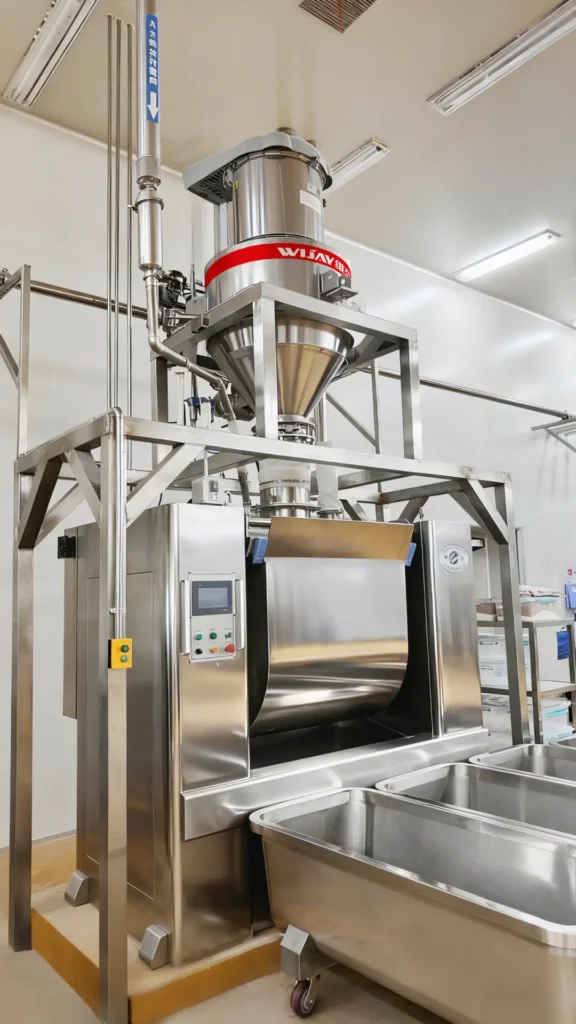
Feed pretreatment module. Bagged powder enters a dust-free feeding station equipped with dust extraction and vibrating screening equipment, removing flour clumps, woven-bag fibers, and other contaminants at the source — suppressing dust emission and improving raw material cleanliness from the first step.
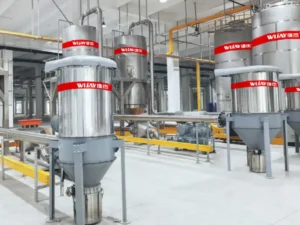
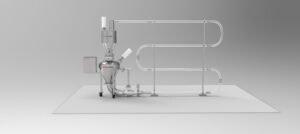
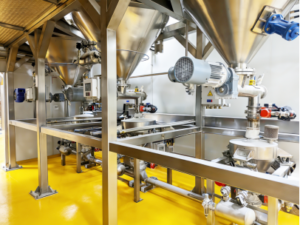
Enclosed pneumatic conveying module. Flour, yeast, salt, and baking powder all travel through sealed pneumatic piping over long distances, fully enclosed against dust exposure, moisture ingress, and pest contamination.
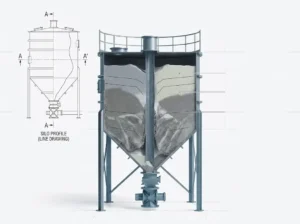
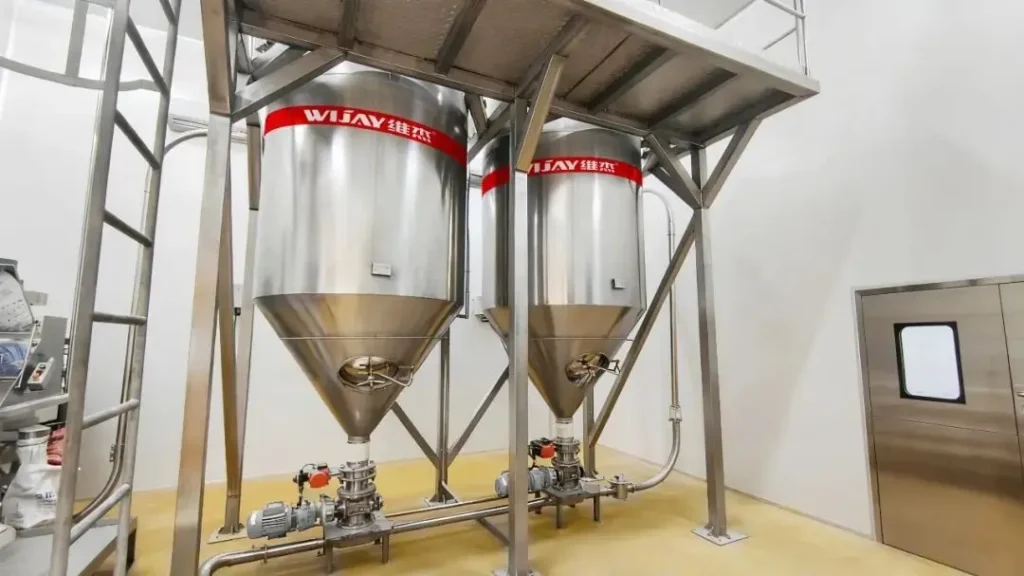
Storage silo module. The system is built around 2 large silos, 2 medium silos, and 10 buffer silos, each fitted with level monitoring and anti-bridging components. Because flour, yeast, and baking powder are all moisture-sensitive, sealed silo storage keeps their physical and chemical properties stable over time.
Multi-tank weighing and batching module. 5 weighing tanks separate bulk flour storage from functional minor-ingredient storage, with high-precision load cell sensors feeding data to a PLC control system. The system doses and weighs automatically according to each product’s formula, feeding 4 dough mixers with one-touch recipe switching — enabling precise, coordinated batching of both bulk and minor ingredients.
Downstream delivery and data control terminal. Batched material is delivered directly to the mixing station, supported by 2 liquid tanks and a CIP cleaning system. A human-machine interface centralizes level status, flow rate, tank condition, batching records, and fault alerts — with complete production records retained to meet food traceability requirements.
See also: how CIP cleaning systems reduce cross-contamination in powder handling
Core Pneumatic Conveying Parameters and Technical Advantages
Pneumatic conveying is the production backbone of any powder-handling plant, and the piping structure here was optimized specifically around the workshop layout and the moisture-sensitivity of staple-food flour.
Peak conveying capacity: 6 t/h. The negative-pressure pneumatic conveying design is built for round-the-clock, scaled production, with reserve load capacity supporting simultaneous draw from four dough mixers without supply interruption or flow fluctuation — keeping downstream mixing continuous.
50 meters horizontal, 15 meters vertical conveying. In central staple-food factories, the physical distance between raw material silos and the mixing station is often substantial. Traditional mechanical conveying is constrained by turns and distance; pneumatic piping routes flexibly around beams and columns, working around obstacles while keeping the equipment footprint compact.
Food-grade stainless steel piping throughout, enabling dust-free operation, which delivers three distinct benefits:
- Production safety — reducing the risk of flour dust accumulation and explosion, and improving overall workshop air quality.
- Raw material savings — sealed conveying prevents powder leakage, cutting losses of high-value minor ingredients like baking powder and yeast. Plants moving from open transfer to fully enclosed pneumatic conveying typically see minor-ingredient loss rates fall by a meaningful margin, directly improving raw material yield.
- Food hygiene — sealing out dust and pests, with a CIP system capable of cleaning tanks and piping to prevent cross-contamination between products, meeting staple-food clean workshop standards.
Multi-Silo Batching: Solving the Bulk-vs-Minor Ingredient Challenge
Mantou, huajuan, and steamed bun formulas differ meaningfully from one another. Flour is the bulk primary ingredient, while yeast, baking powder, and salt are trace but critical minor ingredients — and coordinating precise batching between the two is where most automation projects struggle. This project uses 2 large silos, 2 medium silos, 10 buffer silos, and 5 weighing tanks to keep materials compartmentalized, with each storage zone independently controlling its own discharge rate and weight. When switching product types, operators simply select a recipe on the touch panel, and the system completes proportioning automatically — no manual transport or weighing of minor ingredients required.
This delivers:
- Stable, controlled batch-to-batch dosing accuracy
- Recipes that can be stored, edited, or created for new product development
- Physical separation of materials that prevents mixing at the hardware level
- A CIP cleaning unit that clears residual material from piping and tanks quickly during changeover
Related reading: flour automatic batching system design for multi-product bakery
Project Outcomes: Building a Quality Moat at the Raw Material Stage
In staple-food industrialization, the plants that win are the ones that standardize production, control batch-level quality, and run multiple products in parallel without compromise. This automation line closes the loop on powder handling from intake through conveying to batching, using multi-silo coordination for bulk and minor ingredients, 6 t/h throughput, and enclosed conveying spanning 50m horizontal and 15m vertical to fit a central factory layout — managing quality across storage, transport, and batching from the source.
Single-Machine Equipment vs. Full-Line Automation Planning
Many suppliers in this space sell conveying equipment as standalone machines, leaving the plant to handle system integration on its own. This approach frequently results in poorly planned piping layouts, weak equipment coordination, missing minor-ingredient batching and cleaning functionality, and difficult, expensive retrofits down the line.
WIJAY Systems is positioned differently: as a full-plant material automation planning provider with pneumatic conveying as the core technology. The scope covers site survey, process simulation, piping layout, custom non-standard equipment, food-grade structural design, installation and commissioning, staff training, and post-installation upgrades — delivered as one continuous engineering relationship rather than a single equipment sale. Every system is validated through FAT (Factory Acceptance Testing) before shipment, reducing on-site debugging time and commissioning risk.
See also: pneumatic conveying for bakery plant vs. mechanical conveying — which fits your line]
Frequently Asked Questions
Q: What’s the difference between negative-pressure and positive-pressure pneumatic conveying for flour and minor ingredients?
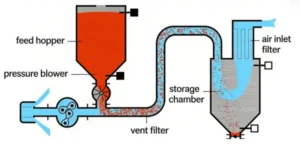
Negative-pressure (vacuum) conveying draws material through sealed piping under suction, which is well suited to multi-point intake from bagged or bulk sources and helps contain fine, moisture-sensitive powders like yeast and baking powder without leakage. Positive-pressure systems push material and are often preferred for longer straight-line runs to a single destination. The right choice depends on your intake points, distance, and material characteristics.
Q: How does the system prevent -contamination between different product formulas?
Physical separation is built at the hardware level — bulk flour and each minor ingredient occupy dedicated silos and weighing tanks, and the CIP (Clean-in-Place) system flushes tanks and piping between changeovers, so residual material from one formula doesn’t carry into the next batch.
Q: Can this type of system integrate with our existing dough mixers and factory floor layout?
Yes. The engineering process starts with an on-site survey of your existing equipment placement, piping routes, and mixer count, and the conveying network — including horizontal and vertical runs — is custom-routed around your building structure rather than requiring a facility redesign.
Q: What happens if we need to add production lines or increase capacity later?
Capacity headroom and expansion routing are built into the initial process design. Because the system uses modular silos, weighing tanks, and piping sections, additional buffer silos, weighing tanks, or a fifth mixer connection can typically be added without redesigning the core conveying backbone.
Q: How is batching accuracy maintained across bulk flour and trace minor ingredients simultaneously?
Each weighing tank uses dedicated high-precision load cell sensors feeding a PLC control system, so bulk flour and minor ingredients are weighed independently and combined according to the active recipe — rather than relying on a single shared measurement point, which is where manual and single-machine setups typically lose accuracy.
Ready to Upgrade Your Central Bakery’s Material Automation?
If your frozen staple food or central bakery plant is dealing with dust from manual feeding, long-distance supply challenges, inconsistent batching accuracy between bulk and minor ingredients, or cross-contamination risk during product changeovers, WIJAY Systems can help.
We conduct on-site surveys and design custom bulk material conveying systems — from food-grade powder conveying and flour automatic batching to full CIP-integrated central bakery automation — built around your plant’s actual layout and production targets.
Contact us today with your production capacity and site layout, and our engineering team will prepare a tailored automation proposal and quotation for your plant.