Conveying powder battery production is one of those engineering problems that looks straightforward on a process flow diagram and becomes genuinely difficult on a real plant floor. Anode material is fine, light, electrically conductive, easily airborne and unforgiving of contamination. Distances are long. Pickup points are many. Lines run continuously, and every transfer point is a place where product quality can be lost, dust can escape and capacity can quietly disappear.
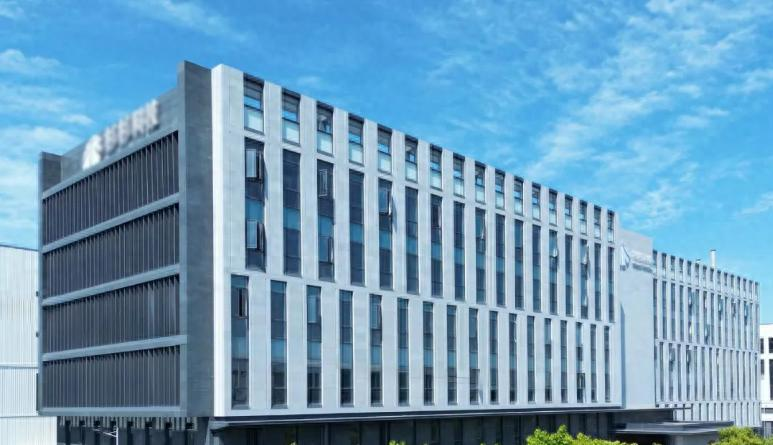
WIJAY recently completed exactly this kind of project. Guangdong WIJAY Material Automation Systems Co., Ltd. delivered the core conveying scope for the lithium battery anode material integrated project at the Sichuan production base of an internationally recognized Fortune 500 new energy company. The scope covered the raw coke and calcined coke post-grinding handling systems and the fine powder handling system — and it produced a record that matters to the industry: the first vacuum conveying distance above 300 meters recorded in the anode material field, with the longest line running 380 meters.
This article walks through the background, the engineering behind the solution, and what the commissioning and operation of a line like this actually teaches about conveying powder in battery production at scale.
Background: Why Anode Material Is Called “Black Gold” — and Why Moving It Is the Hard Part
Anode material is often described as the heart of a lithium battery. In practice, it is a fine carbon powder with a set of properties that make pneumatic conveying both the obvious choice and a difficult one.
It is light. Bulk density is low enough that the material stays airborne easily and settles slowly. It is fine. The post-grinding and classification stages produce a particle size distribution with a substantial fine fraction, which raises cohesion, increases dust load on filters, and turns deaeration time from an afterthought into a design variable. It is electrically conductive. Carbon dust in suspension and carbon dust settled on equipment surfaces both create housekeeping and electrical-safety considerations that an open mechanical conveyor handles poorly.
And it is valuable. Anode material is one of the highest-cost components in a cell, and losses at transfer points, spillage at open connections and contamination from the plant environment translate directly into yield loss and quality deviation. In a plant running continuous production, the conveying system is not a supporting utility. It is the artery that determines whether the process runs at rate and at specification.
The Sichuan project was structured around two distinct material streams:
- Post-grinding handling for raw coke and calcined coke. The raw material entering the process and the material after calcination behave differently, and both had to be moved from grinding through to the metering points that feed the next stage.
- Fine powder handling. Dozens of collection points across the plant generate fine powder that has to be consolidated and delivered to packaging units without dusting, loss or cross-contamination.
Two streams, different pickup geometries, different material conditions, one plant. The design had to solve both without turning the facility into a maze of separate small systems.
The Challenge: Twelve Lines, Four Lines, and a 380-Meter Route
The scope that WIJAY took on had three hard constraints that shaped every subsequent decision.
Throughput per line. The post-grinding system required 12 high-efficiency production lines — 9 for raw coke and 3 for calcined coke — with a conveying capacity of 8 tons per hour on each line. That is not an occasional transfer. It is continuous, rate-controlled material movement, and every line has to hold its rate independently while sharing the plant’s air supply and control architecture.
Distance. The longest route in the system reaches 380 meters. This is the number that changed the engineering conversation. In vacuum conveying, distance is not a linear cost. The pressure differential available at the pickup point has to overcome the line resistance along the entire route, and as length increases, the usable differential at the far end falls. Beyond a certain length, the material no longer arrives at the rate the process needs, and adding more vacuum at the source stops helping.
Collection points. The fine powder system has to consolidate material from dozens of collection points and deliver it to the packaging unit at 5 tons per hour per line across 4 dedicated lines. Multiple pickup points on a shared vacuum network means the control system has to sequence pickups so that one point opening does not starve the others, and the filter receivers at each pickup have to be sized for the actual dust load at that location.
Put those three together and the difficulty becomes clear. The plant needed long-distance conveying, high per-line capacity, many pickup points and complete dust containment — at the same time, in the same system. That combination is what separates a routine powder conveying installation from a system that actually has to be engineered for a battery production line.
The Solution: Mobile Bin, Vacuum Conveying, Transfer Bin, Metering Bin
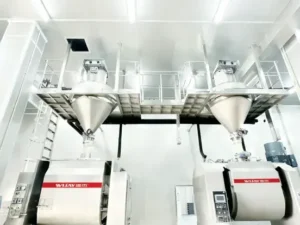
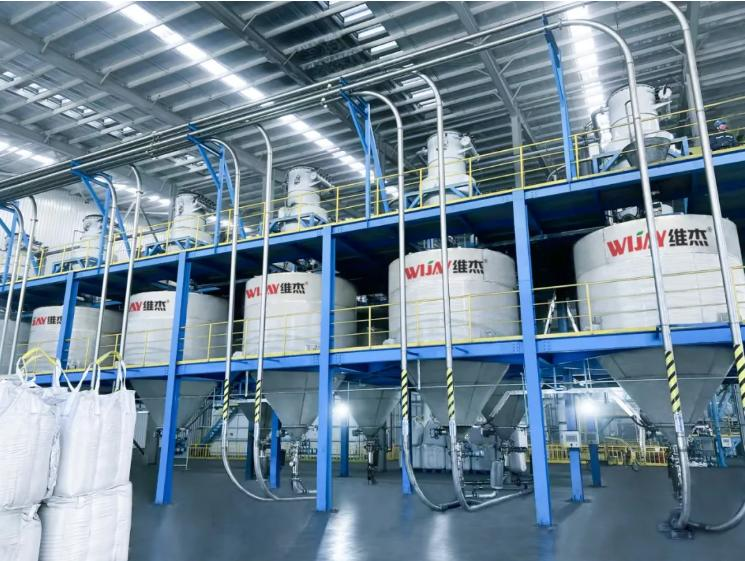
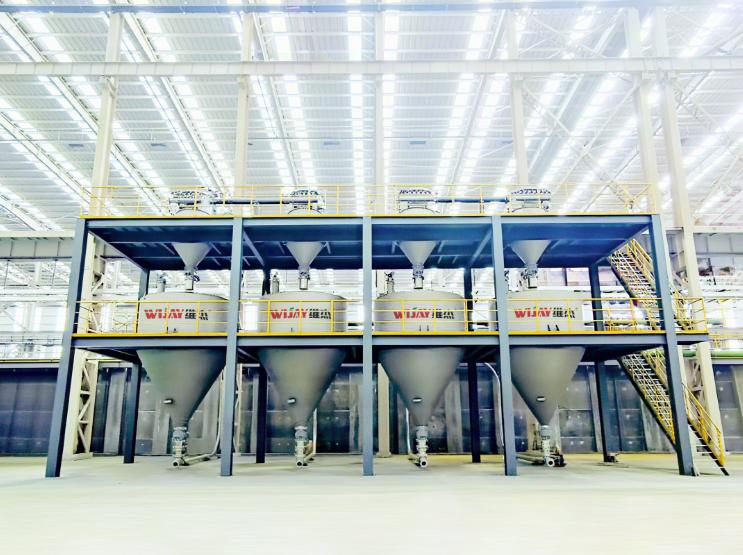
WIJAY’s process design for the post-grinding system follows a consistent architecture on every line: mobile bin → vacuum conveying → transfer bin → metering bin.
The sequence is deliberate. Material is discharged from grinding into a mobile bin, which decouples the grinding stage from the conveying stage — the grinder does not have to stop when the conveying line cycles, and the conveying line does not have to run at the grinder’s instantaneous rate. From the mobile bin, the material is drawn into the vacuum line and conveyed to a transfer bin, which acts as the intermediate buffer and the point at which the conveying cycle hands off to the metering stage. The metering bin then feeds the next process step at a controlled rate.
Four things in that architecture matter more than the sequence itself.
Vacuum, not pressure. The entire line runs under negative pressure. Any fugitive dust at a flange, a gasket or a worn valve is drawn back into the system rather than expelled into the room. For a fine conductive carbon powder in a plant with high housekeeping standards, the direction of the leak is a design decision, not a detail. Vacuum also means the pickup point does not pressurize the upstream equipment, which simplifies the interface with the mobile bins.
Fully enclosed transfer. Material moves from bin to bin without an open transfer point anywhere in the route. That is what protects the product from plant contamination and protects the plant from carbon dust — the two sides of the same containment boundary.
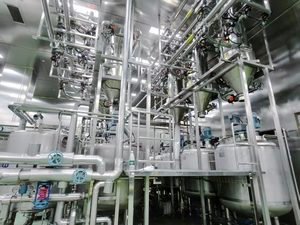
Distributed pickups on a controlled network. The fine powder system’s dozens of collection points are not simply tied into one vacuum header. Each pickup has its own receiver and its own place in the control sequence, so that the network delivers a steady flow to packaging rather than a series of competing demands on the same vacuum source.
Line-level independence. Twelve post-grinding lines and four fines lines each hold their own rate and their own cycle. A fault or a rate change on one line does not cascade into the others, which is what allows the plant to run at partial load without destabilizing the whole conveying system.
The 380-meter achievement came out of this architecture rather than out of a single component. Holding conveying rate at that distance required the line geometry, the air injection and the receiver sequencing to be designed together, with velocity held inside the working window along the full route so that the material arrives at rate rather than arriving intermittently or not at all.
Results: A Record, and What It Actually Delivers
The headline result is the record: the first vacuum conveying distance above 300 meters in the anode material field, with the longest line at 380 meters. That is a genuine technical milestone, and it was validated in operation rather than on a drawing.
But the record is not what the plant operates on. What the plant operates on is the day-to-day performance that the architecture delivers.
Rate is held at the design point. Twelve post-grinding lines at 8 tons per hour each, and four fines lines at 5 tons per hour each, running continuously with the conveying cycles sequenced so that the metering bins are fed at a steady rate.
Dust is contained, not managed. Because the whole system runs under vacuum and every transfer is enclosed, the plant does not carry a continuous housekeeping load from the conveying system. That matters for both product quality and for the combustible-dust housekeeping obligations that apply to carbon powder operations.
Material loss is minimized. In a material at this cost level, loss at transfer points is a direct hit on yield. Enclosed transfer from mobile bin through transfer bin to metering bin removes the open points where loss would otherwise occur.
The system is automated as one loop. Pickup sequencing, conveying cycles, receiver discharge and metering are tied into one control architecture rather than run as independent skids. For a plant with twelve lines and dozens of fines pickups, that is the difference between a system an operator can run and a system an operator has to babysit.
The architecture adapts. The same design logic covers two different material streams — raw coke, calcined coke and fine powder — without treating each one as a separate engineering project.
Review: What a 380-Meter Vacuum Line Teaches
Looking back at the project, three lessons stand out, and they are the ones we would carry into the next long-distance system for conveying powder in battery production.
First, distance is a system problem, not a vacuum-source problem. The instinct when a long line underperforms is to add vacuum capacity at the source. That stops working past a certain length, because the constraint is the usable differential at the far end, not the absolute vacuum level at the inlet. What solved it here was the line architecture — geometry, air management and receiver sequencing designed together — not a larger vacuum pump.
Second, in anode material, containment and quality are the same requirement. Fine conductive carbon powder does not tolerate open transfer points, and neither does the plant. Designing the system as one sealed boundary from the mobile bin to the metering bin solves the dust problem and the contamination problem and the loss problem in a single decision, rather than as three separate retrofits.
Third, multi-point collection needs a control architecture, not just piping. The fines system’s dozens of collection points only work at 5 tons per hour per line because the pickups are sequenced and each receiver is sized for its local dust load. A shared header with simple valves would have produced surging, starved pickups and unstable packaging feed.
WIJAY builds these systems as complete enclosed units rather than as component packages: integrated line architecture, fully enclosed conveying, dust-free operation, low material loss, automation that ties the whole route into one control loop, and an architecture that adapts across industries and materials. For a lithium battery anode material plant, that combination is what makes the conveying system an artery rather than a bottleneck.
For plants scoping a long-distance vacuum conveying system for battery production, the first step is material characterization and a route review before the line geometry is fixed [internal link: WIJAY vacuum conveying system design]. For existing lines that lose rate over distance or generate dust at transfer points, the first step is a boundary and air-balance audit [internal link: WIJAY conveying system audit and service]. Where batching accuracy and dust containment are production requirements, the conveying system and the automation should be specified together [internal link: WIJAY bulk material handling automation].
FAQ
Why use vacuum conveying instead of pressure conveying for anode material?
Vacuum keeps the entire line under negative pressure, so fugitive dust at flanges, gaskets and valves is drawn back into the system rather than expelled into the plant. For a fine conductive carbon powder, that containment direction is a quality and housekeeping advantage, and it also avoids pressurizing upstream equipment such as mobile bins.
How is a 380-meter vacuum conveying distance achieved?
Not by adding a larger vacuum source. Long-distance vacuum conveying requires the line geometry, air management and receiver sequencing to be designed together so that the usable pressure differential is maintained along the full route and velocity stays inside the working window. Beyond a certain length, the constraint is the differential at the far end, not the vacuum level at the inlet.
What does the mobile bin → vacuum conveying → transfer bin → metering bin sequence solve?
It decouples grinding from conveying, buffers the material between stages, and delivers a controlled feed rate to the next process step. The mobile bin lets the grinder run independently of the conveying cycle, and the metering bin gives the downstream process a stable rate rather than a batch pulse.
How are dozens of fine powder collection points handled on one system?
Each pickup has its own filter receiver and its own place in the control sequence. The pickups are sequenced so that one point opening does not starve the others, and each receiver is sized for the actual dust load at that location. A simple shared header would produce surging and unstable feed to packaging.
What capacity does the system deliver?
Twelve post-grinding lines — 9 for raw coke and 3 for calcined coke — at 8 tons per hour each, plus 4 dedicated fines lines at 5 tons per hour each delivering to the packaging unit.
Is this architecture applicable to other powders beyond anode material?
Yes. The same design logic — enclosed transfer, vacuum containment, staged buffering and sequenced multi-point pickup — applies to other fine, light or conductive powders in battery production and other industries where dust containment, material loss and long-distance reliability are production requirements.
CTA
If you are planning a long-distance conveying route for anode material, cathode material or another fine powder in battery production, and the distance is starting to look like the limiting factor, talk to WIJAY before the line geometry is fixed. Send us the material data, the pickup and discharge points, the required rate per line and the route length. We will help determine the right conveying architecture, the realistic distance envelope and the control strategy that keeps every line at its design rate — and build it as one enclosed, automated system rather than a collection of components.