When engineers start choosing pneumatic conveying systems for heavy materials, the first instinct is almost always pressure. If the material is dense, add more pressure. If it still plugs, add more pressure again. The line runs, but the elbows wear through in months, the compressors run hot, and the maintenance team is replacing wear parts on a schedule that was never in the budget. The system is “working.” It is also consuming itself.
Heavy materials — dry bulk solids with bulk densities typically above 100 lb/ft³ (1,600 kg/m³) — behave nothing like the light powders most conveying systems are designed around. Metal powders, metal oxides, zircon sand, silica sand, quartz sand and similar dense, abrasive solids punish systems that were sized on tonnage and a material-velocity table. They need a design logic built around three things that are not the same thing: pressure, leverage and velocity.
Most of the failures we see in the field are not pressure failures. They are leverage failures and velocity failures wearing a pressure costume. This article breaks down what actually decides whether a heavy material conveys reliably, and what separates a system that lasts from one that becomes a maintenance line item.
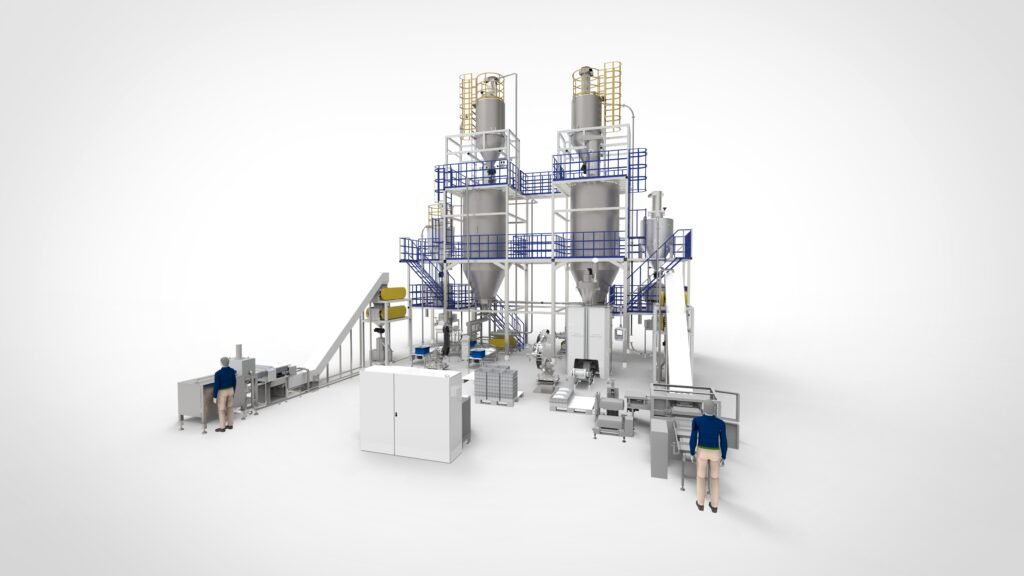
What Makes a Material “Heavy” — and Why It Changes the Design
“Heavy” in pneumatic conveying does not mean “large.” It means high bulk density and, usually, high abrasiveness and a particle shape that resists suspension.
The practical threshold most designers use is around 100 lb/ft³ (1,600 kg/m³), but the number alone is not the whole story. A heavy material also tends to have:
- High particle true density, which raises the suspension velocity required to keep it moving.
- Angular or irregular particle shape, which increases interparticle friction and wall abrasion.
- Low air retention, which makes dense phase harder to stabilize unless the design compensates.
- High abrasiveness, which turns velocity into wear at every bend and transition.
Put those four together and the standard dilute-phase approach starts to fail. Dilute phase keeps particles individually suspended at high velocity — typically in the 4,000–6,000 ft/min range. For a heavy abrasive solid, that velocity is a wear rate. The elbows become the consumable, the particle breakage becomes a quality issue, and the energy cost per ton climbs.
This is why dense phase is the usual answer for heavy materials. But dense phase alone is not enough either.
The Real Constraint: Leverage, Not Just Pressure
This is the part most catalog-based selection misses. A dense phase pressure conveying system for heavy materials typically needs to operate at pressures of at least 100 psig. That is a necessary condition. It is not a sufficient one.
At high bulk density and long conveying distance, the pressure gradient along the line becomes the limiting factor. The material forms a dense plug or bed, and the air pressure at the upstream end must overcome the friction of that bed against the pipe wall along the entire length. As the line length increases, the pressure available at the downstream end of the plug drops. The plug stalls. The line plugs. Adding more pressure at the vessel helps up to a point — then the pressure rating, the compressor cost and the wear penalty at the feed end become the new constraints.
What solves this is not more pressure at the vessel. It is conveying leverage — the ability to maintain a usable pressure differential across the plug along the full length of the line. In practice, this means a design that introduces air at multiple points along the route, so the plug is pushed from behind and supported from within rather than relying on a single pressure source at the inlet.
Without that leverage, even a 100 psig system will struggle to convey dense material over practical distances. With it, the same pressure envelope moves the material reliably at lower velocity — which is the whole point, because lower velocity is what controls wear.
This is a design decision, not a control setting. It has to be built into the line architecture: air injection points, booster sequencing, line geometry and the pressure vessel sizing all have to be specified as one system.
Why Velocity Is the Wear Variable, Not Pressure
Abrasive wear scales roughly with velocity to a power between 2 and 3, depending on impact angle and particle shape. Pressure does not wear steel. Velocity does.
That is why the design logic for heavy materials has to be: hold velocity as low as the material’s pickup and saltation requirements allow, and use pressure and leverage to do the work that velocity would otherwise do.
Two things follow from that.
First, the terminal section of the line is where wear concentrates. Gas expands as pressure drops along the line. On a single-diameter line, the terminal velocity can reach two to three times the starting velocity, which means the last bends take the worst of the wear. Stepped-diameter piping — increasing pipe size in stages — is the standard method for holding velocity inside the working window along the full length. Many systems have a correct starting velocity and fail in the final section.
Second, bend geometry and material matter as much as the pipe. The dominant wear mechanism at a bend depends on impact angle. A shallow-angle strike can remove more metal than a perpendicular impact. Long-radius bends, ceramic or bi-metal liners at the first bend and at any reduction, and rotatable straight sections are standard practice for heavy abrasive service. Selecting them against the actual impact conditions — not against a generic “abrasive service” label — is what separates a bend that lasts years from one that lasts months.
Material Testing Is Not Optional
The single biggest gap between a heavy-material system that works and one that disappoints is whether the material was characterized before the line was designed. Five properties drive most of the decisions:
- Bulk density, loose and tapped — sets vessel volume, batch size and rotary valve discharge per revolution.
- Particle size distribution — sets the velocity floor, the explosion classification and the segregation risk. The fine tail often matters more than the average.
- Permeability and air retention (deaeration time) — determines whether dense phase is feasible and how high the solids-to-air ratio can be pushed.
- Abrasiveness and particle hardness — sets the pipe material, bend type and wear-part maintenance plan.
- Breakage sensitivity — sets the velocity ceiling and whether dilute or dense phase is the right route.
Bench testing covers most of this. But for heavy materials, bench data is not the final word. Every empirical formula is built on “some form of some material.” None of them was written for your specific powder. The only way to pin down the minimum velocity, solids loading and pressure loss for a heavy material is to run it through a pilot loop that reproduces the actual line geometry — straight runs, bends, reductions and vertical lifts.
On a zircon sand application we reviewed, the bench data suggested a velocity that would have worn the elbows out within a year. The pilot loop showed that a slightly lower velocity, combined with a stepped-diameter layout and additional air injection at the mid-line, held the plug stable at a wear rate the plant could live with. The difference was not in the pressure rating. It was in the line architecture that the pilot test exposed.
What Dense Phase Design for Heavy Materials Looks Like
A heavy-material dense phase system is not a standard dilute-phase line with a bigger compressor. It is a different architecture. The core elements:
High-pressure dense phase conveying. Operating pressures of at least 100 psig are the baseline for heavy materials over practical distances. Below that, the leverage budget is too thin for reliable conveying.
Multi-point air injection (booster design). Air is introduced along the line, not just at the vessel. This maintains the pressure differential across the plug and allows the system to push dense material at lower velocity than a single-source design would require.
Stepped-diameter piping. Pipe size increases along the line to offset gas expansion and hold velocity in the working window. This is what protects the terminal bends from the worst wear.
Wear-resistant components at the right locations. Ceramic or bi-metal liners at the first bend, at any reduction, and at the terminal bends. Rotatable straight sections. Wear-part access designed into the layout, not bolted on afterward.
Enclosed, dust-free conveying. Heavy materials are often hazardous as fine dust even when they are benign in bulk. Full containment from feed point to receiver, correctly sized filtration and grounding to the applicable standard are part of the design, not an add-on.
Automation that ties it together. Vessel sequencing, booster control, feed rate and receiver cycling have to run as one loop. A heavy-material system that is manually tuned drift away from its operating point within weeks.
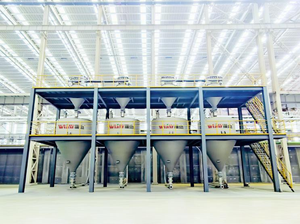
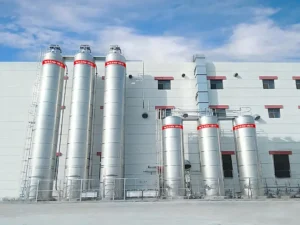
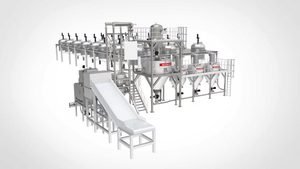
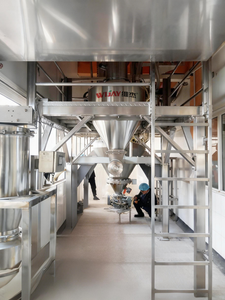
This is the architecture WIJAY builds for heavy-material service. The pressure vessel, the air injection strategy, the line geometry, the receiver and the controls are specified together against the material data and the actual load profile — not against a catalog table.
What This Looks Like Across Industries
WIJAY has designed and built heavy-material conveying systems across a range of industries, and the pattern repeats: the material dictates the architecture, and the architecture dictates the operating cost.
Metal and powder processing. Copper, bronze, nickel, iron, tin and lead powders, plus tungsten oxide, copper oxide, nickel oxide, iron oxide, magnesium oxide, molybdenum oxide and manganese dioxide. These materials combine high density with abrasiveness and, in some cases, reactivity. Enclosed conveying, grounding and correctly sized filtration are part of the design brief, not a compliance afterthought.
Foundries and mineral processing. Zircon sand, olivine sand, silica sand and quartz sand. These are the classic heavy abrasive materials: high bulk density, angular particles and wear rates that punish dilute-phase designs. Dense phase with multi-point air injection and stepped-diameter piping is the standard route.
Chemical processing. Dense chemical powders and specialty mineral compounds where contamination control and material loss matter as much as throughput. Fully enclosed conveying with low-velocity dense phase protects both product quality and the plant environment.
Building products and industrial materials. Abrasive aggregates, fillers and mineral-based materials used in construction and industrial applications. Dust containment and low material loss are the production requirements, and the system architecture has to deliver both across multiple products and changeovers.
Across all of these, the goal is the same: move the material reliably, contain it completely, wear the equipment as slowly as the material allows, and keep the line at its designed operating point for years rather than months.
Why Customization Is the Whole Game
Standard pneumatic conveying systems are not designed for heavy materials. They are designed for a range of light-to-medium powders, and the design assumptions behind them — velocity, bend radius, pressure rating, receiver sizing — do not survive contact with a heavy abrasive solid.
Custom engineering here does not mean “a bigger version of the standard skid.” It means the line architecture is built around the specific material: the pressure envelope, the injection strategy, the line geometry, the wear protection and the control loop are all selected against measured material properties and the actual production profile.
That is what produces the outcomes that matter on a heavy-material line:
- Maximum reliability at the designed operating point
- Reduced pipeline and component wear, with a planned wear-part schedule
- Lowest total cost of ownership, including energy, wear parts and downtime
- Long service life, with service access designed into the layout
WIJAY builds heavy-material systems as fully enclosed units from feed point to receiver, with dust containment at every transition, low material loss through correctly sized receivers and filters, and automation that ties feed rate, air supply and receiver sequencing into one control loop. Positive-pressure and dilute-phase configurations are available where dense phase is not the right route. Custom layouts accommodate multi-point loading and discharge. The same architecture adapts across industries without re-engineering the line for every new powder.
For plants starting a heavy-material line, the first step is material characterization and a load-profile review [internal link: WIJAY dense phase conveying system design]. For existing lines that plug, wear or lose capacity, the first step is a boundary audit against the material data the line was actually designed for [internal link: WIJAY conveying system audit and service]. Where automated material flow and dust containment are production requirements, the conveying system and the automation should be specified together [internal link: WIJAY bulk material handling automation].
FAQ
What counts as a “heavy material” in pneumatic conveying?
Typically dry bulk solids with bulk densities above 100 lb/ft³ (1,600 kg/m³), often combined with high abrasiveness and angular particle shape. Metal powders, metal oxides, zircon sand, silica sand and quartz sand are common examples.
Why isn’t high pressure enough to convey heavy materials reliably?
Because the limiting factor over distance is the pressure differential across the plug, not the pressure at the vessel. A single high-pressure source loses usable differential as the line lengthens and the plug stalls. Multi-point air injection maintains the differential along the line, which is what allows reliable conveying at lower velocity.
Why is dense phase preferred for heavy abrasive materials?
Dense phase runs at lower velocity than dilute phase, and abrasive wear scales roughly with velocity to the 2nd–3rd power. Lower velocity means less elbow wear, less particle breakage and lower energy per ton. The trade-off is that dense phase requires the right material properties and the right line architecture to be stable.
Do I need pilot testing if I already have material data?
For heavy materials, yes. Bench data tells you whether dense phase is feasible and what the velocity floor is. It does not tell you the actual minimum velocity, solids loading and pressure loss for your specific material in your specific line geometry. Pilot testing on a loop that reproduces the real layout is the only way to pin those numbers down before committing to the full system.
How do I control wear on a heavy-material line?
Hold velocity as low as the material allows, use stepped-diameter piping to prevent terminal velocity from climbing, select bend geometry and liner material against the actual impact conditions, and design wear-part access into the layout. Wear is a velocity problem more than a pressure problem.
Can one system handle multiple heavy materials?
Yes, if the system is designed with a velocity and pressure envelope that covers the most demanding material, and if cleanout and changeover are designed into the layout. A system tuned to a single heavy powder often struggles when a second material with different density or abrasiveness is introduced.
CTA
If you are choosing pneumatic conveying systems for heavy materials and the current design is still “more pressure when it plugs,” the line is telling you the architecture is wrong. Send WIJAY the material data — bulk density, particle size distribution, abrasiveness, moisture, and any permeability or breakage results you have — along with the line layout and operating requirements. We will help determine whether dense phase with multi-point air injection is the right route, what the wear strategy should be, and what system configuration will hold the material reliably without consuming the line in the process.