A pneumatic conveying diverter is rarely the most expensive item in a conveying system, and it is almost always the one that causes the most trouble. The blower is specified with margin. The pipe is sized correctly. The receiver is generous. Then the line goes into service, and within a few weeks the same symptoms appear: powder leaking past the seal into the wrong destination, a dead pocket of material sitting in the valve body that drops into the next product, an actuator that cannot index under line pressure, or a diverter that jams because a few grams of cohesive powder have compacted into the seat.
None of these look like a diverter problem at first. They look like a quality deviation, a housekeeping issue, a control fault or a “difficult material.” In practice, they are the predictable consequence of a diverter that was selected on port count and price rather than on sealing principle, dead-volume geometry and the conveying phase it has to survive.
This article breaks down how a diverter actually works, where each type fails, and how to specify one against the material instead of against the drawing.
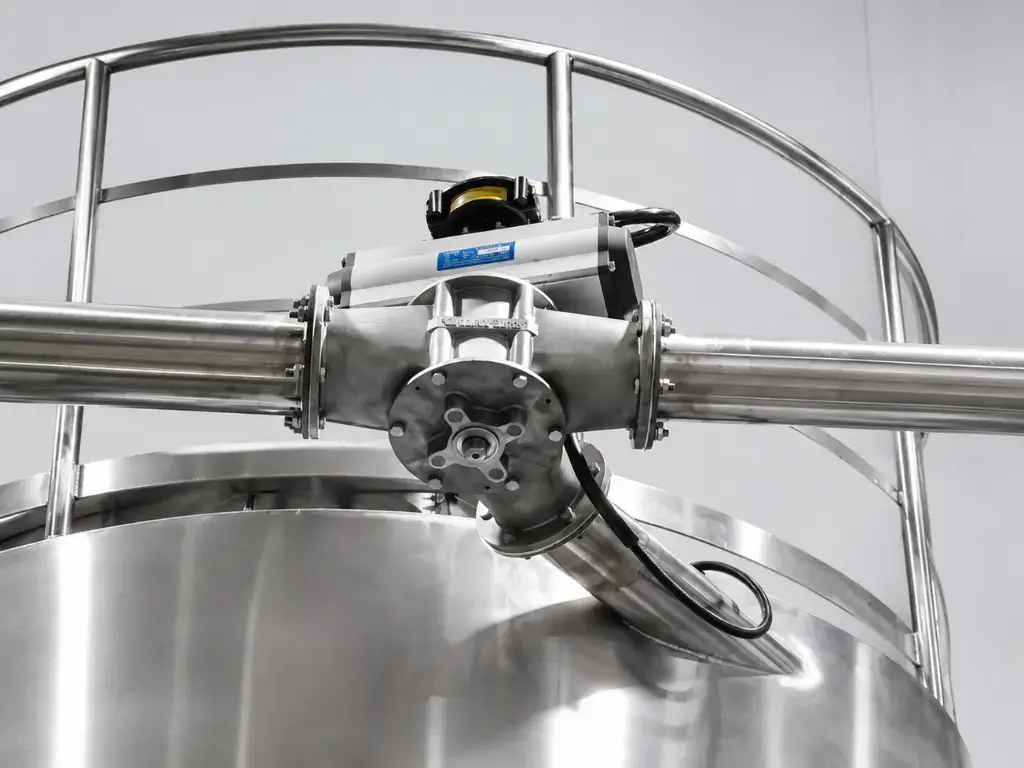
Why the Diverter Is the Weak Link in a Multi-Point Line
A single-destination pneumatic line is a closed boundary from feed point to receiver. The moment you add a diverter, that boundary gets a moving interface inside it — a rotating tube, a pivoting plug or a flap that has to seal against line pressure while also being able to move.
That moving interface creates three distinct risks that do not exist on a fixed line:
Product carryover. Material that remains in the valve body or in a dead pocket after the diverter indexes becomes contamination in the next product. In food, pharmaceutical and battery material operations, that is not a housekeeping issue — it is a batch rejection.
Seal leakage. A diverter that does not seal fully against line pressure leaks conveying air and, on the wrong design, leaks powder into the non-selected outlet. Air leakage also changes the solids loading and can destabilize the conveying cycle.
Indexing failure under load. A diverter that indexes easily with no pressure in the line may not index at all when the line is pressurized, because the actuator is fighting the differential and the seal is loaded against its seat. This is the failure that produces an alarm at 2 a.m.
Each of those risks is a design decision. None of them is inevitable — but none of them is visible on a spec sheet that lists only port size and number of outlets.
How a Pneumatic Conveying Diverter Actually Works
The most common multi-outlet design in dry bulk service is the rotary tube selector. Understanding its components explains why the design decisions matter.
The oscillating (rotary) tube. A curved or angled tube mounted inside the valve body rotates to align its outlet with one of several fixed ports on the body. The material path is a continuous tube from the common inlet to the selected outlet, which is what keeps the flow smooth and avoids abrupt changes in direction.
The actuator. An electric motor, pneumatic actuator or manual handle rotates the tube to the required position. The actuator must have enough torque to move the tube against the seal load, not just against its own friction.
The position feedback. A limit switch or proximity sensor confirms that the tube has reached the selected port. Without reliable position feedback, the system cannot know whether it is safe to start conveying — and an incorrect position means material goes to the wrong place.
The inflatable seal. This is the component that determines whether the diverter is hygienic or not. The seal sits at the outlet end of the rotating tube and inflates against the fixed port to create a pressure-tight, product-tight joint. When the diverter needs to index, the seal deflates, the tube rotates, and the seal re-inflates at the new port.
That sequence — deflate, index, re-inflate, verify, then convey — is the operating logic of the whole valve. Any design that shortcuts it produces leakage or carryover.
Where Each Diverter Type Fails
There is no universally correct diverter. There is a correct diverter for a given phase, material and hygiene requirement. Here is the honest breakdown.
Rotary Tube Selector Valve
The workhorse for multi-outlet distribution in dense phase, dilute phase and vacuum service. The continuous tube path handles abrasive and fragile powders reasonably well, and the design supports a genuine pressure-tight seal when the inflatable seal is properly specified.
Where it fails: on cohesive powders, material can compact around the rotating tube and in the seal area, making indexing stiff or impossible. On very fine powders, the seal itself becomes a wear item and a leak path if it is not sized for the differential pressure. And on tall installations, the vertical geometry of some selector designs creates a dead pocket below the tube.
Rotating Pipe Diverter
Similar operating principle to the rotary tube selector, with a different construction. Used in high-pressure service for abrasive and fragile powders.
Where it fails: the same cohesive-powder issues, plus a larger internal volume in some designs, which increases the amount of material that stays in the valve between products.
Drum Diverter (Rotating Plug)
A cylindrical plug with a through-port rotates inside a matched body. The tight clearances and the plug geometry make this the preferred choice for hygienic applications where product retention must be avoided.
Where it fails: the tight clearance that makes it hygienic also makes it sensitive to abrasive wear and to any particle that gets between the plug and the body. On abrasive service, the clearance opens and the sealing advantage disappears.
Y-Type Diverter
A flap or blade pivots inside a Y-shaped body to direct flow to one of two outlets. Simple, compact and widely used in dilute phase and vacuum systems, including abrasive service in heavy-duty versions.
Where it fails: the Y-piece itself creates a dead volume. Material sits in the unselected leg and in the cavity behind the flap. On a product change, that material becomes contamination. On a cohesive powder, it becomes a plug that eventually breaks loose and arrives at the receiver as a slug.
That dead volume is the single most under-discussed limitation in Y-type diverter selection. If the application is multi-product, it matters more than the price difference.
Where Diverters Actually Cause Problems in the Field
A food ingredient line ran four products through a single conveying route with Y-type diverters at each branch. Changeover required flushing the line, but the diverter’s unselected leg was never fully cleared. Traces of the previous product appeared intermittently in the next batch, and the plant was running a full clean-out between products that took most of a shift. The fix was not a bigger flush. It was replacing the Y-type valves with drum diverters whose geometry eliminated the dead leg, which cut changeover time substantially and removed the contamination source.
A mineral powder line used a rotary tube selector on an abrasive product. The inflatable seal became a consumable, replaced on a schedule that had not been in the maintenance plan. The real problem was that the diverter had been selected for port count without reference to the abrasiveness of the material, and the seal was doing work that a different sealing principle would have handled better.
A chemical powder system had a diverter that indexed reliably in test and failed intermittently in service. The actuator had been sized against the tube’s own friction, not against the seal load plus the pressure differential. It worked at low line pressure and stalled at high pressure. The valve was correct in principle and undersized in one specific dimension.
In each case, the diverter was not a bad component. It was a component selected against the wrong criteria.
How to Specify a Pneumatic Conveying Diverter Correctly
The selection sequence should follow the material, not the port count.
Start with the conveying phase. Dilute phase and dense phase place different demands on the seal and the actuator. A diverter that works in dilute phase may not hold in dense phase, and a dense-phase-rated valve is usually unnecessary cost in a dilute-phase line.
Then the material. Abrasiveness determines whether tight-clearance designs will survive. Cohesion determines whether dead volumes will compact. Particle size distribution determines whether the seal will be abraded by fines. Fragility determines whether the internal geometry can afford abrupt direction changes.
Then the hygiene requirement. If the line runs multiple products, dead volume is a design constraint, not a preference. Drum diverters and fully swept rotary designs belong in that conversation; Y-type valves generally do not.
Then the seal principle. An inflatable seal gives a genuine pressure-tight joint but is a wear item and needs an air supply and a control sequence. A metal-to-metal or clearance seal is more durable but less tight. The right answer depends on whether leakage means dust in the room, product in the wrong outlet, or both.
Then the actuator and feedback. Size the actuator against the seal load plus the differential pressure, not against the free-moving torque. Specify position feedback that the control system actually uses as an interlock, not just as an indicator.
Then the materials of construction. Stainless for hygienic and corrosive service, wear-resistant alloys or coatings for abrasive service, and a body material that matches the plant’s cleaning regime.
Then the control sequence. Deflate, index, re-inflate, verify, convey. The sequence should be enforced by the control system, not left to the operator.
How WIJAY Integrates Diverters Into the System
WIJAY treats the diverter as part of the conveying architecture, not as a purchased component bolted onto a line. That means the diverter is selected against the material data — bulk density, particle size distribution, cohesion, abrasiveness and the conveying phase — and against the number of pickup and discharge points the plant actually needs.
The practical result is a system where the diverter does not become the weak link. Fully enclosed conveying from feed point to receiver, with the diverter inside that boundary, keeps the dust contained and the product protected. Low material loss depends on a diverter that seals, and changeover speed depends on a diverter that does not trap material. Automation ties the diverter position into the conveying sequence as an interlock, so the system cannot convey to the wrong destination or index under pressure.
Custom layouts handle multi-point loading and discharge without turning each branch into a separate small system, and the same architecture adapts across food, chemical, mineral, polymer and battery material applications. Where the plant runs multiple products, the diverter selection is made on dead-volume geometry first, because that is what determines whether changeover is measured in minutes or in shifts.
For plants adding discharge points to an existing line, the first step is a review of the diverter and the air balance together, because a new branch changes both [internal link: WIJAY pneumatic conveying system design]. For lines already showing carryover, leakage or indexing faults, the first step is a boundary audit of the diverter and seal condition [internal link: WIJAY conveying system audit and service]. Where batching accuracy and dust containment are production requirements, the conveying system and the automation should be specified together [internal link: WIJAY bulk material handling automation].
FAQ
What does a pneumatic conveying diverter do?
It directs material from one conveying line to one of several destinations, or combines several pickup points into one destination. It sits inside the conveying boundary, so its sealing and geometry directly affect dust containment, product purity and system reliability.
What is an inflatable seal, and why does it matter?
An inflatable seal sits at the outlet of the rotating tube and expands against the fixed port to create a pressure-tight, product-tight joint. It is what makes a rotary tube selector hygienic. It is also a wear item, so it must be specified for the differential pressure and the material’s abrasiveness.
Why does material carry over between products?
Because the diverter has dead volume — an unselected leg, a cavity behind a flap, or a pocket below the rotating tube — where material stays after the valve indexes. On multi-product lines, dead-volume geometry matters more than the price difference between valve types.
Why does a diverter fail to index when the line is pressurized?
Usually because the actuator was sized against the tube’s free-moving friction rather than against the seal load plus the pressure differential. It works in test and stalls in service. The actuator and seal have to be specified together.
Which diverter type is best for abrasive material?
It depends on the conveying phase and the wear mechanism. Rotary tube selectors and drum diverters with appropriate wear-resistant construction are common choices, but the tight clearances that make drum diverters hygienic also make them sensitive to abrasive wear. The selection has to be made against measured abrasiveness.
Can I add a discharge point to an existing line without changing the diverter?
Sometimes, but the air balance has to be reviewed at the same time. A new branch changes the flow distribution, and a diverter that was adequate for two destinations may not seal or index reliably with three. The diverter and the air balance should be reviewed together.
CTA
If your multi-point line is showing product carryover, seal leakage or intermittent indexing faults, the diverter is the first place to look — and the last place most people look. Send WIJAY the material data, the conveying phase, the number of pickup and discharge points and the symptoms you are seeing. We will help determine whether the diverter type is wrong, undersized or simply not matched to the powder, and design the diverter into a fully enclosed, automated system where it stops being the weak link.