Most powder handling system reviews for sugar processing are written by people who have never stood next to a caking hopper at 3 a.m. They compare methods on paper — pneumatic versus mechanical, dilute versus dense, screw versus belt — and conclude that everything works if you size it correctly. Then the plant installs the system, and within six months the sugar has bridged in the transition, the dust has settled on the overhead steel, the changeover between products takes half a shift, and the maintenance team is replacing wear parts on a schedule that was never in the budget.
Sugar is not a difficult material in the way that, say, titanium dioxide or abrasive fly ash are difficult. It is difficult in a different way: it is a combustible dust, it is hygroscopic, it crystallizes in dead zones, and it is a food ingredient, which means hygiene and cross-contamination are production constraints rather than afterthoughts. Those four facts eliminate a surprising number of conveying methods before the comparison even begins.
This article reviews the actual methods available, explains where each one fails on sugar, and gives a selection sequence that starts with the material rather than the equipment catalog.
The Four Facts That Decide Everything
Before comparing methods, be clear about what sugar does in a handling system.
Sugar dust is combustible. Sugar dust has a minimum ignition energy low enough that a static discharge can ignite it, and sugar dust explosions have occurred in refineries, bakeries and confectionery plants. Particle size matters — below 500 µm counts as combustible dust, and below 75 µm is the most violent — and the fines fraction is exactly what concentrates in filters and settles on overhead surfaces.
Sugar is hygroscopic. Adsorbed moisture forms liquid bridges at particle contact points, and cohesion rises sharply. Sugar that sits in a transition, a dead leg or a hopper cone under humid conditions will cake, bridge and then discharge in slugs. This is the single most common source of dosing error in confectionery and bakery plants.
Sugar is a food ingredient. Cross-contamination between products, allergen control and cleanability are regulatory and commercial requirements, not preferences. A system that cannot be cleaned quickly and completely between products limits the product mix the plant can run economically.
Sugar crystals are friable and mildly abrasive. High-velocity handling generates fines, and fines change dissolution behavior, dust load and flow characteristics. In chocolate, fondant and coating applications, the fines fraction is a quality variable.
Read those four together and the design brief writes itself: contain the dust, keep velocity down, eliminate dead zones, and make the system cleanable.
Reviewing the Pneumatic Methods
Pneumatic conveying moves material through a sealed pipe using air. The method variations matter enormously for sugar.
Dense Phase Conveying
Dense phase moves material as a slow-moving bed or plug at low velocity, typically an order of magnitude below dilute phase. It handles high capacity over long distances, works for single-source or multiple-destination layouts, and reduces abrasion and particle degradation.
On sugar: dense phase is a strong option where the material properties support it — sugar retains air reasonably well and can form a stable plug. The low velocity is the key advantage, because it minimizes fines generation and elbow wear. The trade-off is that dense phase requires a pressure vessel or a carefully designed system, and the receiver must have enough deaeration time built into the cycle so that the sugar settles rather than carrying into the filter.
Where it fails: on very fine powdered sugar or icing sugar blends where cohesion is high and the material will not form a stable plug reliably. And on systems where the receiver cycle was designed for a free-flowing granular product.
Lean (Dilute) Phase Positive Pressure
A blower-driven system that conveys material at velocities above the saltation point, using a rotary valve or airlock to feed material from the bin into the line. Continuous operation, suitable for less abrasive materials.
On sugar: this is the most common architecture for granulated sugar, and it works — with caveats. The velocity is the problem. Dilute phase on sugar generates fines, abrades elbows and, in a positive-pressure system, leaks dust outward at every gasket and worn valve. On a confectionery line, that outward leak is a continuous housekeeping cost and a dust explosion exposure.
Where it fails: multi-product lines where dust containment and changeover matter, and any sugar application where fines generation affects product quality.
Lean Phase Suction (Negative Pressure Dilute Phase)
A blower-driven system that pulls material from the feed point to the destination. Suction is typically done at higher velocities and is suited to irregular or uneven particle shapes.
On sugar: the negative pressure is the advantage — fugitive dust is drawn into the system rather than expelled. But dilute-phase velocity still generates fines and wears elbows. It is a reasonable choice for intake and multi-point pickup, less so for long-haul conveying of a fragile crystalline product.
Vacuum Conveying
Vacuum systems use positive displacement exhausters, rotary blowers, centrifugal blowers or rotary vane/side channel pumps to create negative pressure that draws material into a receiving vessel, where air and product are filtered and separated. Lean or dilute phase vacuum systems are highly versatile and can run at high or low operating pressures depending on the material.
On sugar: vacuum is often the better pneumatic choice in confectionery, bakery and ingredient plants, because the leak direction is inward. Dust at flanges, gaskets and worn valves gets pulled back into the system rather than into the room. That single change lowers housekeeping labor and reduces the dust load available for a secondary explosion. Vacuum is also natural for multi-point pickup — several silos, bag dump stations or day bins feeding one destination.
Where it fails: distance. The usable pressure differential is limited to roughly one atmosphere, so very long runs and very high tonnages become difficult and expensive.
Reviewing the Mechanical Methods
Mechanical conveying is often cheaper in capital cost and is the right answer in specific duties. On sugar, it is right less often than the catalogs suggest.
Screw Conveyors
Cost-effective for short distances, adding minor amounts of powder, unloading bulk bags and discharging small hoppers. Can be installed vertically, horizontally or on an incline.
On sugar: usable for short metering runs and for feeding from a hopper into a pneumatic pickup. Not suitable as a primary conveying method over distance, and the trough creates cleaning and dead-zone problems on a multi-product line. Sugar can cake in the clearance between the flight and the trough.
Belt Conveyors
Used for bulk materials like coal, ore, salt, sand and grain. Consist of two or more pulleys with a continuous belt rotating around them.
On sugar: an open belt is a dust source and a hygiene problem. It is not appropriate for a food-grade sugar stream where containment and cleanability matter.
Bucket Elevators
A series of buckets attached to a belt or chain, used to elevate bulk materials vertically.
On sugar: efficient for vertical lift of coarse material, but an open-boot, open-head machine that exchanges air with the plant at the boot, the loading leg, the discharge and the head. On sugar dust, that air exchange carries dust into the building, and the moving belt inside a dusty casing is a recognized ignition-risk location. Cleaning between products requires stopping and opening the machine.
Vibrating Conveyors
Used for fragile bulk powder materials. Highly sanitary and gentle, and can handle dry, wet, frozen and abrasive products.
On sugar: a reasonable choice for gentle handling over short distances — cooling, screening feed, transfer between adjacent process steps. Not a solution for conveying over distance or for multi-point distribution.
Where the Review Usually Goes Wrong
The failure in most powder handling system reviews is that they compare methods on throughput and capital cost, and stop there. On sugar, that produces the wrong decision, because the costs that matter are the ones that recur:
Housekeeping labor. An open or positive-pressure system that leaks sugar dust into the plant creates a continuous cleaning load. Over a year, that labor often exceeds the capital cost difference between the systems being compared.
Changeover downtime. A system that cannot be cleaned quickly between products limits the product mix. In a plant running multiple recipes or product grades, this is a commercial constraint, not a maintenance detail.
Fines generation. Every pass through a high-velocity system generates fines. Those fines change the product, increase the filter load, and in some products are an off-spec fraction.
Dust explosion exposure. Sugar dust is combustible. The containment architecture and the housekeeping obligations that come with it are part of the operating cost, not a compliance checkbox.
A review that ignores those four items is not a review. It is a price comparison.
What This Looks Like in the Field
A confectionery plant was running a positive-pressure dilute phase system for bulk sugar. It worked, technically — but it blew sugar out regularly, generated significant housekeeping cost, and periodically blew out rupture panels on the silos. Every rupture panel event required a manual replacement. When the system was reviewed, the fix was not a bigger blower. It was a switch to vacuum conveying, which reversed the leak direction, drew the dust back into the system, and eliminated the rupture panel events. The facility became measurably cleaner, and the housekeeping load fell with it.
A bakery ingredient line had a screw conveyor feeding a pneumatic line. The screw worked for metering but created a dead zone at the discharge that caked over a weekend shutdown. Operators were clearing the transition every Monday morning. The fix was a redesigned transition with a different feeder interface, which eliminated the accumulation point rather than adding cleaning labor to compensate for it.
A multi-product sugar and cocoa line used Y-type diverters at the branches. Changeover required a full flush, but the unselected leg of each Y-piece was never fully cleared, and traces of the previous product appeared in the next batch intermittently. The fix was replacing the Y-type valves with drum-style diverters with no dead leg, which eliminated the carryover and cut changeover time substantially.
In each case, the answer was not “pneumatic is better than mechanical” or “vacuum is better than pressure.” The answer was matching the method to the sugar and to the operating reality.
How WIJAY Approaches a Sugar Handling System
WIJAY designs and builds powder handling and pneumatic conveying systems for food, chemical, mineral, polymer and battery material applications, and treats the method selection as a material question rather than a product line question.
For sugar, the starting point is characterization: bulk density (loose and tapped), particle size distribution including the fines fraction, moisture and hygroscopicity, caking tendency, dust explosibility parameters and the plant’s actual product mix and changeover requirements. The conveying method — vacuum or pressure, dilute or dense phase, pneumatic or a hybrid with a short mechanical feed — is selected against that data and against the dust hazard strategy.
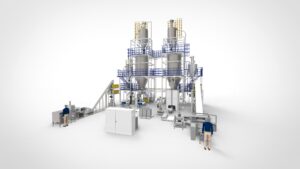
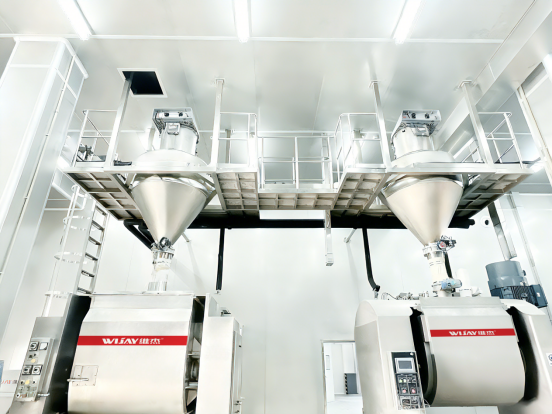
The system is then built as one enclosed boundary: dust contained from intake to the point of use, low material loss through correctly sized receivers and filtration, dosing accuracy achieved by weighing close to the process rather than upstream at the silo, dead-volume-free diverters for multi-product routes, and automation that ties pickup, conveying, receiver sequencing and batching into one control loop.
Custom layouts accommodate multi-point intake and discharge, and the same architecture adapts across sugar, flour, cocoa, starch and other hygroscopic or combustible powders without re-engineering the line for every product. Changeover is designed into the geometry rather than handled by cleaning labor.
For plants scoping a new sugar handling system, the first step is material characterization and a dust hazard review before the layout is fixed [internal link: WIJAY sugar and ingredient handling system design]. For existing systems blowing dust or requiring long changeovers, the first step is a boundary audit rather than an equipment replacement [internal link: WIJAY conveying system audit and service]. Where batching accuracy and dust containment are production requirements, the conveying system and the automation should be specified together [internal link: WIJAY bulk material handling automation].
FAQ
What is the best conveying method for sugar?
There is no single best method. Vacuum pneumatic conveying is often the strongest choice in confectionery, bakery and ingredient plants because dust leaks inward rather than into the plant. Dense phase is preferred where fines generation and wear must be minimized. Mechanical methods have narrow, specific roles — short metering runs, gentle short-distance transfer.
Why is sugar dust a bigger concern than most plants assume?
Sugar dust is combustible, with a minimum ignition energy low enough that static discharge can ignite it. Sugar dust explosions have occurred in refineries, bakeries and confectionery plants. Bulk sugar being non-flammable does not make sugar dust safe.
Why does sugar cake and bridge in a conveying system?
Sugar is hygroscopic. Adsorbed moisture forms liquid bridges at particle contact points, and cohesion rises sharply. Dead zones, long transitions and hopper cones under humid conditions are where caking starts. The fix is geometry — eliminating dead zones — combined with moisture control at the air source and sealing.
Can one system handle multiple sugar products or recipes?
Yes, if dead-volume-free diverters are used and changeover is designed into the layout. Y-type diverters have dead volume that carries material between products. Drum-style or fully swept diverters eliminate the dead leg and are the right choice for multi-product routes.
Why does a screw conveyor cause problems on sugar?
Sugar can cake in the clearance between the flight and the trough, and the trough itself creates dead zones that are hard to clean. Screw conveyors have a role for short metering runs, but they are not a primary conveying solution for a food-grade sugar stream.
How do I know if my current system is costing more than it should?
Look at the recurring costs rather than the equipment: housekeeping labor, changeover downtime, fines generation, filter replacement frequency and wear-part schedules. A system that looks cheap at the purchase order often carries the highest operating cost over ten years.
CTA
If your sugar handling system is coating the plant in dust, requiring a half-shift to change products, or fighting caking at the same transition every week, the problem is the method selection, not the operators. Send WIJAY the material data, the current layout and the symptoms. We will help determine whether vacuum conveying, dense phase or a hybrid approach is the right route, and design a system that contains the sugar from intake to process with the dust control, low loss and automation your production actually requires.