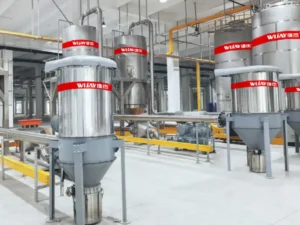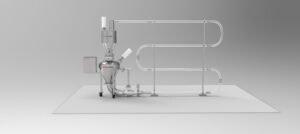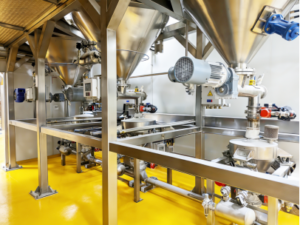
This case study covers an anonymized, large-scale candy manufacturer running multiple parallel hard-candy and filled-candy lines, where sugar powder is the core raw material feeding several downstream process stations at once. Sugar powder carries a distinct set of handling risks: it is classified St1 for dust explosion hazard (Kst value 200–250 bar·m/s), it is strongly hygroscopic, and it readily builds up static charge. The plant layout added another constraint—material had to move across floors, with a combined run of 70 meters horizontal and 30 meters vertical lift, through an environment where relative humidity fluctuated between 45% and 75%. Wijay Systems was engaged to replace manual milling and transfer with an enclosed, engineered conveying and metering system sized to this specific material and layout.
Core Operational Challenges
| Challenge | Description |
|---|---|
| Heavy manual labor with contamination exposure | Unpacking, feeding, grinding, and transfer were fully manual, requiring 6–8 operators per section; open handling created risk of hair, fiber, and other foreign-object contamination inconsistent with GB 14881 food hygiene requirements |
| Blockage risk in long-distance conveying | Sugar powder’s viscosity rises sharply once it absorbs moisture; a standard dilute-phase system (low solid-gas ratio, high velocity) would push material breakage above 2% and cause sticking at elbows and reducers, with each blockage requiring 1.5–3 hours of downtime to clear |
| Dual pressure from dust explosion risk and GMP cleanliness | With a minimum explosible concentration of 20–35 g/m³ and minimum ignition energy of only 10–20 mJ, sugar powder is a high-risk explosive dust; open grinding and transfer produced fluctuating dust levels that standard extraction struggled to hold within safe limits, with measured material loss of 1.2–1.8% |
| Metering inconsistency with no digital record | Platform-scale manual weighing carried a relative error of ±1.5%, with batch-to-batch variation in particle size and dosing; all records were paper-based, with no real-time data capture and no way to trace a quality issue forward or backward through the process |
| Poor coordination across multiple production lines | Several candy lines shifted between peak and off-peak production, and the manual process couldn’t supply sugar powder on demand — grinding output and downstream station consumption fell out of sync, making sugar powder supply the bottleneck during peak periods |
Custom-Engineered Bulk-Material Handling Solution
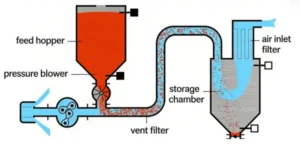
Based on powder property testing and pipeline pressure-drop simulation, the design moved away from a standardized packaged conveying system and toward a customized architecture built around dense-phase, plug-flow. The full line links six modules over an industrial Ethernet network, with a solid-gas ratio of 30–45 and a conveying velocity of 6–9 m/s to limit particle breakage and static buildup.
Key System Component
| Module | Function |
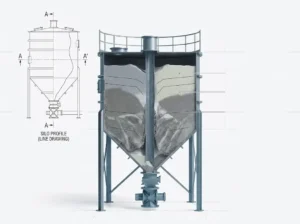
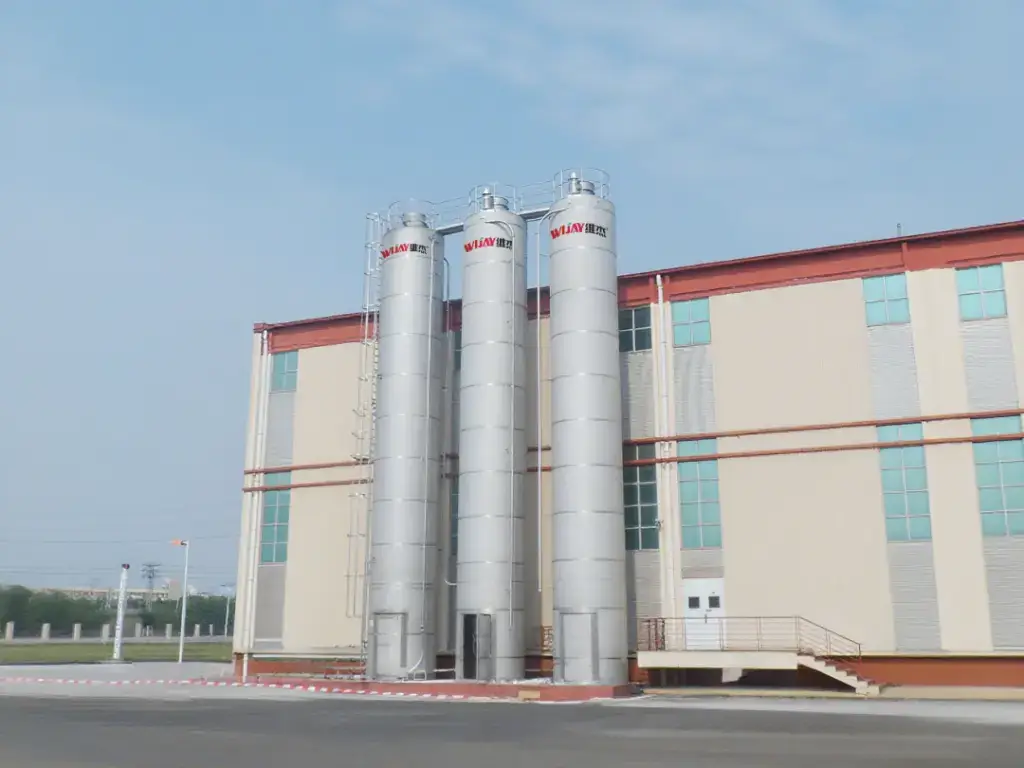
| Feeding station & storage unit | Enclosed, explosion-proof feeding with pulse-jet back-blow dust collection (≥99.9% filtration efficiency); 304 stainless steel contact parts, electropolished to Ra≤0.8μm, CIP-ready; radar level sensing with high/low interlock and pneumatic anti-bridging hopper |
| Grinding & screening pretreatment unit | Variable-frequency, closed-loop feed control synced to downstream demand; post-grind vibrating screen removes particles above 250μm; fully enclosed, negative-pressure dust collection at the grinding chamber |
| Dense-phase unit | Deep-dried compressed air (dew point ≤ −40°C) prevents in-line condensation; low-wear, large-radius sanitary elbows; real-time pressure monitoring with staged back-blow clearing logic |
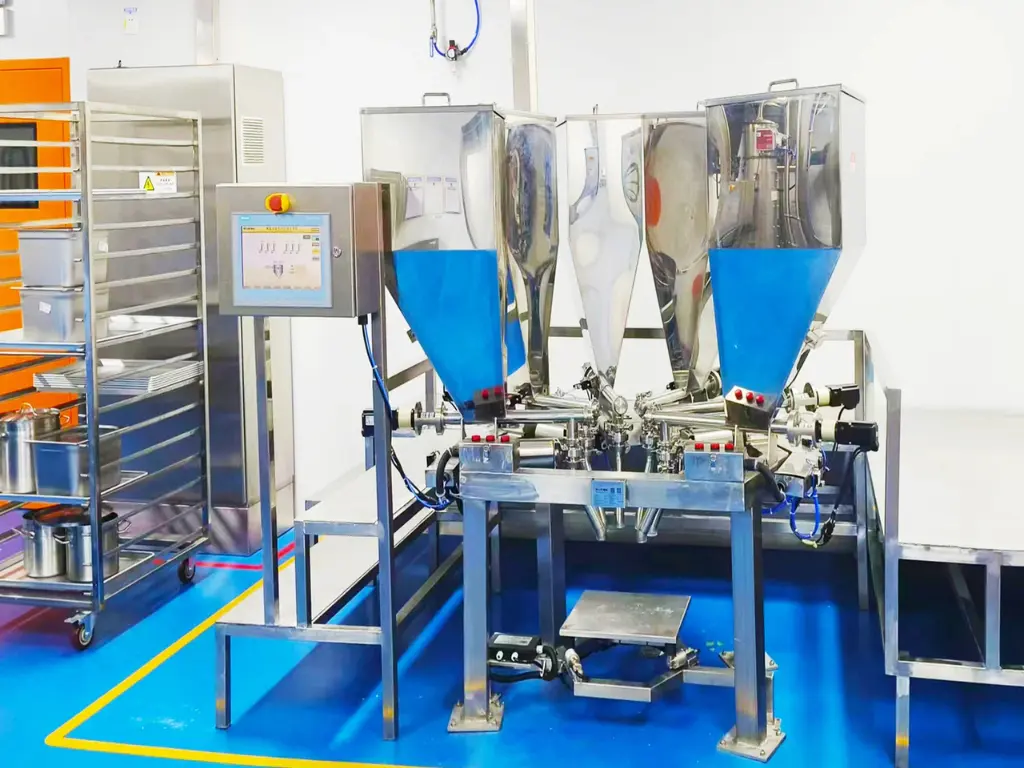
| Multi-station automatic metering & dosing unit | Load-cell weighing to each station’s overhead silo, recipe-driven automatic dosing, with level-signal interlock back to the grinding/conveying unit for automatic replenishment |
| Metering & manual packaging unit | Parallel branch for automatic metered dosing into bags for external supply or offline storage, with the operator only handling bag connection and sealing |
| PLC/HMI control & safety interlock unit | Central logging of grinding output, silo levels, metering values, and fault history; full explosion-protection interlocking per GB 15577 |
Project-Specific Engineering Difficulties
| Engineering Difficulty | Design Response |
|---|---|
| Moving a hygroscopic, blockage-prone powder over 70m horizontal + 30m vertical without excessive breakage | Dense-phase, low-velocity plug-flow conveying held at a solid-gas ratio of 30–45 and 6–9 m/s, rather than a high-velocity dilute-phase design |
| Preventing in-line moisture condensation and caking | Compressed air deep-drying to a conveying air dew point of ≤ −40°C, eliminating the humidity source that drives sugar powder clumping inside the pipe |
| Managing dust explosion risk across the full material path | Built to GB 15577, with Ex tD A21/22-rated electrical components, explosion venting on silos and dust collectors, grounding below 4Ω (silos) and 10Ω (pipeline), and multi-level interlocks for over-temperature, over-pressure, blockage, and abnormal level conditions |
| Synchronizing grinding output with multiple downstream stations running on independent demand cycles | Variable-frequency grinding feed control that tracks real-time downstream consumption, with silo level signals interlocked back to the grinding and conveying stage to automate replenishment without manual coordination |
Measurable Project KPIs & Operational Improvements
| KPI | Baseline | After Implementation | Improvement % | Measurement Method |
| On-site operating personnel per section | 6–8 operators | 1–2 operators (patrol/monitoring role) | ~75% reduction | Headcount comparison, pre- vs. post-retrofit |
| Pipe blockage incident rate | Frequent, with 1.5–3 hours downtime per incident | Reduced by more than 90% | >90% reduction | Blockage incident logging, pre- vs. post-retrofit |
| Raw material loss (dust/spillage) | 1.2%–1.8% | ≤0.3% | ~75–80% reduction | Measured material loss/mass balance |
| Metering relative error | ±1.5% (manual platform scale) | ≤±0.5% (automated load-cell metering) | ~67% tighter tolerance | Weighing accuracy validation |
Frequently Asked Questions
Why choose dense-phase over dilute-phase conveying for sugar powder?
Dense-phase conveying moves material at lower velocity and higher solid-gas ratio, which reduces particle breakage and limits the friction that builds static charge. For a hygroscopic, explosion-classified powder like sugar, that combination matters more than the higher throughput speed dilute-phase systems offer.
How is dust explosion risk managed in a sugar powder conveying system?
Risk is addressed at the system level: explosion-rated electrical components, explosion venting on silos and dust collectors, bonded and grounded piping to prevent static discharge, and interlocked shutdown logic for abnormal pressure, temperature, or blockage conditions, rather than relying on a single safeguard.
How do you stop moisture from condensing inside a pneumatic conveying line?
The compressed air used to convey the material is dried to a very low dew point before entering the line, removing the humidity that would otherwise condense on the pipe wall and cause hygroscopic powders like sugar to cake or stick during transport.
How much more accurate is automated load-cell metering compared to a manual platform scale?
In this project, automated metering held a relative error of ≤±0.5%, compared with ±1.5% for manual platform-scale weighing — a meaningful tightening for a process where dosing consistency directly affects finished product taste and texture.
Can one conveying system supply multiple production lines with different demand cycles?
Yes, when the grinding and metering stages are linked through level-based interlock signals. Downstream consumption at each station triggers replenishment upstream automatically, which keeps supply synchronized without a person manually balancing output across lines.
What typically causes pipe blockage when conveying sugar powder over long distances?
Blockages are usually linked to moisture pickup raising the material’s viscosity, combined with conveying velocities or solid-gas ratios that aren’t matched to the material. Controlling both the air’s dew point and the conveying velocity is the standard mitigation.
Handling a hygroscopic or explosion-classified powder over a long or multi-level run?
Share your material properties, layout distances, and throughput requirements, and our engineering team will review the conveying approach that fits.