No plant manager wants to make the call. The one where a customer found a fragment of a fastener, a strand of hair, or an insect wing in a finished bag of flour, starch, or sugar — and now the batch, the lot, maybe the week’s production, has to come back.
Screening machines are the last mechanical checkpoint standing between raw material variability and a product recall. Yet in most facility audits, the screener is treated as a commodity purchase — sized to a flow rate, bolted into the line, and rarely revisited until something goes wrong. That’s a mistake. Contaminants entering a dry powder stream range from natural material — insect fragments, larvae, husk, hair — to processing debris: bin scale, packaging fiber, twine, metal shavings, hardware. Left uncaught, any of these can trigger a short-term shutdown, a raw material write-off, a full product recall, or a liability claim that damages both the producer’s brand and the equipment supplier’s reputation.
This guide breaks down what QA and process engineering teams actually evaluate when specifying a commercial-grade screener: screening machine type, screen mesh selection, and inspection burden — the three variables that determine whether a screener earns its place in the line or becomes the weak point in your HACCP plan.
Three Screening Machine Types, Compared on Real Production Criteria
There are three screening technologies in common industrial use for dry powders like flour, starch, sugar, salt, and corn meal: vibratory, centrifugal, and gyratory screening machines. Each moves product differently, and that motion — not the marketing spec sheet — determines contamination capture rate and throughput.
Vibratory Screening Machines
Vibratory screeners use one or two vibration motors with eccentric weights that drive the unit in a circular or linear pattern with a vertical component. They’re built for single-pass, batch-scale work — typically 50 lbs. or less per cycle — which makes the entry cost attractive for operations just starting a screening program.
The trade-off is in the motion itself. The vertical component of vibratory travel means product loses contact with the mesh for measurable stretches of the cycle. That reduces recovery efficiency and screen throughput per unit of mesh area, and the gap compounds — often exponentially — as production speed increases. Vibratory units also require frequent mesh tension checks; low tension degrades separation, and screen cleaners have limited effect because the motor imparts less energy and vertical travel to dislodge near-size or sticky particles, which raises the risk of mesh blinding. For a low-volume, single-pass operation, vibratory screening is a reasonable starting point. For continuous product flow, it isn’t.
Centrifugal Screening Machines
Centrifugal screeners — originally developed for wastewater treatment — use rotational force to break up (deagglomerate), scalp, and dewater granular material, from dry bulk solids to solid-laden slurries. They’re compact, space-efficient, and widely used across chemical, food, dairy, pharmaceutical, plastics, mineral, and packaging processing, often built into pneumatic conveying systems by suppliers with in-house screening capability.
The catch: centrifugal force will forcibly break up clumps in flour, sugar, salt, or starch — including clumps that contain contaminants. Because the system isn’t designed to distinguish “acceptable product” from “reject,” a contaminant can be shattered into particles small enough to pass straight through the cylindrical mesh and into the final product stream. Centrifugal units also aren’t well suited to friable material; the aggressive paddle action can damage fragile particles and shift particle-size distribution outside acceptable limits, and the high relative velocity between product and mesh routes a larger share of good product into the tailings.
Mesh wear is the other cost driver. Because material is forced through under rotational load, centrifugal screens see meaningfully higher screen wear and failure rates than other designs — which drives more frequent tension maintenance and inspection.
Gyratory Screening Machines
Gyratory screeners set the sanitation and quality benchmark of the three. Independent operator testing has confirmed gyratory screening removes contaminants more effectively than either vibratory or centrifugal technology. The horizontal gyration, combined with a larger effective separation area, allows the machine to strip contaminants while sustaining commercial-scale throughput — the combination most QA teams are actually trying to solve for.
Because the motion is purely horizontal, a single gyratory unit can stack multiple screens of the same mesh opening while routing product in different directions across the deck — packing significantly more usable screen area into the same footprint than a vibratory or centrifugal machine of comparable size. The resulting horizontal, low-agitation motion extends dwell time on the mesh and slows the screening action, which is what makes gyratory screening well suited to scalping (removing oversize particles), grading, and fines removal from free-flowing dry powders — giving fine particles maximum, unforced opportunity to pass through the mesh for more precise, more repeatable separation.
Screen Mesh: The Variable Most Buyers Underweight
Screen type gets the attention in a sales conversation. Mesh selection is what actually determines whether the machine performs to spec on your product. Every application should be validated in lab-scale sample testing to confirm mesh size and weave against your required tolerance and screening efficiency — not assumed from a catalog spec.
Mesh Types by Screening Machine
Gyratory and vibratory units most commonly run woven mesh — synthetic (nylon or polyester) or metal wire — with square openings, chosen because it’s durable and cost-efficient relative to alternatives. All food-contact mesh should meet current FDA and EU regulatory requirements. Screens are typically stacked with progressively finer openings as product moves down through the deck; oversize material is carried off at each level and undersize material continues down, with material retained on each screen logged for quality traceability.
Centrifugal screeners typically run wedge wire screen, 1¼–1½ in. (31.75–38.1 mm) wide — a welded design built for durability and blinding resistance, at a higher initial cost offset by longer service life. Wedge wire is well matched to high-volume separation of larger particles, particularly in solid/liquid separation, but it is not the first choice for fine contaminant capture: fine particles can pass through the 1¼–1½ in. wire gaps. For fine separation, woven screen — despite a typically shorter service life — can achieve separations down to roughly 0.005 mm, versus a practical minimum of about 0.03 mm for wedge wire.
Mesh Material: Metal vs. Non-Metallic
Non-metallic (synthetic) mesh generally offers longer service life and lower contamination risk if the screen does degrade — synthetic fiber fragments carry lower product-safety risk than metal fragments. Stainless steel woven mesh handles high-oil-content material like corn or oats well, but as wire mesh degrades, strands can loosen and enter the product stream — fragments small enough that even advanced detection equipment may miss them. Metal mesh also tends toward shorter service life overall, because the repetitive motion of screening induces plastic deformation and progressive dislocation in the wire, driving more frequent retensioning and maintenance.
Inspection Frequency: The Operating Cost Nobody Puts on the Spec Sheet
Screening machine type doesn’t just determine capture rate — it determines how much labor and downtime the mesh will demand over its service life.
- Vibratory: The zig-zag horizontal/vertical travel pattern requires frequent mesh tension checks, since low tension directly reduces screening capability, and blinding risk is elevated due to limited cleaner effectiveness.
- Centrifugal: Requires the highest inspection load of the three. Forced material transfer accelerates wear and screen failure, and because rotating paddle assemblies are involved, mesh failure — when it occurs — tends to be sudden and severe. Inspection after every batch, or daily at minimum, is standard practice.
- Gyratory: Requires meaningfully less mesh maintenance. Because product moves gently across the deck, wear is minimized and the volume of usable product recovered — rather than diverted to tailings — is maximized.
Inspection interval should be set based on screening machine quality, mesh material, product flow rate, and material abrasiveness — with maintenance records feeding directly into your QA program as a baseline for mean time to failure (MTTF).
Where Screening Fits Into the Full Production Line
Evaluated in isolation, a screening machine looks like a single-purpose contamination checkpoint. In practice, it’s one stage in a material handling system that also has to move powder without generating dust, without product loss, and without cross-contamination between runs.
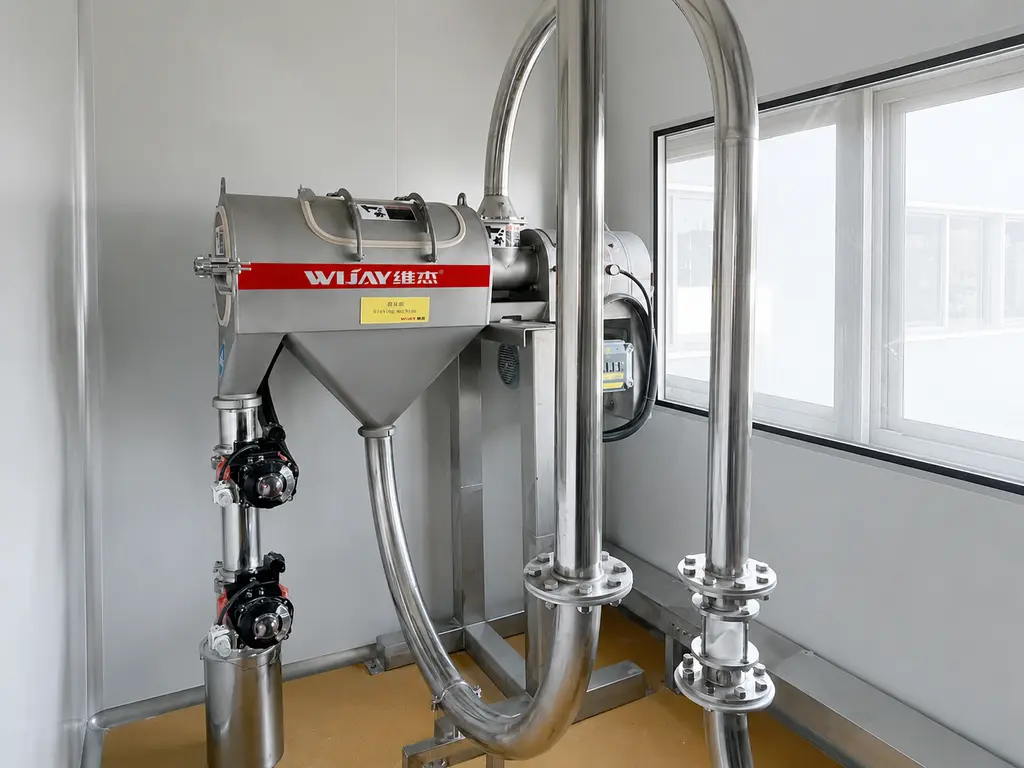
That’s the perspective WIJAY Systems designs from. We build screening into fully integrated dry bulk material handling and pneumatic conveying lines — enclosed transfer, low-dust and low-product-loss conveying, and automated controls — across food, chemical, and industrial powder processing. The goal isn’t a screener that meets spec on a data sheet; it’s a line where contamination control, product recovery, and uptime are engineered together, because that’s the standard a recall-conscious QA department actually has to hold.
If you’re specifying or re-evaluating screening equipment for a dry powder line, WIJAY’s process engineering team can review your product characteristics, throughput targets, and contamination risk profile before you commit to a screen type or mesh spec.
FAQ: Screening Machines for Powder Processing
What’s the difference between vibratory, centrifugal, and gyratory screening machines? Vibratory units use a circular or linear motion with a vertical component and suit small, single-pass batches. Centrifugal units use rotational force to deagglomerate and push material through mesh, and are compact but can fracture contaminants into pass-through-sized particles. Gyratory units use purely horizontal motion, which independent testing has shown captures contaminants more effectively while sustaining higher commercial throughput.
Which screening machine is best for fine powders like flour or starch? Gyratory screening machines are generally the preferred choice for fine, free-flowing dry powders requiring scalping, grading, or fines removal, due to their gentler, horizontal motion and larger effective screen area.
How often should screen mesh be inspected? It depends on machine type. Centrifugal screeners generally need inspection every batch or daily due to higher wear from forced material transfer. Vibratory screeners need frequent tension checks. Gyratory screeners typically require the least frequent mesh maintenance because of their lower-agitation motion.
Is woven mesh or wedge wire mesh better for contamination control? Woven mesh generally achieves finer separation — down to roughly 0.005 mm — versus a practical minimum of about 0.03 mm for wedge wire, making woven mesh better suited to capturing fine contaminants. Wedge wire is better suited to high-volume separation of larger particles and solid/liquid separation.
Does screen material affect food safety risk? Yes. Non-metallic (synthetic) mesh is generally lower risk if it degrades, since fragments are easier to detect and less likely to embed in product. Metal wire mesh can loosen microscopic strands into the product stream as it wears, which can be difficult to detect even with advanced inspection equipment.