Pneumatic conveying has earned its place as one of the most widely used methods for moving dry bulk solids in industrial settings, especially where plant layout, environmental control, and process flexibility top the list of priorities. But when the material being conveyed is abrasive, the same characteristics that make pneumatic conveying efficient — high velocity, particle impact, turbulence, and directional changes — become the primary drivers of surface wear and process instability. Together, they erode pipe, valves, and material-contact equipment fast enough to meaningfully increase both maintenance cost and unplanned downtime.
This breaks down the real causes of wear in pneumatic conveying systems and what to do about them — starting with the one variable most specs get wrong before a single pipe is ever installed.
Why Understanding Material Characteristics Comes First
Minimizing material-driven wear should be under consideration before a system supplier is selected or a single length of conveying pipe is installed. A material’s intrinsic characteristics determine how it behaves in transit, how aggressively it wears contact surfaces, and how quickly that wear accelerates as conveying velocity increases.
Material Benchmarking and Testing
Plant managers, project engineers, and operations leads who work with a range of materials regularly may reasonably think of themselves as material experts — but that familiarity is often limited to the specific processes and equipment they’ve operated, not the full range of abrasive behavior a material can exhibit under different conveying conditions.
In abrasive applications, particle shape and angularity matter as much as hardness. Sharp, irregular particles can penetrate even the most durable pipe materials over time. In a testing lab, researchers use microscopy, digital image analysis, and angularity measurement to evaluate wear severity, and experienced system suppliers typically draw on years of accumulated material analysis data, comparing new test results against historical benchmarks to specify the right wear protection.
Testing also establishes particle size and the size distribution that matters just as much in pneumatic conveying. Most dry bulk materials fall into one of two broad categories. Fine powders — dust, ash, and similar materials — behave almost like a fluid, fluidizing with minimal air. Their light, individual particles let air pass easily through and around them, dissipating slowly over time, which means they can be conveyed with minimal compressed air and retain that air well. Granular materials, by contrast, are typically denser and more angular, requiring more air to fluidize. Lime, bentonite, kaolin, and especially silica sand are representative granular powders — air passes between the particles, but these materials retain that air poorly.
The applications that genuinely demand specialized expertise are the ones with a wide particle size distribution — a mix of both granular and fine particles in the same stream. In these cases, particularly under dense-phase conveying, segregation and line blockage are the recurring challenges. Segregation happens when lighter particles accelerate faster in the airstream and separate from heavier granular particles — a costly problem downstream when blend ratio matters to the next process step. The common fix — adjusting air volume and reducing velocity to preserve mix uniformity — can unintentionally raise blockage risk elsewhere in the line. Put simply, blockages occur when compressed air can’t penetrate a material plug, and wide-distribution materials are especially vulnerable to this because fines fill the gaps between larger particles and block air penetration. Overcoming this requires genuine material understanding paired with deliberate air distribution.
Understanding Wear: Hardness, Resistance, and How They Interact
Wear in a pneumatic conveying system is driven by the interaction of particle hardness, geometry, velocity, and flow conditions inside the pipe. Material hardness is the baseline indicator of abrasive potential. The Mohs hardness scale, originally developed for mineralogy, remains a useful reference point: materials in the 1–3 range are minimally abrasive and rarely need special consideration. Materials in the 4–6 range are moderately abrasive and require careful handling, particularly when suspended at high velocity in the airstream. Hard materials rated 7–10 — garnet, silica, or alumina among them — erode equipment surfaces, including lined pipe, rapidly, especially with sharp or irregular particle edges. Notably, jagged, moderately hard particles can sometimes prove more abrasive than harder, more rounded ones.
Beyond hardness and shape, a particle’s drag behavior also shapes how it interacts with surfaces. Particles with higher drag coefficients tend to accelerate and decelerate more sharply during conveying, generating greater turbulence inside the pipe wall. In dilute-phase conveying, where particles remain suspended at high velocity, this effect is amplified even for materials that rank relatively soft on the Mohs scale. Dense-phase conveying, by contrast, allows a substantial portion of material to travel along its own self-formed material bed, extending the service life of pipe and other contact surfaces.
Wear in a pneumatic conveying pipeline ultimately shows up in one of three forms:
Impact wear is the most visible and often the most severe, occurring when particles strike a surface at a steep angle — elbows, tees, and diverter valves are the typical failure points. For moderately and highly abrasive materials, lined or reinforced construction at these components is standard practice, along with design measures like long-radius elbow transitions that reduce abrupt directional change and particle friction.
Sliding wear is common in dense-phase conveying, where particles scrape along the pipe wall and generate a consistent wear pattern over time. Even a small increase in conveying velocity accelerates this effect.
Turbulence-induced wear shows up most often in high-velocity, dilute-phase conveying, where uncontrolled air and material flow generate vortices and create multidirectional impact points inside the pipe. But turbulent wear isn’t exclusive to dilute-phase systems — dense-phase conveying depends on properly aligned pipe, elbows, and flange connections, and when a material plug passes through a misaligned section, plug integrity breaks down, typically forming a wear point 3 to 8 feet (0.9–2.4 m) downstream of the misalignment.
Velocity Is the Primary Driver of Exponential Wear
Velocity is the dominant factor controlling wear in a pneumatic conveying system. It directly determines the kinetic energy transferred when a particle strikes a surface. Unlike hardness or particle geometry — factors that establish a material’s abrasive potential — velocity acts as a wear intensity multiplier. Extensive empirical research and field observation show that erosive wear increases exponentially with particle velocity: doubling velocity can increase wear rate by 4 to 8 times, depending on material characteristics and impact angle. That nonlinear relationship is exactly why even a modest increase in conveying velocity can meaningfully shorten the service life of pipe, elbows, and system components — before accounting for the operational cost of the resulting downtime.
Dilute- and dense-phase conveying are generally distinguished by whether operating velocity runs above or below saltation velocity — the minimum air velocity required to keep material fully suspended in a horizontal conveying line. Dilute-phase conveying typically operates above this threshold. Below it, material begins losing suspension and settling toward the bottom of the pipe, forming a material bed that moves slower than the surrounding air — the defining condition of dense phase.
While the industry broadly treats dense-phase conveying as any process running below saltation velocity, not all dense phase is equal. Some dense-phase systems operate below that threshold but still run in an inefficient velocity range that continues to drive elevated wear. Many dense-phase processes rely on comparatively high air and particle velocities, typically in the 30–50 ft/sec (9.1–15.2 m/s) range, sometimes with additional air injection points along the pipeline to help maintain plug stability. But as compressed air expands and accelerates, the counterintuitive result is that wear doesn’t actually decrease.
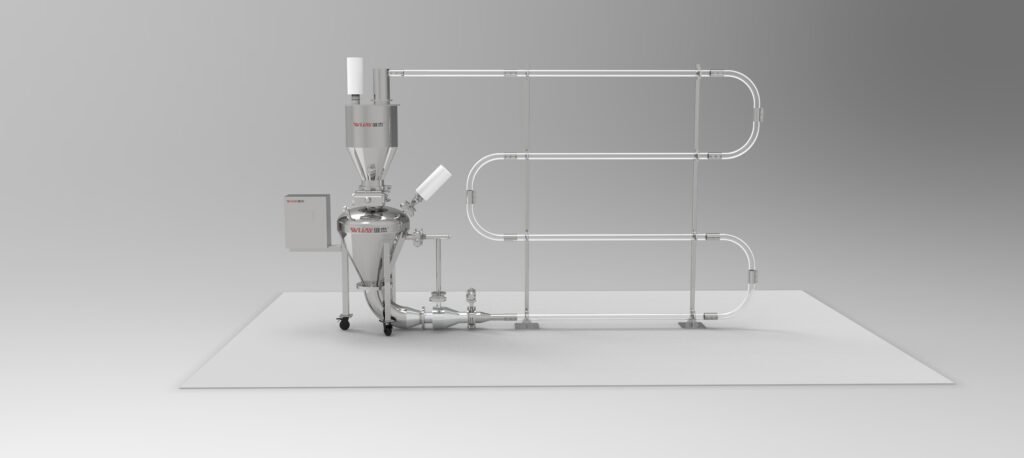
True low-velocity dense-phase conveying, by contrast, is defined not just by high solids loading but by genuinely controlled, plug-flow material movement — typically below 15–25 ft/sec (4.6–7.6 m/s). At that velocity, the kinetic energy involved in particle impact is orders of magnitude lower, translating directly into longer service life for pipe, elbows, and process equipment. Ultimately, the industry’s real challenge is recognizing that “dense phase” isn’t a binary classification — it’s a continuum. Only the lowest-velocity end of that continuum meaningfully reduces wear, optimizes energy consumption, and stabilizes material flow.
Low-Velocity Dense-Phase Conveying Is the Preferred Approach
Abrasive materials will always present a challenge for pneumatic conveying systems, but the industry has clear, field-proven principles for managing that challenge. Beyond fundamentally understanding the material — recognizing how hardness, drag, and particle behavior interact to drive wear — the most consequential factor is deliberately controlling conveying velocity. These are the variables that decide whether a system runs reliably or wears out ahead of schedule. Adopting dense-phase conveying alone doesn’t guarantee reduced wear; only a genuinely optimized, low-velocity approach consistently lowers kinetic energy, stabilizes flow, and defends against the exponential nature of abrasive wear. Designed and specified around these principles, even the most demanding abrasive materials can be conveyed with confidence, minimal downtime, and preserved system performance.
Frequently Asked Questions
Why does velocity matter more than material hardness in pneumatic conveying wear? Hardness and particle shape determine a material’s abrasive potential, but velocity determines how much kinetic energy is transferred on impact — and that relationship is exponential, not linear, making velocity the dominant variable in actual wear rate.
What’s the difference between impact, sliding, and turbulent wear? Impact wear occurs at sharp directional changes like elbows and tees. Sliding wear develops from particles scraping continuously along pipe walls, common in dense-phase conveying. Turbulent wear results from uncontrolled vortices and multidirectional impact, most common at high velocity but also possible at misaligned dense-phase pipe sections.
Is all dense-phase conveying low-wear? No. Some dense-phase systems still operate at 30–50 ft/sec (9.1–15.2 m/s), which remains an inefficient, higher-wear velocity range. True low-velocity dense-phase conveying typically runs below 15–25 ft/sec (4.6–7.6 m/s).
How much does doubling conveying velocity increase wear? Field data and empirical research indicate wear rate can increase 4 to 8 times when velocity doubles, depending on material hardness, particle geometry, and impact angle.
What is saltation velocity in pneumatic conveying? It’s the minimum air velocity required to keep material fully suspended in a horizontal pipeline. Dilute-phase conveying operates above this threshold; dense-phase conveying operates below it.
A Different Kind of Closing Thought
Most conversations about abrasive wear start after a plant has already replaced a third set of elbows this year. The material didn’t change. The velocity did — usually creeping up gradually as throughput targets shifted, until nobody could point to the exact day the wear curve went exponential. WIJAY Systems designs pneumatic conveying lines around genuinely low-velocity, plug-flow dense-phase transport for exactly this reason — because the fix isn’t a harder pipe, it’s a slower, better-controlled airstream. If your maintenance log has quietly become a velocity problem in disguise, that’s worth a direct conversation with our engineering team before the next elbow goes.