Food, plastics, and fine chemical plants running parallel production — a dozen dough mixers, a bank of extruders, multiple reactor vessels, each running its own recipe and consuming a different mix of raw materials — face a version of the same problem once the workstation count climbs past a handful: the more stations you add, the more ways there are for material management to go wrong.
The instinct that causes the most damage here is treating multi-station feeding as a scaling exercise — take whatever feeding setup works for one station and multiply it by the number of stations on the floor. That approach doesn’t scale, and it fails in predictable ways: dosing errors climb with station count, multiple stations requesting the same material at once create contention and starvation, each station’s independent weighing hardware duplicates capital cost while scattering quality data across the floor, and the piping network turns into a maintenance nightmare that gets harder to service with every station added. Most failed multi-station projects don’t trace back to bad hardware — they trace back to a missing top-level system design.
This guide explains why copying single-station feeding across multiple workstations fails and what a properly engineered multi-station feeding system actually needs: centralized storage, centralized batching, intelligent scheduling, and a control architecture built to scale with the station count rather than multiply against it.
Background: The Four Real-World Problems in Multi-Station Material Handling
High Dosing Error Risk as Station Count and Recipe Variety Climb
Different stations running different products means different material ratios at every point. The more stations rely on manual feeding and manual proportioning, the more likely human error compounds, and a single dosing mistake translates directly into a quality deviation in that batch.
Material Contention When Multiple Stations Draw Simultaneously
When several stations request the same material at the same time, and the system lacks time-sequenced scheduling logic, network flow capacity is consumed unevenly. Some stations end up under-supplied or outright starved, disrupting the production rhythm across the whole floor rather than just the one station that happened to lose contention.
Decentralized Weighing Duplicates Equipment and Fragments Data
Configuring a separate weighing setup at every station multiplies capital equipment costs, and weighing data ends up scattered across stations with no unified record, making quality traceability significantly harder when an issue needs to be traced back to a specific batch.
Poor Piping Planning Compounds Maintenance Difficulty
Simply replicating a single-station piping design for every additional workstation causes the pipe network to expand in direct proportion to station count. The result is a facility with piping crossing in every direction, and inspection, repair, and changeover purging all become substantially harder as the network grows more tangled.
Core Technical Explanation: Four Design Principles Behind a Multi-Station Feeding System
1. Centralized Raw Material Storage
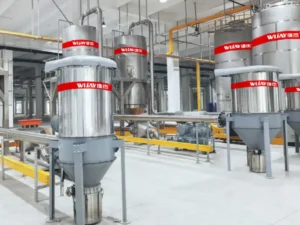
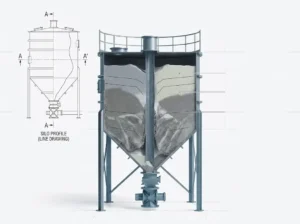
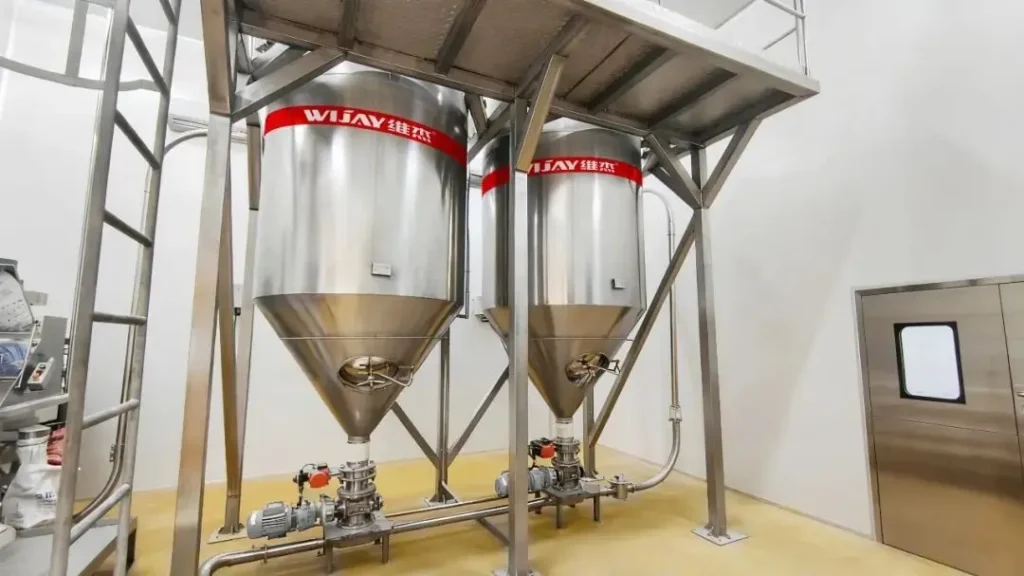
All primary and secondary materials are stored in large central silos or storage tanks rather than scattered across individual stations, with each material physically isolated in its own dedicated storage to eliminate the risk of cross-material mixing at the source.
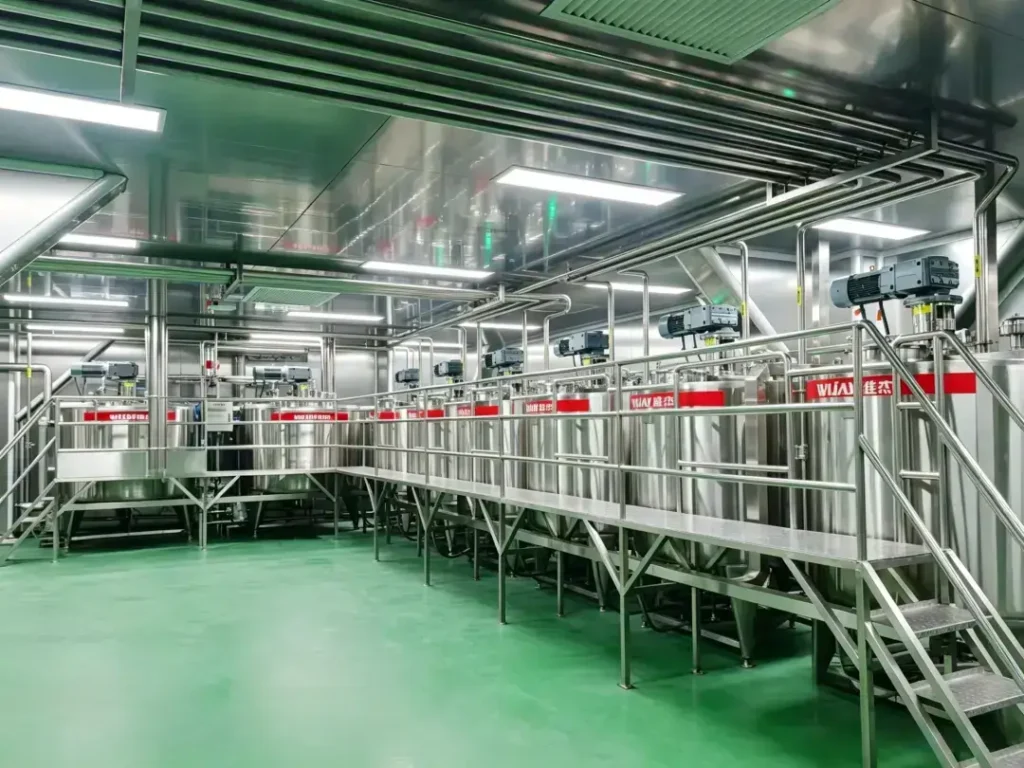
As a reference point for what this looks like at scale, one anonymized food powder automation project configured six large storage tanks, two dual-port loading stations, a screening unit, eight buffer tanks, and eight weigh tanks to serve eight parallel mixing stations — handling flour, baking powder, yeast, and other powder materials at a rated throughput of 10 t/h across 70 meters of horizontal conveying and a 30-meter vertical lift. With centralized storage in place, none of the eight stations needed raw material bags staged nearby.
2. Centralized Batching Before Distribution
Rather than each station proportioning its own materials, the more scalable architecture batches centrally, then distributes:
- The central control system calls the appropriate product recipe and performs precision batching of primary and secondary materials at a central weigh station.
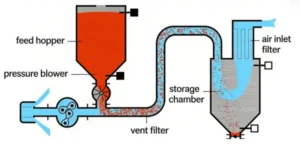
- Once batching is complete, the material is distributed through the conveying network to the corresponding processing station.
- For minor specialty ingredients used in small quantities, station-level local weighing can supplement the centralized system as needed.
This architecture centralizes weighing hardware, reducing duplicate capital equipment, and keeps every recipe stored and managed in one control system rather than requiring each station to maintain its own — a single recipe update propagates everywhere instead of needing to be repeated station by station.
3. Intelligent Valve Banks with System-Level Time-Sequenced Scheduling
This is the element that most clearly separates a genuine multi-station system from a stack of single-station units, and it’s the direct fix for material contention:
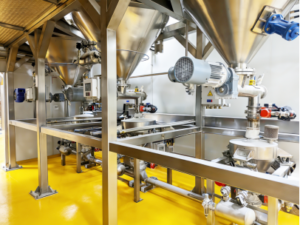
- Intelligent switching distribution valve banks route material to the correct station on demand.
- The system sets a defined limit on how many stations can draw simultaneously; when multiple stations request material at once, the scheduling logic automatically queues and sequences them, allocating network flow in order rather than letting every request compete at the same time.
- For operations with frequent recipe switching, automated piping purge clears residual material between changes, preventing cross-batch contamination between different material runs.
4. PLC Central Control with Recipe Database, Tiered Permissions, and Full Traceability
- A built-in recipe database lets operators call a recipe by number rather than manually calculating proportions on the floor.
- Tiered access control limits standard operators to selecting existing recipes, while only administrator accounts can modify batching parameters — reducing the risk of an unauthorized or accidental recipe change.
- The system logs the material type, ratio, and feed timing for every station and batch, with searchable production records that support full-chain traceability.
- Real-time audible/visual alarms flag level anomalies and convey faults so that on-site staff can respond immediately.
Single-Station Feeding vs. Multi-Station Feeding: What Actually Changes
| Factor | Single-Station Feeding (Replicated) | Properly Designed Multi-Station System |
|---|---|---|
| Material storage | Scattered near each station | Centralized, materially isolated storage |
| Batching/weighing | Duplicated hardware per station | Centralized batching, distributed to stations |
| Simultaneous demand | No coordination — first-come, first-served | Time-sequenced scheduling with a defined concurrency limit |
| Recipe management | Maintained separately per station | Centralized recipe database, single point of update |
| Traceability | Fragmented across stations | Unified, batch-level data logging |
| Piping complexity | Grows linearly (and messily) with station count | Planned as one coordinated network from the start |
For plants weighing whether their current setup is a genuine multi-station design or just several single-station systems sharing a floor, a system-level simulation run against actual peak concurrent demand is generally the fastest way to confirm before committing to a full redesign.
Practical Field Troubleshooting & Decision-Making Guidance
Key Parameters to Calculate Before Design Begins
| Parameter | Why It Matters |
|---|---|
| Maximum number of simultaneously feeding stations | Determines the system’s required conveying capacity and the scheduling logic’s concurrency limit |
| Peak hourly consumption per station, summed | Establishes overall system processing capacity; plan for a 15–20% margin above this figure |
| Complete material list (primary, secondary, minor ingredients) | Confirms particle form and moisture/abrasion/explosion/hygiene properties station by station |
| Station distribution data | Horizontal distance, vertical lift, and elbow count from storage to each station |
| Recipe business logic | Whether batching happens centrally before distribution or independently at each station, and how frequently recipes change during production |
Industry-Specific Emphasis for Multi-Station Systems
| Industry | Multi-Station Priority |
|---|---|
| Frozen/bakery food (multiple dough mixers) | Food hygiene compliance, CIP cleaning capability, insulation, and anti-moisture design for hygroscopic materials like yeast and flour |
| Plastics (multiple extrusion stations) | Handling both granule and powder materials, wear-resistant components for abrasive fillers, thorough purge design for frequent grade changeovers |
| Chemical (multiple reactor vessels) | Full dust explosion protection, tiered metering for bulk vs. minor ingredients, fully enclosed leak-proof design |
Is the Problem Fixable, or Does It Point to a Missing Top-Level Design?
| Symptom | Operating Fix | Sign of a Missing System-Level Design |
|---|---|---|
| Occasional dosing error at one station | Retrain, add a double-check step | Errors recur across many stations, regardless of training, pointing to no centralized recipe database |
| One station is occasionally short on material | Manually adjust scheduling/priority | Multiple stations experience this whenever several run simultaneously — a sign that scheduling was never engineered in |
| Weighing data hard to reconcile during an audit | Improve manual logging | Data is fragmented because weighing was never centralized in the first place |
| Piping maintenance takes longer at one station | Address that specific run | Maintenance difficulty is rising facility-wide as station count grows — a sign of uncoordinated, replicated piping |
| Minor cross-batch contamination on recipe switch | Extend manual cleaning | Contamination recurs structurally because no automated purge cycle exists |
Rule of thumb: if the same failure mode shows up across multiple stations rather than being isolated to one, the root cause is almost always a missing top-level design element — centralized storage, centralized batching, scheduling logic, or a unified control system — not a hardware defect at any single station.
Key Design & Operation Best Practices
- Calculate maximum simultaneous demand before sizing anything — this single number drives conveying capacity, valve configuration, and scheduling logic more than any other input.
- Centralize weighing wherever recipe accuracy matters, and reserve station-level local weighing only for genuinely minor, low-volume ingredients.
- Set an explicit concurrency limit in the scheduling logic, rather than assuming the network can handle unlimited simultaneous requests — this is what actually prevents contention, rather than just adding blower capacity to compensate for it.
- Store the full recipe library centrally, with tiered permissions limiting who can modify batching parameters versus who can only select an existing recipe.
- Plan the full piping network as a single system from the earliest design stage, not station by station — this is what keeps maintenance manageable as the station count grows.
- Validate scheduling logic during commissioning by simulating full concurrent load, not just testing stations one at a time — contention problems often don’t show up until multiple stations draw simultaneously under realistic conditions.
Common Mistakes & Pitfalls to Avoid
- Treating multi-station feeding as “single-station design times N.” This is the most common root cause of contention, duplicated costs, and unmanageable piping as the station count climbs.
- Skipping centralized batching in favor of per-station weighing “for simplicity.” This looks simpler up front, but it increases hardware costs and fragments the traceability data that a quality audit will eventually need.
- Not setting a defined concurrency limit in the distribution logic. Without it, the system has no way to prevent multiple stations from competing for the same material simultaneously.
- Underestimating how much piping complexity compounds with each added station. A network designed station-by-station, rather than as a single coordinated system, becomes progressively harder to maintain as the facility scales.
- Deferring recipe database and tiered permissions to “later.” Retrofitting centralized recipe management into a system where every station maintains its own is more disruptive than designing it in from the start.
- Testing stations individually during commissioning instead of simulating a full concurrent load. Contention and starvation issues often don’t appear until multiple stations draw material simultaneously under real production conditions.
FAQ
How is a multi-station feeding system different from installing several single-station feeders?
A multi-station system centralizes material storage, batching, and scheduling into a single coordinated design, with a defined limit on simultaneous station demand — several independent single-station feeders installed side by side lack that coordination and tend to compete for material rather than share it in a managed way.
How do I calculate the right capacity for a multi-station feeding system?
Sum the peak hourly consumption across all stations that could realistically run simultaneously, add a 15–20% margin for future expansion, and size the conveying network and scheduling logic against that peak concurrent figure rather than an average across all stations.
Can minor ingredients be handled differently from bulk materials in a multi-station system?
Yes — centralized batching generally handles primary and secondary bulk materials, while low-volume specialty ingredients are often more practical to manage through supplemental station-level local weighing rather than routing them through the full centralized system.
What causes material contention in a multi-station feeding system?
Contention occurs when multiple stations request the same material simultaneously, and the system has no time-sequenced scheduling logic to manage the order and rate at which each request is served — the fix is a defined concurrency limit and queuing logic, not simply more blower capacity.
Does every industry need the same multi-station feeding system design?
No — food operations generally prioritize hygiene compliance and moisture control, plastics operations need to handle both granule and powder materials with wear-resistant components, and chemical operations require dust explosion protection and enclosed, leak-proof design specific to their materials.
Ready to Design a Multi-Station Feeding System for Your Facility?
Every multi-station operation has a different combination of station count, recipe complexity, and simultaneous-use pattern — the right centralized storage, batching, and scheduling design depends on all three. Share your material list, station count and layout, recipe-switching frequency, and site distance so an engineering team can calculate peak concurrent demand and propose a system architecture built for your specific production floor.