
If you handle sulfur, fine aluminum, powdered sugar, or other low minimum ignition energy (MIE) materials, a standard conveyor is not enough. An explosion proof pneumatic conveying system for low MIE powders must be designed around the physics of the dust, not just the material flow rate. The difference is not small. Coarse sulfur dust may have an MIE around 15 mJ. Once sulfur is ground below 75 microns, that MIE can drop to roughly 0.38 mJ. A person walking across a carpet can generate 10 to 30 mJ of static discharge. That is enough energy to ignite the dust cloud many times over.
This is why low MIE powders are a different category of risk. They do not need a faulty motor or a hot bearing to explode. A spark you cannot see or feel is enough. After working with chemical, food, mineral, and energy plants, we have seen the same pattern: the explosion risk is rarely in the powder alone. It is in the system design that ignores how MIE changes when particle size drops.
Why Low MIE Powders Are a Different Kind of Risk
Every combustible dust has an MIE—the minimum spark energy needed to ignite a dust cloud. The lower the MIE, the easier the dust ignites. Some common values show the range clearly:
| Material | Typical MIE (mJ) | Risk Level |
|---|---|---|
| Benzene | 0.20 | Very High |
| Aziridine | 0.48 | Very High |
| Fine magnesium | <5 | Extremely Sensitive |
| Fine aluminum | 1–10 | Very High |
| Sulfur | 1–15 | Sensitive |
| Polyethylene | 10 | High |
| Grain dust | 10–60 | High |
| Powdered sugar | 30–60 | Moderate |
| Corn starch | 30–60 | Moderate |
The critical point is that MIE is not fixed. It falls as particle size decreases. A powder that is safe to handle in coarse form can become extremely dangerous after milling, grinding, or pneumatic conveying creates fines. In a conveying line, particles hit each other and the pipe walls. Every impact can create more fines. The dust you start with is not always the dust you end with.
This is why a Dust Hazard Analysis that only tests incoming material is incomplete. The MIE must be tested at the particle size the powder will actually reach inside the system.
The Three Ingredients of a Dust Explosion—and What Changes with Low MIE
A dust explosion needs fuel, oxygen, and an ignition source. Remove one, and the explosion cannot happen. Low MIE powders make the ignition source much harder to control.
Fuel: The Powder Itself
Any combustible powder is fuel. Low MIE powders are more sensitive because the particles are smaller, lighter, and easier to suspend in air. They stay airborne longer and travel farther. A dust cloud that would settle quickly with coarse powder can remain explosive for minutes.
Oxygen: The Atmosphere
Without oxygen, there is no oxidation and no explosion. For powders with MIE below 20 mJ, reducing oxygen is often the most reliable protection strategy. Nitrogen inerting is the standard approach. The goal is to keep oxygen below the limiting oxygen concentration (LOC) of the specific powder. In practice, this often means maintaining oxygen below 6% to 8%, depending on the material.
Ignition: The Spark You Cannot See
Heat and electrical discharge are the two main ignition sources. For low MIE powders, static electricity becomes the dominant risk. Fine particles with large surface area accumulate charge easily. A brush discharge from a charged plastic liner, an ungrounded metal part, or even a human body can release enough energy to ignite a dust cloud with MIE below 3 mJ.
This is why every conductive component must be bonded and grounded. Flexible connectors must be conductive or static-dissipative. Filter media must be antistatic. Operators should wear conductive footwear and avoid synthetic clothing that generates static.
What an Explosion Proof Pneumatic Conveying System for Low MIE Powders Must Do
Protection is not one device. It is a layered system. Here is what we evaluate for every low MIE application.
1. Test the Powder at Its Real Fines
Before design, the powder must be tested for MIE, minimum explosive concentration (MEC), limiting oxygen concentration (LOC), Kst, and Pmax. These values determine the protection strategy. A powder with MIE of 3 mJ and LOC of 8% needs different protection than one with MIE of 50 mJ and LOC of 12%.
The sample must represent the powder at its finest. If the process creates fines, test the fines. This is a step many projects skip, and it is a common cause of under-protected systems.
2. Inert the Conveying Atmosphere
For powders with MIE below 10 mJ, inerting is often required. Nitrogen is injected into the conveying line and vessels to keep oxygen below the LOC. An inline oxygen analyzer monitors the atmosphere continuously. If oxygen rises above the setpoint, the system alarms and increases nitrogen flow. In more advanced systems, conveying pauses automatically until oxygen returns to a safe level.
Inerting also protects product quality. Many low MIE powders are sensitive to moisture or oxidation. A closed-loop nitrogen system keeps the product dry and stable.
3. Remove Ignition Sources by Design
A well-designed low MIE conveying system has no ignition sources in the material path. That means:
- No electrical components inside the hazardous zone. Pneumatic vacuum conveyors that run entirely on compressed air avoid motors, solenoids, and wiring in the material path.
- Conductive construction throughout. Pipes, hoppers, filters, and flexible connections must be conductive and bonded to a common ground.
- No hot surfaces. Bearing temperatures, motor surfaces, and friction points must stay well below the auto-ignition temperature of the powder.
- Gentle conveying. Dense phase conveying moves material at low velocity, reducing impact, friction, and fines generation.
4. Bond and Ground Everything
For low MIE powders, grounding is not optional. Every conductive component must have a low-resistance path to earth. Flexible hoses must be conductive. Filter bags must be antistatic. Operators must be grounded. Ground monitoring systems that continuously verify resistance are strongly recommended for critical applications.
5. Contain and Isolate If Prevention Fails
Even with prevention, protection is still needed. Explosion venting, flameless venting, chemical suppression, and explosion isolation valves limit damage if ignition occurs. Isolation valves are especially important in conveying lines because they prevent a deflagration from spreading from one vessel to another.
Real-World Case: Fine Sulfur Conveying at a Chemical Plant
A specialty chemical manufacturer was conveying fine sulfur powder with a measured MIE of 0.8 mJ. The existing dilute phase system used a standard rotary valve and flexible hose connections. The plant had two small fires in six months, both near the filter receiver.
Our team reviewed the setup. The flexible hose was not conductive, so static accumulated on the fabric surface. The filter bags were standard polyester, not antistatic. The rotary valve had metal-to-metal contact points that could generate sparks under certain conditions.
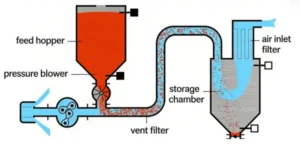
We redesigned the system around low MIE explosion protection principles. The dilute phase system was replaced with a dense phase vacuum conveying system using nitrogen inerting. Oxygen was maintained below 5%. All flexible connections were replaced with conductive, grounded hoses. Filter media was upgraded to antistatic material. The rotary valve was replaced with a pneumatic vacuum receiver with no rotating parts in the material path.
The system has run for more than two years without a fire or explosion. The plant also reduced product degradation because dense phase conveying was gentler on the sulfur particles.
What to Ask Before You Buy
When evaluating equipment for low MIE powders, ask these questions:
- Has the powder been tested for MIE at the actual fines particle size?
- What is the LOC, and how will oxygen be monitored and controlled?
- Are all conductive components bonded and grounded?
- Is the conveying method gentle enough to minimize fines?
- What protection devices are included—venting, suppression, isolation?
- Does the design meet NFPA 652 and applicable ATEX requirements?
A supplier who cannot answer these questions clearly is not equipped to handle low MIE powders.
FAQs
1. What MIE value makes a powder “low MIE”?
There is no universal cutoff, but powders with MIE below 10 mJ are generally considered high risk. Below 3 mJ, the risk is severe, and inerting is typically required. Sulfur, fine aluminum, and some pharmaceutical powders can have MIE below 1 mJ.
2. Can I use a standard dust collector for low MIE powder?
No. Standard dust collectors may have non-conductive filter media, ungrounded components, and no inerting capability. A low MIE application requires a collector designed for the specific MIE, LOC, and Kst values of the powder.
3. How is oxygen controlled in a conveying system?
Nitrogen is injected into the conveying line and receiving vessels. An inline oxygen analyzer monitors the atmosphere continuously. The control system adjusts nitrogen flow to keep oxygen below the LOC. If oxygen exceeds the setpoint, the system alarms and can pause conveying automatically.
4. Does grounding alone prevent explosions with low MIE powders?
Grounding is essential but not sufficient. It removes static discharge as an ignition source. Inerting, equipment design, and protection devices are also required. A layered approach is the only reliable strategy.
5. How often should a low MIE conveying system be inspected?
Inspection frequency depends on the material and operating conditions, but quarterly checks of grounding continuity, filter media, flexible connections, and oxygen analyzers are a good baseline. After any maintenance that opens the system, verify grounding and bonding before restarting.
Final Thoughts
Low MIE powders are not just “more combustible.” They follow different physics. The margin between safe operation and disaster is measured in millijoules. That margin cannot be managed with guesswork or standard equipment.
At Wijay Systems, we design explosion protection into low MIE powder conveying projects from the start—from powder testing through inerting, grounding, equipment selection, and compliance documentation. If you handle sulfur, fine metals, pharmaceutical powders, or any material with low MIE, our engineering team can help you assess the risk and build a system that is safe by design.
Contact Wijay Systems to discuss your low MIE powder handling project.