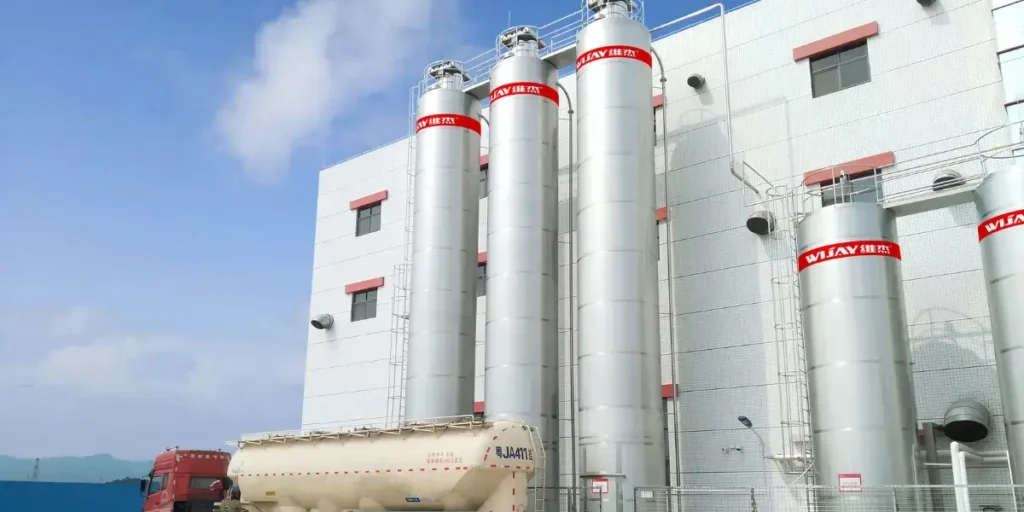
Mass flow silo design for hygienic bulk food storage addresses a problem most quality teams don’t discover until it’s already caused a batch failure: a storage silo can look completely clean on the outside while material quietly stagnates, cakes, and degrades inside the hopper. In many conventional vessels — funnel flow silos, steep-walled bins, poorly proportioned hoppers — powder settles into stagnant zones where consolidation, moisture migration, and microbial activity build up gradually and invisibly. Eventually, those deposits break loose during discharge and contaminate the exact product stream they were supposed to stay separate from.
Mass flow design solves this at the source by keeping material moving continuously, which is what actually prevents stagnation, moisture buildup, and deposit formation — not better housekeeping or more frequent cleaning cycles.
How Mass Flow Eliminates the Stagnant Zones That Cause Spoilage
Traditional funnel flow silos discharge material through a narrow central channel while large volumes of product sit motionless against the vessel walls. That stationary material is exactly where degradation conditions develop — powder that isn’t moving has nothing preventing it from sitting undisturbed for weeks or months.
Mass flow design removes those dead zones by keeping the entire vessel contents moving together toward the outlet whenever discharge occurs, rather than allowing pockets of material to sit inactive along the walls. Uniform movement through the whole vessel is what actually improves hygienic storage conditions — it isn’t a byproduct of the design, it’s the mechanism.
This matters most for food powders prone to time-dependent consolidation: flour, sugar, cocoa, starches, and dairy powders all compact under their own weight over extended storage. As consolidation pressure builds, the material gains cohesive strength and becomes progressively harder to move — which can lead to caking, stable obstructions, degraded flowability, and localized spoilage risk in the material that’s been sitting longest. A mass flow hopper keeps material moving before it has time to develop that cohesive strength in the first place.
Stagnant zones also create favorable conditions for microbial activity. Moisture and heat can accumulate in isolated pockets inside a silo, and mold, bacteria, or insects can establish themselves in material that never gets disturbed. Keeping the whole vessel in continuous, uniform motion is what limits that risk — not spot cleaning after the fact.
Why Mass Flow Enforces FIFO — and Why That Matters for Food Safety
Residence time control is central to preserving food quality in bulk storage. Ingredients held past their intended shelf life inside the silo itself — not just on a warehouse shelf — can oxidize, absorb moisture, lose flavor, or degrade nutritionally before they ever reach the production line.
Mass flow design naturally produces first-in, first-out (FIFO) discharge: material loaded first is the material that exits first, because the entire stored volume moves together. That predictability gives processors real control over lot tracking, inventory turnover, and how long any given batch actually sits in storage.
Funnel flow behaves in the opposite way. Freshly loaded material moves quickly through the central flow channel while older material stays trapped against the walls — which produces a first-in, last-out pattern where the oldest material in the silo can remain there indefinitely, invisible to anyone tracking inventory by date loaded rather than by what’s actually discharging.
For hygroscopic or fat-containing ingredients especially, that extended residence time is a real quality risk — moisture absorption, agglomeration, oxidation, and flavor deterioration are all more likely the longer material sits undisturbed. There’s a second risk layered on top: sloughing. Material that has adhered to the hopper wall over time can eventually detach and drop into the active flow stream, carrying degraded product, compacted lumps, or microbial contamination directly into what was supposed to be a clean batch. Mass flow prevents this by keeping material moving along the walls continuously as the hopper empties, so nothing has time to build up into a deposit worth sloughing off in the first place.
The Engineering Behind Reliable Mass Flow
Mass flow isn’t a property of silos in general — it’s the result of specific engineering, and getting it wrong is easy to do without realizing it. Hopper angle, outlet dimensions, wall friction characteristics, and the material’s own flow properties all have to work together to produce genuinely uniform discharge. A silo that looks like a standard mass flow hopper on paper can still behave like funnel flow in practice if any one of these variables is off.
When it’s engineered correctly, the sliding motion of bulk material against the hopper wall during discharge produces a natural scouring effect that continuously clears residual material from the surface. That wall-cleaning action is what prevents the cohesive deposits that build up in poorly designed systems — without it, residual powder gradually hardens into stable ratholes or wall buildup that retains old material indefinitely, contaminates fresh product as it eventually breaks loose, and makes routine cleaning significantly harder than it should be.
Mass flow also helps control particle segregation. Many food blends separate during filling as fine and coarse particles settle differently based on size and density. Funnel flow makes this worse, since material is drawn primarily from the center of the vessel while segregated material sits undisturbed near the walls. Uniform flow through a properly designed mass flow hopper promotes natural remixing during discharge, which helps processors maintain ingredient homogeneity and consistent product quality batch to batch.
A Case Worth Sharing: When the Silo Wasn’t the Problem — the Flow Pattern Was
We worked with a food ingredient processor experiencing intermittent contamination flags on a dairy powder blend — nothing traceable to raw material quality or the mixing process, but recurring enough that QA had started treating it as an unexplained variable to manage around rather than a root cause to solve. The storage silo itself looked clean on every scheduled inspection.
The actual issue was a funnel flow pattern in a silo that had been sized correctly for capacity but never verified for flow behavior against the material’s specific cohesive properties. Older material had been accumulating against the hopper walls for months, slowly consolidating, and periodically sloughing off in small quantities during discharge — just often enough to produce the intermittent contamination flags, and rarely enough that it took real investigation to connect the pattern to the silo’s flow behavior rather than an upstream process issue. Once flow properties testing confirmed the mismatch between the existing hopper geometry and the material’s actual cohesive strength, a hopper modification — adjusting wall angle and surface finish rather than replacing the vessel outright — corrected the flow pattern to genuine mass flow. The contamination flags stopped. The lesson wasn’t that the plant needed a new silo; it was that silo capacity and silo flow behavior are two entirely different engineering questions, and only one of them had actually been verified.
Getting Hygienic Storage Right From the Design Stage
Hygienic bulk food storage depends on more than sanitation schedules and cleaning procedures — it depends on whether the silo itself is designed to prevent stagnation in the first place. Mass flow design, verified against the actual flow properties of the material being stored, is what eliminates dead zones, enforces FIFO discharge, controls segregation, and keeps hopper walls genuinely clean through continuous material movement rather than through downstream intervention. Getting this right at the design or retrofit stage is considerably less costly than tracing an intermittent contamination or quality issue back to a flow pattern nobody thought to test.
FAQ
How can a silo look clean from the outside but still cause contamination? Because the problem develops inside the hopper, in stagnant zones along the walls that aren’t visible during a routine exterior inspection. Material trapped in those zones can consolidate, absorb moisture, and support microbial growth for extended periods before it eventually breaks loose during discharge.
What’s the practical difference between mass flow and funnel flow? In mass flow, the entire contents of the silo move together toward the outlet whenever it discharges, producing a natural FIFO pattern. In funnel flow, material moves quickly through a central channel while older material stays trapped near the walls, which can result in the oldest material in the silo never fully discharging under normal operation.
Does a hopper’s angle alone determine whether it achieves mass flow? No. Mass flow depends on the combination of hopper angle, outlet size, wall friction against the specific material, and the material’s own flow properties — not angle in isolation. A hopper that looks correctly proportioned can still behave like funnel flow if these factors aren’t matched to the actual material being stored.
Can an existing funnel flow silo be corrected without full replacement? Often, yes. Depending on the mismatch between current geometry and the material’s flow properties, a retrofit — adjusting wall angle, changing surface lining, or modifying the outlet — can convert an existing vessel to genuine mass flow behavior without replacing the silo structure itself.
Why does particle segregation get worse in funnel flow silos specifically? Because funnel flow draws material primarily from the center of the vessel, which allows fine and coarse particles that separated during filling to remain segregated near the walls instead of being remixed during discharge. Mass flow’s uniform movement naturally remixes the material as it exits, which funnel flow doesn’t replicate.
If your plant has experienced intermittent quality flags, caking, or contamination that doesn’t trace cleanly back to raw material or process conditions, the storage silo’s flow pattern is worth verifying before assuming the vessel itself needs replacing. WIJAY Systems designs and retrofits bulk food storage and handling systems — enclosed, low-degradation, engineered around the real flow properties of your material — across food, chemical, and other bulk material industries. If you’d like a second look at a silo that isn’t behaving the way its geometry suggests it should, our process engineering team is glad to talk it through.