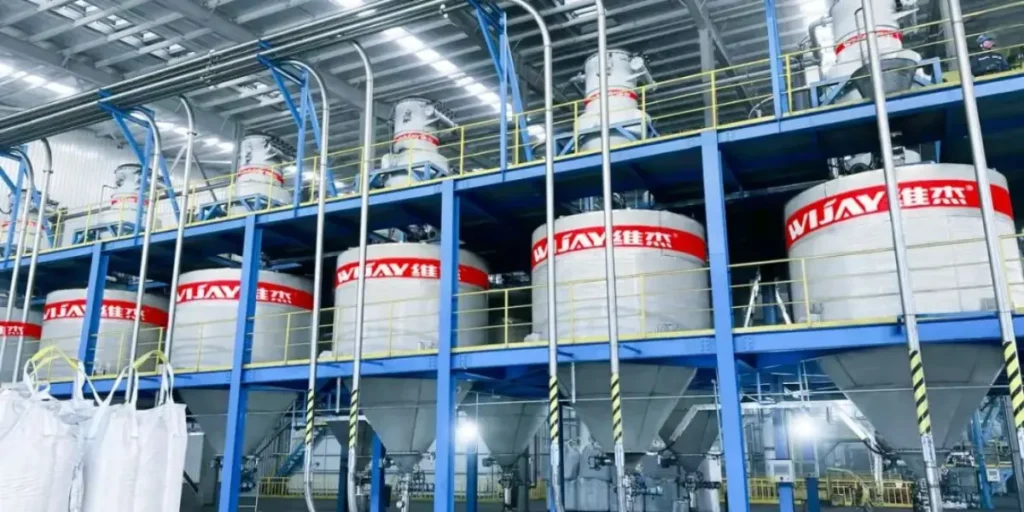
Intermediate cone silo design exists to solve a problem that doesn’t show up until a plant actually builds the bigger silo it needs — internal pressure that increases disproportionately with size, and that pressure degrading material, jamming discharge, or in severe cases, threatening the structure itself. Storage silos paired with automated conveying have become standard in modern bulk material plants, and system suppliers can typically deliver an integrated solution. What’s genuinely difficult is designing and building a high-quality large silo — because bigger silos introduce problems, like vibration and excessive stress on stored material, that smaller silos simply don’t generate at the same scale.
This article explains why silo size and internal pressure are directly linked, walks through the common ways plants try to manage that pressure, and makes the case for why intermediate cones are the one method that offers genuinely predictable results — including a real case where they solved an impact problem a plant had been treating as an unavoidable cost of running a large silo.
Why Bigger Silos Create Problems Smaller Ones Don’t
When a plant needs higher throughput or shorter lead times, the practical response is often to store more raw material — which for silo-based operations means building taller or wider vessels. That decision can introduce problems the plant has never encountered before, because bulk solids under higher pressure in a larger silo behave differently, and usually not in the plant’s favor.
The typical symptoms of oversized-silo pressure problems include material breakage and degradation, caking and consolidation, difficult discharge that disrupts downstream processes, equipment impact and vibration that can cause discharge feeder failure and inaccurate metering, and in severe cases, structural collapse of the hopper itself. Managing internal silo pressure comes down to understanding the interaction between the silo wall and the material it’s holding.
Silo Impact and Vibration: Where the Pressure Problem Becomes Visible
Silo impact has several possible causes, and the most common is stick-slip behavior: friction along the wall varies, a temporary arch forms in the material, and that arch collapses suddenly, generating a sharp impact. Other contributing factors include material consolidation or degassing behavior interacting with silo geometry, flow pattern shifting from mass flow to funnel flow, and asymmetric outlets or failed discharge equipment creating uneven flow.
In every case, higher internal pressure means more frequent and more severe impact. Impact typically weakens as fill level drops, eventually stopping below a certain level — and notably, impact behavior depends on batch history, not just current fill level. A representative example: a round silo 9 meters in diameter and 11 meters tall, storing milk powder, might show impact when material exceeds 18 tons if it was previously filled to capacity (50 tons) — but show no impact at all if it was never filled above 30 tons in its history.
Why Silo Pressure Doesn’t Behave Like Liquid Pressure
In a liquid vessel, pressure at the bottom is directly proportional to fill height. Bulk solids don’t follow that rule. In a bulk solids silo, downward pressure doesn’t increase linearly, because friction between the material and the silo wall causes the material to effectively “hang” on the wall, keeping bottom pressure lower than the frictionless theoretical value would predict.
That means pressure distribution actually depends on two variables: the wall’s coefficient of friction, and the silo’s height-to-diameter ratio (surface area relative to circumference). The practical consequence is that high pressure is more likely in tall or wide silos, and in silos with lower wall friction — and lower friction itself can result from fat deposits on the wall (common in soybean meal and feed silos), long-term wall polishing by the material (which requires both a relatively hard material and mass flow), switching to a different bulk material than the silo was originally designed for, or changes in the material’s own properties, such as bulk density.
Common Methods for Reducing Silo Pressure — and Their Trade-Offs
When high pressure is causing real problems, the goal becomes reducing it, and in practice, most methods work by altering wall friction conditions — which is worth flagging up front, because that means many of these methods are material-specific and can lose effectiveness if the silo is later used for a different material.
Wall rings. Simple in structure, but genuinely difficult to size correctly; oversized rings can create localized funnel flow and stagnant material, which is a real liability for perishable products.
Mesh strips. Similar limitations to rings, with the added risk of tearing or detaching under high load.
Segmenting into multiple bins. The effect is calculable in advance, and it enables multi-material storage — but the structure is complex, costs more, and tends to create off-center discharge.
Textured wall surfaces (coating or grooving). Lower cost and genuinely effective, but wall loading increases, dead zones become a risk, and the surface may need repolishing after extended use.
Internal inserts (plates, cones, chains). Pressure reduction can be significant, but the resulting stress and flow pattern are difficult to predict, which introduces real structural risk if not engineered carefully.
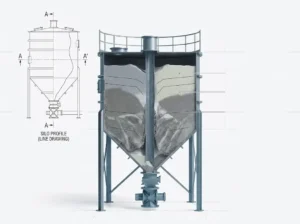
Intermediate cones — the method worth focusing on.
Why Intermediate Cones Are the Predictable Option
Intermediate cones work on the same principle as a silo’s main hopper cone, and they deliver a specific, genuinely useful combination of benefits: reduced internal material pressure, increased but predictable wall loading, pressure drop and structural loading that can both be precisely calculated, meaningful pressure reduction even in shorter silos, mass flow preservation, and reactivation of the downward-moving material “plug” — which helps prevent settling and consolidation. They’re also structurally compact and straightforward to install.
The key distinction from other internal inserts is predictability. Where a generic internal plate or baffle introduces stress and flow effects that are genuinely hard to model in advance, intermediate cones are engineered against calculable design factors, which is what makes them viable for new-build design rather than just reactive retrofits.
What Actually Determines Whether an Intermediate Cone Design Works
Effectiveness depends entirely on design quality, and that design rests on a specific set of engineering inputs. Wall friction measurement determines the pressure level in combination with silo geometry. Target pressure level needs to be established differently depending on the situation: for an existing silo, that means identifying the fill level where problems actually begin; for a new silo design, it means testing the material’s consolidation behavior directly. Internal friction angle, typically measured with a Jenike shear tester, determines the pressure drop achieved within the cone itself. And flow and arching studies — Benink arch theory is commonly used here — allow the pressure reduction from a given intermediate cone to be calculated precisely enough to size the cone correctly the first time.
Balancing Cone Count Against Installation Cost
Using more intermediate cones reduces total silo height and material use, but increases installation cost. In practice, this means calculating multiple configurations and selecting the option that balances pressure reduction, structural material, and installation cost most effectively for the specific application — not defaulting to a single “standard” cone count regardless of silo size or material.
Understanding Stick-Slip Behavior in Powders Like Milk and Whey
Milk powder and whey powder are classic stick-slip materials: wall friction is high at rest, drops suddenly once flow begins, then rises again as flow stops — repeating in a cycle. This behavior shows up clearly in wall friction testing, and it’s also intuitively recognizable in everyday terms — it’s the same mechanism behind the audible “squeak” when squeezing a plastic bag of powder.
A Case Worth Sharing: When “That’s Just How This Silo Behaves” Wasn’t Actually True
We worked with a dairy ingredient producer running a large milk powder silo that generated regular impact and vibration once fill level exceeded a certain threshold — loud enough to be a genuine concern, and frequent enough that the plant had simply built it into their operating expectations, treating it as an unavoidable characteristic of storing milk powder at that scale.
Wall friction testing and flow analysis on the actual material showed the impact was driven by the stick-slip behavior characteristic of milk powder, amplified by the silo’s height-to-diameter ratio and the pressure that geometry generated at higher fill levels — a calculable, addressable condition rather than an inherent limitation of the material itself. Retrofitting the silo with a calculated set of intermediate cones, sized against the material’s measured internal friction angle and the silo’s specific geometry, reduced internal pressure enough to eliminate the impact entirely across the silo’s full fill range, while preserving mass flow and avoiding the stagnant zones a less predictable method might have introduced. The plant’s operating team, who had genuinely come to accept the noise and vibration as a fixed cost of the silo’s scale, found that the “unavoidable” problem had a calculable, engineered solution all along. The lesson: pressure-related silo problems that get treated as inherent to a material or a silo’s size are frequently a design gap, not a physical limit — and the difference only becomes visible once the actual wall friction and consolidation behavior are properly tested.
Getting Silo Design Right for Sensitive Materials
For stick-slip materials like milk powder and whey powder, and for fragile, highly cohesive, or otherwise process-sensitive materials generally, avoiding high internal pressure is essential — not optional. In large mass-flow silos or silos with asymmetric geometry, the negative consequences of high pressure deserve serious engineering attention rather than being accepted as a cost of scale. Among the available pressure-reduction methods, intermediate cones stand out specifically for their predictability: quantity and dimensions can be precisely calculated, they’re flow-pattern friendly, and both process and structural risk stay genuinely controllable. For new large silos handling fragile or pressure-sensitive materials, the practical recommendation is to design intermediate cones in from the start — integrating them at the design stage costs meaningfully less than retrofitting them after the problem has already shown up in production.
FAQ
Why does a larger silo create pressure problems a smaller one doesn’t? Because internal pressure in a bulk solids silo depends on the silo’s height-to-diameter ratio and wall friction, not simply on fill volume. Taller or wider silos, and silos with lower wall friction, generate disproportionately higher internal pressure — which is why scaling up silo size can introduce impact, caking, or discharge problems that never occurred at a smaller scale.
Why is impact behavior linked to a silo’s fill history, not just its current fill level? Because consolidation and stick-slip behavior in bulk solids can depend on how much pressure the material has previously experienced. A silo that was once filled to capacity may show impact at a fill level where the same silo, if never filled that high, would show none — which is why fill history matters when diagnosing the problem.
Are wall coatings or textured surfaces a good alternative to intermediate cones? They can be effective and relatively low-cost, but the pressure reduction they deliver is harder to calculate precisely, wall loading increases, dead zones become a real risk, and the surface may need repolishing after extended use. Intermediate cones offer more predictable, calculable results for the same underlying pressure problem.
Can intermediate cones be retrofitted into an existing silo, or only designed into new construction? Both are possible, but retrofitting costs meaningfully more than designing them in from the start, because a retrofit has to work within the silo’s existing geometry and structural constraints rather than being optimized alongside them from the beginning.
What testing is actually needed to size an intermediate cone correctly? Wall friction measurement against the specific material, internal friction angle testing (typically with a Jenike shear tester), and flow and arching analysis specific to the material and silo geometry. Skipping this testing and estimating cone size from a similar-looking application is the most common way intermediate cone designs underperform.
WIJAY Systems designs intermediate cone silo solutions for large bulk solids storage — calculated against your material’s actual wall friction, internal friction angle, and consolidation behavior, not estimated from a generic silo template — across food, chemical, and other bulk material industries. If your silo is generating impact, vibration, caking, or discharge problems you’ve been treating as unavoidable at that scale, that’s worth a conversation with our process engineering team before the next structural inspection finds something more serious.