An engineered vacuum conveying solution exists because specifying pneumatic conveying equipment from a blank sheet is harder than it should be — and most process engineers who’ve been through it know exactly where it goes wrong. The receiver gets sized on throughput alone and jams on a cohesive powder six months later. The filter media gets picked off a catalog default and can’t keep up with dust loading on the actual product. The discharge valve doesn’t seal against the pressure differential the system actually runs at. None of these are equipment failures in the traditional sense — they’re specification failures, made before a single component was ever installed.
Pneumatic conveying earns its place as a preferred method for dry bulk solids handling for real reasons: it minimizes dust, eliminates manual handling, reduces wear on downstream equipment, and delivers the consistent, repeatable feed rates that tight process tolerances depend on. As industries push toward cleaner operations, better worker safety, more automation, and seamless integration with mixing, batching, blending, packaging, and extrusion, vacuum conveying keeps gaining ground as the default choice for moving dry solids through a plant.
But the underlying engineering principles that make a vacuum conveying system reliable don’t change from supplier to supplier — what changes is whether those principles get applied deliberately or guessed at. That’s the actual case for pre-engineering: not a marketing shortcut, but a way of removing the guesswork from decisions that have historically been made by trial and error.
The Five Components Every Vacuum Conveying System Is Built Around
Pre-engineered vacuum conveying is a modular, flexible approach to moving dry bulk solids and powders, and while configurations vary by material and application, every system is built around five core components working together.
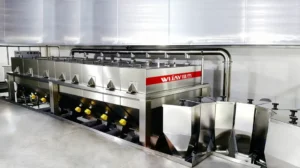
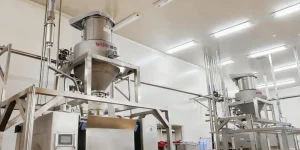
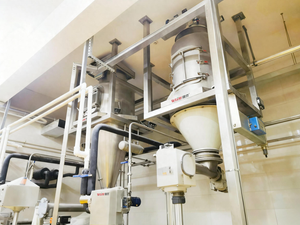
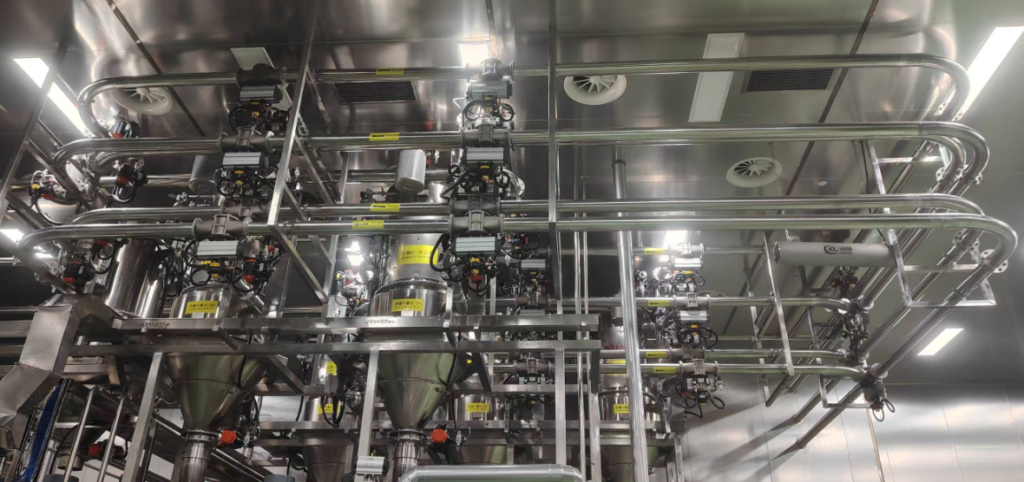
The vacuum receiver sits at the center — the primary unit that collects conveyed material, designed for fast, clean discharge and straightforward maintenance, typically fitted with filtration media suited to fine or dusty powders. The vacuum pump or blower system supplies the necessary suction, using rotary lobe, regenerative, or venturi vacuum technology depending on material characteristics and throughput requirements. Conveying line piping moves material while minimizing friction and preserving product integrity from source to destination. A pickup wand or line is where material enters the conveying line, engineered for smooth, blockage-free operation. And a filtration or dust collection assembly protects the vacuum generator from fine particulate while ensuring clean air discharge through cartridge, bag, or cyclonic separation.
Individually, none of these five components is complicated. What determines whether the system actually performs is how they’re matched to each other and to the specific material being conveyed.
The Receiver–Filter–Discharge Valve Interface
Vacuum conveying performance is fundamentally shaped by the receiver body design, its interaction with material flow behavior, and the equipment it’s loading into. Vacuum receivers come in three primary body configurations, each engineered for different material characteristics and process conditions.
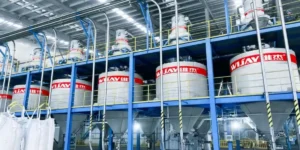
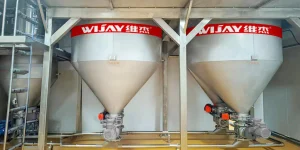
Concentric cone receivers suit easily conveyed, free-flowing powders that discharge reliably under low cohesion. Eccentric cone receivers are built for more difficult materials with moderate cohesion, variable bulk density, or irregular particle shape that need improved flow regulation. For the most challenging applications, tubular hopper configurations are designed for materials prone to bridging, rat-holing, or caking, providing the vertical-wall flow assistance needed to maintain steady discharge and prevent flow blockages.
Selecting the right receiver body is foundational, because conveying performance is directly tied to how well the material actually flows.
Why Filter Selection Determines System Efficiency
While the vacuum generator establishes the system’s driving force, the filtration component governs airflow quality and stability. Vacuum receiver filters typically use anti-static, non-stick media rated at 99.9% efficiency down to 1-micron particles, ensuring reliable air-material separation and fast dust release between batches.
Filter selection depends on particle size distribution, headroom, sanitary or cleaning requirements, and maintenance constraints. Options include:
- Sock filters — smooth-surfaced media with low residual dust and fast pulse cleaning, well suited to pharmaceutical and food applications with strict sanitary requirements
- Cartridge filters — high surface-area-to-volume ratio, supporting a compact receiver footprint while maintaining filtration efficiency and stable vacuum levels under continuous operation
- Side-access pleated bag filters — larger filter area with strong dust release performance, stable pressure differential over longer cycles, and convenient maintenance access in confined spaces
- Top-access pleated bag filters — allow clean-side bag removal, potentially avoiding confined-space entry procedures, suited to facilities aiming to reduce exposure during maintenance
- Integral filter assemblies — for lower conveying-rate systems where maximum filter area isn’t a primary requirement, offering strong dust release and simplified maintenance
Filter choice has to match anticipated dust loading, particle size distribution, material abrasiveness, and the pulse-cleaning frequency needed to maintain steady-state airflow.
Discharge Valve Selection and Integration
Discharge valve integration with the receiver and filtration components is critical to batch consistency, discharge reliability, and overall vacuum integrity. Discharge options include power- or counterweight-actuated flap valves for fast-cycle batch discharge; slide gate or orifice valves for precise metering into downstream equipment; rotary valves providing airlock function for continuous conveying or metering discharge; and clamp or butterfly valves for compact installations requiring simple flow isolation. Selecting the right discharge valve requires evaluating sealing performance, material compressibility, downstream pressure conditions, and the mechanical demands of the conveying duty cycle.
Material Behavior and Conveying Dynamics
From a process engineering standpoint, understanding material behavior is both the starting point and, often, the limiting factor in successful pneumatic conveying design. Dry bulk solids don’t behave uniformly — conveying performance is governed by a complex interaction of particle size distribution, shape, bulk density, cohesion, friability, moisture content, and angle of repose. Fine, cohesive powders such as silica, starch, carbon black, and titanium dioxide clump easily, resist flow, and require higher energy to entrain. By contrast, free-flowing granular materials like sugar, salt, or polymer pellets accelerate more readily in an airstream but risk impact damage or abrasion at excessive velocity. Even minor formulation changes, environmental shifts, or batch-to-batch variation can alter how material behaves inside the conveying line.
Beyond pickup velocity at the start of the line, a critical design parameter for any pneumatic system is saltation velocity — the minimum air velocity required to keep solids fully suspended and prevent particle settling in horizontal runs. Determining this velocity underpins vacuum pump sizing, pipe diameter selection, safe operating velocity, and predicting system stability under varying load conditions. Running below saltation velocity increases the likelihood of line blockage, pulsation, excessive wear, and process interruption; exceeding it risks product degradation, separation, or yield loss.
Because every material responds differently to acceleration, entrainment, and airflow, material testing matters. In lab testing, engineers characterize flowability, assess cohesive tendency, measure entrainment behavior, and observe potential issues such as caking, abrasion, or static buildup. These findings directly inform final decisions — pickup device geometry, vacuum receiver design and configuration, filtration strategy, line routing, and allowable velocity range. Full-scale test facilities can measure bulk density, flowability, particle attrition, vacuum conveying rate, and receiver design under representative conditions.
Cohesive or poor-flowing powders typically require specialized pickup components, controlled feed mechanisms, or elevated vacuum levels for stable conveying. Abrasive materials may require wear-resistant elbows, reinforced receivers, or velocity management to extend system life. Friable or brittle materials benefit from gentler acceleration profiles and reduced conveying velocity to avoid breakage.
Ultimately, material conveying behavior drives nearly every engineering decision in pneumatic conveying — from vacuum source and filtration strategy to discharge options — and material testing is what ensures the system performs reliably under actual operating conditions.
Why Pre-Engineering Removes the Guesswork
Because pneumatic conveying performance is directly shaped by how material behaves in the airstream — its cohesion, aeration response, bulk density, moisture content, and abrasiveness — receiver selection depends on accurately understanding those characteristics. Even minor variations can change the required conveying rate, receiver configuration, or filtration approach, which makes material characterization a critical step whenever a process is scaled up or a new packaging line is added.
When a process engineer works with an experienced pneumatic conveying specialist, most of the guesswork in specifying a conveying system is removed. Pre-engineering a vacuum conveying package delivers ready-to-use conveying expertise in a standardized five-component package, ready for installation and integration into new or existing production lines. These packages help ensure the system aligns with the required capacity range, cleaning methodology, footprint, headroom constraints, and controls package for the application — reducing design guesswork while keeping pace with production demands.
Applications Across Industries
Demand for vacuum conveying systems varies substantially across pharmaceutical, nutraceutical, food, petrochemical, and chemical processing environments. Each industry carries distinct requirements — sanitary design, enclosure rating, wear resistance, moisture sensitivity, or compatibility with combustible dust. Through material characterization, process evaluation, and collaboration with vacuum conveying specialists, system performance can be optimized by matching receiver design, filtration media, and discharge valve technology to actual material behavior and operational needs.
Simplifying Material Transfer
Pre-engineered vacuum conveying simplifies bulk material handling by offering ready-to-install solutions designed for specific applications and material types. By matching receiver design, filtration, and discharge technology to a material’s flow characteristics, these systems ensure reliable, repeatable, and sanitary transfer while minimizing installation complexity and engineering time.
Direct-to-mixer feed and mobile vacuum conveying illustrate the flexibility and efficiency of pre-engineered solutions. Direct-to-mixer systems vacuum-convey powders and granules precisely into a mixer, reducing manual handling, improving batch consistency, and preserving material integrity. Mobile vacuum receivers allow rapid transfer between process points, minimizing dust, stair climbing, and manual handling while maintaining high-performance vacuum conveying across multiple production lines.
Built for their respective applications — from free-flowing powders to highly cohesive or fibrous materials — these pre-engineered systems help process engineers optimize production, reduce downtime, and improve workplace safety. By integrating targeted receiver, filtration, and discharge technology, pre-engineered vacuum conveying streamlines workflow, improves efficiency, and lets engineers focus on maximizing process performance rather than troubleshooting material transfer.
Frequently Asked Questions
What is an engineered vacuum conveying solution? It’s a pre-engineered, modular package built around five core components — vacuum receiver, vacuum pump or blower, conveying line, pickup device, and filtration assembly — matched to a specific material’s flow characteristics rather than specified from scratch on throughput alone.
Why does receiver body design matter for vacuum conveying? Receiver body configuration — concentric cone, eccentric cone, or tubular hopper — directly determines how reliably a specific material discharges. Materials prone to bridging or caking need different flow assistance than free-flowing powders.
What is saltation velocity and why does it matter? Saltation velocity is the minimum air velocity required to keep solids fully suspended in a horizontal conveying line. Running below it risks blockage and pulsation; running above it risks product degradation and excessive wear.
Does every material need lab testing before specifying a vacuum conveying system? Materials with cohesive, abrasive, or friable characteristics benefit significantly from testing, since flowability and entrainment behavior can vary enough between materials — and even between batches — to change the required receiver configuration or filtration strategy.
Can a pre-engineered vacuum conveying package still be customized? Yes. Pre-engineering standardizes the underlying component selection logic, but configurations are still matched to specific throughput, footprint, cleaning method, and regulatory requirements for the application.
Where WIJAY Fits Into This
An engineered vacuum conveying solution is only as good as the material understanding behind it — which is why WIJAY Systems builds pneumatic conveying lines around enclosed, dust-free transport, automated low-loss handling, and receiver, filter, and discharge configurations matched to the actual material, not a catalog default, across industries from food and pharmaceutical to industrial powder processing. If you’re specifying a new vacuum conveying line or troubleshooting one that never hit its rated performance, our engineering team can walk through your material characteristics and process requirements to scope the right configuration from the start. [Talk to our process engineering team →]