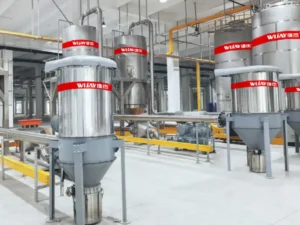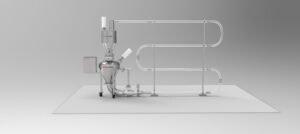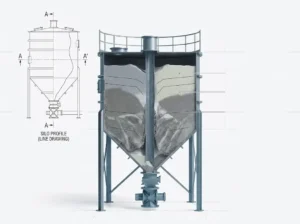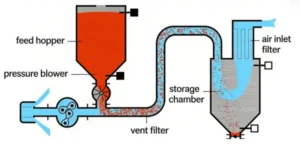

If you are evaluating dense phase pneumatic conveying for compactable materials, you have probably heard the warning: air pressure will compact the product and plug the pipe. It is a fair concern. Materials such as foundry sand, quicklime, refractory batches, sugar alcohols, and compressed candy pellets can pack together under pressure. But the problem is not dense phase conveying itself. The problem is how air is applied. With the right control strategy, dense-phase conveying can reliably, gently, and efficiently move compactable materials.
Dilute Phase vs. Dense Phase: A Quick Comparison
Dilute phase pneumatic conveying uses high air velocity and low pressure. The material is suspended in the air stream and moves quickly through the pipe. This works well for free-flowing, robust materials. But for fragile or abrasive products, dilute phase can cause wear, breakage, and dust. It also uses a lot of air and energy.
Dense-phase pneumatic conveying uses lower velocities and higher pressures. Instead of flying through the pipe, the material moves in dense slugs or waves. Because the material travels slower, there is less impact, less wear, and less product degradation. Dense phase is often the better choice for fragile, abrasive, or long-distance transfers.
The trade-off is that dense phase requires more careful control. If the air is not managed correctly, compactable materials can lock up. That is where many conventional systems struggle.

Why Compactable Materials Are Different
Some bulk solids flow easily no matter what. Others do not. Compact materials tend to pack together when pressure is applied. They may have a wide particle size distribution, subangular shapes, or a mix of coarse and fine particles. Examples include:
- Refractory batches designed to be pressed into bricks.
- Quicklime with a wide range of particle sizes.
- Foundry green sand with unpredictable flow behavior.
- Sugar alcohols such as sorbitol and mannitol.
- Compressed candy pellets that can deform under pressure.
In a conventional dense-phase system, air is often supplied at a fixed rate or from a fixed-pressure source. If the material starts to compact, the air may not reach the right place at the right time. The line plugs. Production stops. Operators spend hours clearing the pipe.
The Real Problem: Fixed Air, Not Dense Phase
It is easy to blame dense phase conveying for plugging. But the real issue is usually the air control strategy. A fixed air supply assumes that the material requires the same amount of air throughout the line. That is rarely true. As the slug moves, the resistance changes. As the material compacts, the air needs to change. A fixed system cannot respond.
What compactable materials need is not more air everywhere. They need the right amount of air at the right location, at the right moment. This is the principle behind intelligent air-assist dense phase conveying.
How Intelligent Air-Assist Dense Phase Works
WIJAY’s approach to dense-phase conveying of compactable materials uses dynamic air injection along the pipeline. Instead of relying on a constant airflow that may compact the product, the system applies air precisely where needed. This keeps the material moving without over-aerating it or causing a blockage.
Think of it as air leverage. The system monitors pressure and flow conditions and injects air at strategic points to break up incipient slugs before they become solid plugs. The material stays in motion. The line stays clear. The process keeps running.
This is not about adding more compressed air. It is about using air more smartly. That distinction matters for energy consumption, maintenance, and product quality.
Conventional Dense Phase vs. WIJAY Intelligent Dense Phase
A conventional dense phase system may work well for free-flowing pellets. But when the material is compactable, it often runs into trouble. The operator may increase pressure to clear a blockage, which can worsen compaction. The system may need frequent manual intervention. Energy use goes up. Reliability goes down.
WIJAY’s intelligent dense phase system takes a different approach. It adapts to the material and the pipeline. It uses pressure data to decide when and where to inject air. It prevents blockages instead of reacting to them. The result is smoother conveying, lower energy use, and fewer shutdowns.
Key Benefits of Intelligent Dense Phase Conveying
First, fewer blockages. Dynamic air injection keeps compactable materials moving. The line does not plug as easily, even with difficult powders.
Second, lower energy consumption. The system does not waste air. It provides air only where it is needed. That makes the conveying process more efficient.
Third, less maintenance. When the system avoids compaction and clogs, there is less strain on pipes, valves, and compressors. Breakdowns decrease, and maintenance costs drop.
Fourth, better product quality. Dense phase already protects fragile materials. Intelligent air control makes it even gentler. The product does not get crushed or degraded.
Fifth, greater flexibility. Whether you handle fine powders, dense granules, or irregular materials, the system can adapt. It can also handle different distances and pipeline layouts.
A Real Case: Foundry Green Sand Transfer
A foundry was conveying green sand from a storage hopper to a mixing station. The sand had a wide particle size distribution and unpredictable flow behavior. The existing dense-phase system used a fixed air pressure. It plugged several times per week. Operators had to stop production and clear the line manually. The sand sometimes compacted so badly that the pipe had to be opened.
The plant installed a WIJAY dense phase system with intelligent air-assist control. The system used pressure sensors to detect changes in the slug and injected air at specific points along the line. After commissioning, plugging dropped dramatically. The line ran consistently. Energy use fell because the system no longer operated at maximum pressure continuously. Maintenance time was reduced, and production uptime improved.
This case shows an important lesson. Compact materials do not need brute force. They need intelligent air control.
What to Check Before Choosing a Dense Phase System
Before selecting a system, gather the right information. You need the following material properties: bulk density, particle size distribution, shape, moisture content, cohesion, and compaction tendency. You need pipeline data: distance, elevation, bends, pipe diameter, and layout. You need process requirements: conveying rate, batch size, cleaning needs, and product quality limits. You also need control requirements: how the system will communicate with the plant PLC and how much automation you want.
A good supplier will ask for this data. Dense phase conveying for compactable materials is not a generic product. It must be designed around the material and the process. The air injection points, pressure settings, and control logic all depend on the application.
Five Frequently Asked Questions
Q1: Can dense phase pneumatic conveying handle materials that compact?
Yes, with the right air control. Conventional fixed-air dense phase systems may plug, but intelligent air-assist systems inject air precisely where needed to keep the material moving.
Q2: What kinds of materials benefit most?
Materials with wide particle size distribution, subangular shapes, or a tendency to pack under pressure. Examples include foundry sand, quicklime, refractory batches, sugar alcohols, and compressed candy pellets.
Q3: Does intelligent air-assist dense phase use more energy?
No. It often uses less energy than conventional dense-phase because it does not operate at maximum pressure continuously. It applies air only where and when it is needed.
Q4: Can an existing dense phase system be upgraded?
In many cases, yes. The upgrade may include pressure sensors, additional air injection points, and new control logic. The feasibility depends on the existing pipeline and equipment.
Q5: How do I know if dense phase is right for my material?
You need material testing and system design. A supplier who understands bulk solids will review your material properties and pipeline layout and then recommend dilute-phase, conventional dense-phase, or intelligent dense-phase based on the application.
Conclusion
Dense-phase pneumatic conveying is a proven method for conveying fragile, abrasive, and long-distance materials. For compactable materials, the key is not avoiding dense phase. The key is controlling air intelligently. Dense phase pneumatic conveying for compactable materials works when air is applied dynamically, not at a fixed rate. That approach prevents plugging, reduces energy use, cuts maintenance, and keeps production running.
If you are planning a new conveying system or fixing an existing one that plugs too often, WIJAY Systems can help. Our engineers work with pneumatic conveying, bulk material handling, feeding, and automation every day. Share your material data, pipeline layout, and process targets with us, and we can help you evaluate the right dense phase solution for your plant.