Every custom pneumatic conveying system supplier claims to engineer around your material and your process. In practice, that word covers two genuinely different things: a system actually designed around your material’s tested properties, and a standard conveying platform with velocity, pipe sizing, and phase selection adjusted just enough to look tailored on paper. The two can look identical in a proposal. They don’t look identical eighteen months later, when one system is still hitting its rated throughput and the other is generating wear, degradation, or contamination problems nobody budgeted for.
This article breaks down what genuine customization actually requires across the industries where pneumatic conveying gets used most — chemical processing, food and beverage, pharmaceuticals, plastics, high-temperature materials, and abrasive-material handling — and what to verify before trusting a supplier’s claim.
What Pneumatic Conveying Systems Actually Do, and Why “Custom” Matters So Much
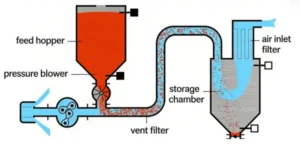
Pneumatic conveying moves dry bulk solids — powders, granules, pellets — through enclosed pipelines using compressed air or an inert gas. Compared to mechanical conveyors, it limits dust exposure, supports sanitary handling, and offers routing flexibility that adapts to a plant’s existing layout rather than forcing the plant to redesign around the equipment. That much is genuinely common across every application.
What isn’t common is which of those advantages matters most for a given material, and that’s exactly where a generic platform starts to underperform. A system built for one material’s abrasiveness, particle fragility, moisture sensitivity, or temperature tolerance isn’t automatically suited to another — which is the entire reason “custom” engineering exists as a category in the first place, and why the difference between real customization and a relabeled standard system shows up so clearly once equipment is actually running.
Chemical Processing: Where “Custom” Has to Mean Material Compatibility, Not Just Phase Selection
Chemical processing routinely combines abrasive compounds, dusty powders, corrosive elements, and toxic materials in a single application, often with strict containment requirements layered on top. Catalysts, specialty chemicals, acid powders, and silica-based substances are common examples, and each typically needs a genuinely tailored approach to avoid excessive pipeline wear and product degradation.
Real customization here means fully enclosed conveying engineered to protect both workers and the surrounding environment, dense-phase transport specifically calibrated for the material’s abrasiveness or fragility, and — critically — wetted-parts material selection verified against the actual chemistry involved, not a default stainless steel assumption applied uniformly across every chemical application. A supplier offering genuine chemical-industry engineering will test material compatibility before finalizing a spec, not after a corrosion problem shows up during a routine inspection.
Food and Beverage: Custom Design Around Contamination and Particle Integrity
Food and beverage production needs contamination control, humidity exclusion, and particle degradation prevention working together, because product integrity and food safety compliance are inseparable from conveying performance in this category. Flour, milk powder, infant formula, sugar, and coffee all require closed-system conveying that locks out ambient humidity and airborne contaminants as a baseline, not an upgrade.
Infant formula is a particularly demanding example worth understanding specifically: spray-dried particle size and shape directly affect product functionality, and rough handling during conveying can damage that structure in ways that compromise the finished product. Low-velocity, dense-phase conveying, genuinely calibrated to the specific formula’s particle characteristics rather than a general “gentle handling” setting, is what actually preserves that structure through the conveying process.
Pharmaceuticals: Precision and Isolation as Non-Negotiable Requirements
Pharmaceutical handling shares food’s cleanliness demands but adds a layer of precision that food production doesn’t typically require — dust control, accurate dosing, and minimizing human contact with the product are all critical, because contamination or dosing inconsistency in this category is a regulatory and patient-safety issue, not just a quality one.
Pneumatic conveying suits pharmaceutical ingredients, excipients, and fine powders specifically because it moves material without exposing it to contamination or direct human handling — relevant throughout tablet powder conveying, capsule formulation bulk transfer, and finished tablet handling. The isolation these systems provide isn’t just a hygiene benefit; it’s often what makes a process genuinely auditable and compliant in the first place, which means the engineering has to be verified against the specific regulatory standard involved, not assumed from general pharmaceutical industry experience.
Plastics and Polymer Manufacturing: Moisture Control and Waste Reduction
Plastics production needs pellets and resin powders moved cleanly between storage, blending, and packaging without picking up moisture or generating streamers — the fine plastic filaments that form when pellets degrade in transit and create downstream processing problems. Getting this wrong doesn’t just waste material; it can compromise finished product quality.
The design priorities here are preserving polymer quality by eliminating streamer formation and moisture absorption, reducing material waste from degraded pellets, and enabling efficient long-distance transfer within large facilities. A system genuinely engineered around dry, gentle transport — not just labeled as suitable for polymers — is what keeps pellets in the condition downstream processing actually requires.
High-Temperature and Aggressive Environment Materials
Some industrial and building material processes involve raw materials or byproducts at elevated temperatures, which introduces a distinct engineering challenge: the conveying system itself has to tolerate heat without degrading, while also protecting personnel from direct exposure to high-temperature material. Dense-phase systems built with genuinely heat-tolerant components, engineered for the specific temperature range involved, deliver material integrity, reduced degradation, and heat-resilient conveying pathways. Automation matters as much as the mechanical design in this category — a properly engineered system keeps operating personnel away from direct contact with high-temperature material entirely, rather than relying on protective procedure alone.
Abrasive Material Conveying: Wear Resistance as the Central Constraint
When a material is genuinely hard on equipment — foundry sand, mineral processing byproducts, certain building materials — wear becomes the primary design constraint rather than one consideration among several, and this is common across foundry, railroad, glass, and mineral processing operations where standard conveying equipment simply doesn’t survive long-term contact with the material.
The engineering response centers on dense-phase conveying at low velocities specifically to minimize impact energy, abrasion-resistant pipeline and bend construction, and system features purpose-built to reduce pipe wear rather than treating frequent elbow replacement as a routine maintenance cost. A supplier genuinely capable across abrasive-material applications typically offers multiple distinct configuration options, since abrasive materials vary enough in hardness and particle geometry that no single design handles all of them equally well.
A Case Worth Sharing: When “Customized” Turned Out to Mean “Relabeled”
We worked with a facility that had purchased a pneumatic conveying system marketed as custom-engineered for their specific abrasive mineral powder. On paper, the proposal referenced the material by name and included dense-phase conveying — which sounded like genuine customization. Within the first year, the plant was replacing discharge elbows roughly every four months, a wear rate well outside what a properly matched dense-phase system should have produced for that material.
Investigation showed the conveying velocity had been set from a standard template for “moderately abrasive dense-phase applications,” not calibrated against actual testing of this specific material’s hardness and particle angularity. The system was dense phase in classification, but the velocity driving impact energy at the elbows hadn’t actually been verified against the material — which meant the “customization” in the original proposal amounted to selecting the right general category of technology without doing the material-specific testing that should have followed. Once the material was properly tested and the system recalibrated to a genuinely appropriate velocity for its actual hardness, elbow life extended to well over two years on the same throughput and distance requirements. The lesson: a proposal that names your material and selects a reasonable technology category isn’t the same as a system engineered around that material’s tested properties — and the gap between the two only becomes visible after the equipment has been running long enough to wear.
What to Actually Verify Before Choosing a Supplier
Comparing suppliers who all claim custom engineering comes down to verifying specifics rather than accepting the word “custom” at face value:
- Was your material actually tested, or was the system specified from a general category your material happens to fall into?
- Is conveying velocity calibrated to your material’s measured hardness and fragility, or set from a standard template for materials “like yours”?
- Are wetted parts and containment specified against your process’s actual chemistry, temperature, and contamination requirements, or defaulted to a generic stainless steel and enclosure standard?
- Does the supplier have engineering depth in your specific industry — chemical, food, pharma, plastics, high-temperature, or abrasive-material handling — or general bulk handling experience applied uniformly across all of them?
- Can the supplier show how the proposed configuration differs from what they’d propose for a different material in the same general category? If the answer is “not much,” the customization may be more nameplate than engineering.
A supplier who can answer these specifically, ideally with test data behind the answer, is offering something meaningfully different from a standard platform with your material’s name written into the proposal.
Getting the Selection Right the First Time
Choosing a genuinely custom pneumatic conveying system supplier comes down to verifying that the word “custom” describes engineering grounded in your material’s actual tested behavior — not a standard technology category selected because it sounds appropriate for materials broadly similar to yours. The gap between those two things doesn’t show up on a proposal. It shows up in wear rates, degradation, and maintenance costs, usually well after the system is already running.
FAQ
How can I tell if a supplier’s “custom engineering” claim is genuine? Ask specifically whether your material was tested — hardness, particle size and shape, moisture content, flow behavior — before the system was specified, and whether conveying velocity and phase selection were calibrated to that testing rather than pulled from a general category template. A supplier with genuine customization will have specific test data to reference.
Can a system be classified as dense phase and still not be properly customized? Yes. Dense phase describes a general category of technology — low velocity, higher solids concentration — but the specific velocity within that category still needs to be calibrated against the material’s actual hardness and fragility. A system that’s technically dense phase but running at a generic velocity setting for “moderately abrasive materials” isn’t fully customized to your specific application.
Why does wetted-parts material selection matter so much in chemical applications? Because chemical compatibility varies significantly between materials that might otherwise seem similar, and the wrong material choice for pipe, valves, and fittings can fail gradually through corrosion — which is harder to catch before it becomes a leak than an immediate, obvious failure would be.
Does a supplier need industry-specific experience, or is general bulk handling knowledge enough? Industry-specific experience matters more than it might seem. Chemical processing, food and pharma, plastics, high-temperature applications, and abrasive-material handling each have distinct engineering priorities, and a supplier applying general bulk handling knowledge uniformly across all of them is more likely to miss a category-specific requirement than one with genuine depth in your specific application.
What’s the practical risk of choosing a relabeled standard platform instead of a genuinely custom system? The risk typically doesn’t show up immediately — it shows up as accelerated wear, particle degradation, or contamination issues that develop over months, after the system has already been running in production and the cost of correcting the design has grown well beyond what it would have been at the specification stage.
WIJAY Systems engineers pneumatic conveying systems around your material’s actual tested properties — hardness, fragility, moisture sensitivity, and temperature tolerance verified before specification, not assumed from a general category — across chemical, food, pharmaceutical, plastics, and other bulk material industries. If you’re evaluating suppliers for a new system, or trying to understand why a “customized” system isn’t performing the way it should, our process engineering team is glad to talk it through.