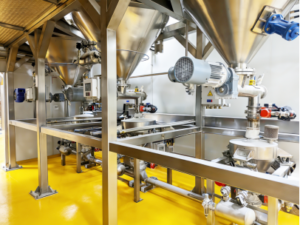
Add enough extruders to a wire and cable or compounding floor, and you eventually cross a threshold nobody marks on a calendar — the point where independent single-unit feeders stop being merely inefficient and start actively working against each other. Machines near the material source pull more than their share, running material through faster than intended. Machines at the far end of the shop starve intermittently, tripping into low-material stops at exactly the wrong moment in a run. Wall thickness drifts, surface defects show up in spec checks, and a batch that should have been clean gets flagged for rework.
The instinct is usually to treat this as a machine problem — check the extruder screw, check the feeder motor, check the hopper sensor. But the pattern across most multi-machine feeding failures isn’t insufficient power at any single unit. It’s that the material supply was never engineered as one coordinated system in the first place — every extruder is drawing air pressure from a network that has no way to schedule, balance, or prioritize competing demand.
This guide breaks down why independent single-unit feeding collapses once machine count and line speed scale up, and what a central feeding system actually needs to include to fix it at the root — not just add capacity, but coordinate it.
Background: Why Independent Single-Unit Feeding Breaks Down at Scale
The Five Recurring Problems on Multi-Extruder Floors
Plastics compounding, wire and cable, and other extrusion-heavy operations running dozens of parallel machines off independent feeders consistently run into the same five compounding issues.
- Simultaneous demand causes chaotic supply and chronic starvation. When multiple extruders request material at the same time, multiple blowers compete for the same air supply network, and line pressure swings sharply. Machines closer to the source get oversupplied and run material too fast; machines farther away lose pressure, receive intermittent supply, and stop repeatedly for material shortage — directly driving line stoppages and defective output.
- Equipment clutter drives up floor management difficulty. Each machine with its own feeder, hopper, piping, and control switch means a large equipment count and crossing pipe runs scattered across the floor. Beyond reducing housekeeping standards, this multiplies the labor required for inspection, maintenance, and fault diagnosis.
- Manual feeding at every machine is labor-heavy and dust-generating. Operators loading, changing, and cleaning hoppers machine by machine represents significant repetitive labor cost, and open, per-machine feeding creates multiple scattered dust points across the floor.
- Changeover is slow and prone to cross-contamination. Independent equipment at each machine means changeover requires stopping each unit individually, cleaning each hopper and line, and reloading — a slow process where incomplete manual cleaning commonly leaves residue that contaminates the next material run.
- No unified monitoring means slow fault response. Independently operating, independently controlled units have no shared monitoring platform, so equipment faults or supply anomalies aren’t caught until someone manually inspects each machine — extending downtime well beyond what faster detection would allow.
The unifying diagnosis across all five: the core problem in multi-machine feeding isn’t insufficient motive power at any one machine — it’s the absence of coordinated scheduling, balanced flow distribution, and pressure management across the network as a whole.
Core Technical Explanation: What a Central Feeding System Needs to Fix This at the Root
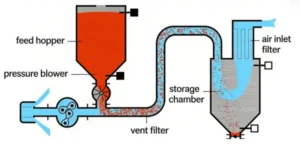
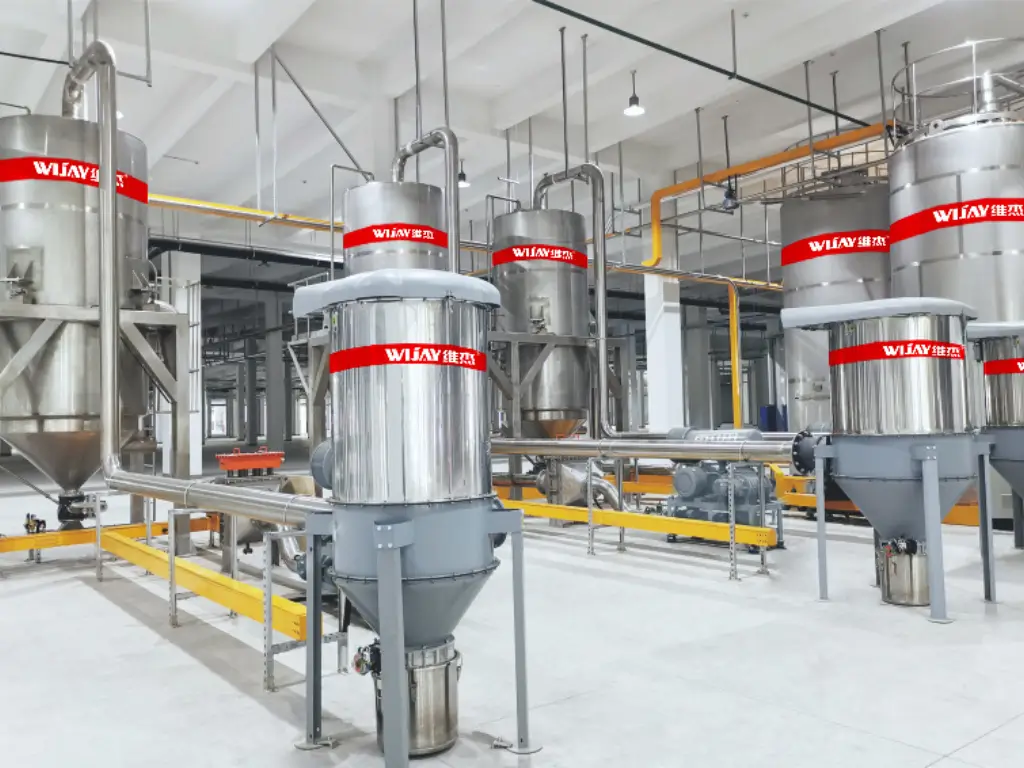
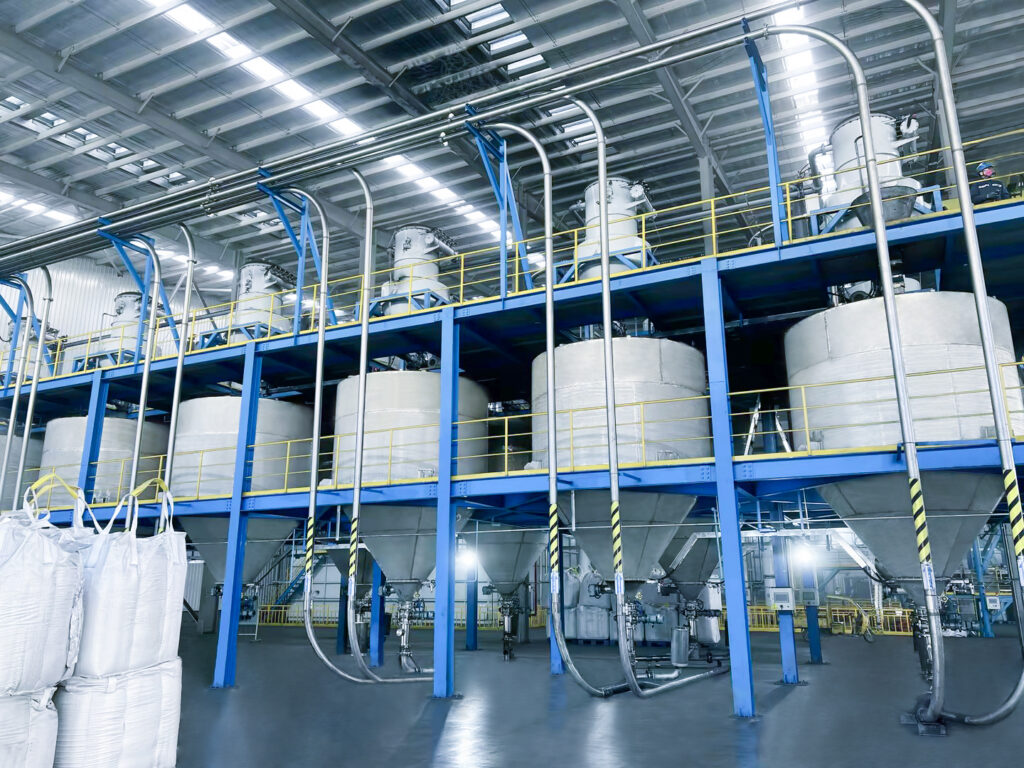
A central feeding system engineered for multi-extruder operation eliminates scattered single-unit equipment and replaces it with centralized material processing, unified network distribution, and system-wide coordinated control.
Single-Unit Feeding vs. Central Feeding: Side-by-Side
| Factor | Independent Single-Unit Feeding | Central Feeding System |
|---|---|---|
| Material supply logic | Each machine competes independently for air/material | Requests are queued, staggered, and balanced across the network |
| Pressure stability | Fluctuates sharply with simultaneous demand | Managed through distribution valving and scheduling |
| Equipment footprint | One feeder/hopper/line per machine, scattered across the floor | Centralized processing feeding a shared, engineered network |
| Changeover process | Stop and clean each machine individually | Switch material at the source; system purges automatically |
| Fault detection | Manual, machine-by-machine inspection | Per-branch monitoring with automated alerts |
| Housekeeping/dust | Multiple scattered dust points | Centralized, enclosed handling |
1. Centralized Raw Material Processing
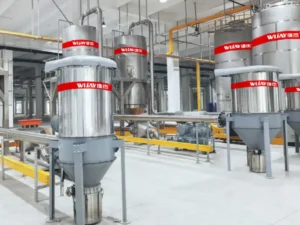
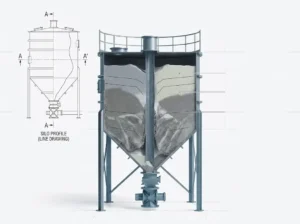
Consolidating unpacking, enclosed feeding, screening, and moisture removal into one centralized processing and storage area — rather than a separate feeding station beside every machine — eliminates the scattered dust points and repetitive manual handling that come with per-machine feeding, while keeping the floor around each extruder clear and organized.
2. Intelligent Multi-Way Distribution with Scheduling Logic
This is the core fix for material contention. A distribution system built with dedicated intelligent valve banks and a scheduling algorithm receives every machine’s material request centrally, then sequences, staggers, and time-shares supply across the network automatically — rather than letting every machine draw simultaneously and let physics sort out who gets shorted. This is what actually eliminates the near-machine oversupply / far-machine starvation pattern, rather than just adding more blower capacity to a system with no coordination logic.
3. Pressure-Drop Simulation for Long, Multi-Branch Networks
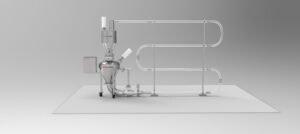
For networks with multiple branches, long runs, and numerous elbows, pressure-drop simulation calculated before installation — sizing main lines, branch lines, and end-run piping with graduated diameters, and optimizing routing and bend count — is what keeps the farthest machines adequately supplied. Skipping this step and sizing pipe diameters uniformly across a long, branched network is a common and avoidable cause of chronic under-supply at the far end of the line.
4. Independent Branch Monitoring for Fault Isolation
Each machine’s supply branch gets its own pressure and flow monitoring point. When one branch develops a blockage, shortage, or anomaly, the system flags that specific branch — allowing targeted troubleshooting on the affected line without interrupting the other machines still running normally. This is what turns a single-machine fault into a localized, quickly diagnosed issue instead of an unplanned inspection of the entire floor.
5. Centralized Automated Purging for Fast Changeover
Rather than stopping and manually cleaning every machine during a material changeover, material switching happens at the source, and the system triggers an automated purge — either system-wide or on the specific branch being changed — clearing residual material from the piping. This is what turns changeover from a slow, contamination-prone process into a fast, repeatable one.
6. Full-System Central Control with Visualization
A unified control platform displaying real-time feed status, flow rate, air pressure, and equipment condition across every machine — with tiered automatic fault alerts pushed to the right personnel — replaces the machine-by-machine manual inspection routine with remote visibility and faster response.
Practical Field Troubleshooting & Decision-Making Guidance
Is Your Multi-Machine Feeding Problem Fixable, or Does It Need Central Feeding?
| Symptom | Operating Fix | Sign You Need a Central Feeding System |
|---|---|---|
| One machine occasionally short on material | Adjust manual scheduling/priority | Multiple machines experience this regardless of manual coordination effort |
| Output quality (wall thickness, surface finish) drifts intermittently | Check individual extruder calibration first | Drift correlates with which machines are running simultaneously, pointing to network-level pressure imbalance |
| Changeover takes longer than planned occasionally | Improve changeover SOPs/training | Changeover is consistently slow across all machines because each requires individual manual cleaning |
| A specific machine has frequent unexplained stops | Inspect that machine’s feeder/sensor first | The same pattern recurs across multiple machines when running simultaneously — a network-level, not a single-unit, issue |
| Difficulty identifying which machine caused a supply issue | Manually check each machine in sequence | Fault identification is consistently slow because there’s no per-branch monitoring |
How Many Machines Before Central Feeding Makes Sense?
There’s no fixed machine count that triggers the decision — it depends more on how often machines run simultaneously, how far apart they’re spaced, and how tight your output tolerance is. A useful signal: if manually staggering machine startup or coordinating between operators has become a routine practice to avoid material contention, that’s evidence the plant has already outgrown independent single-unit feeding and is compensating for it manually.
Key Design & Operation Best Practices
- Diagnose at the network level before replacing individual equipment — a starved machine at the far end of the shop is often a symptom of unmanaged network pressure, not a failing feeder.
- Size piping with pressure-drop simulation, not uniform diameters — a graduated main-to-branch-to-end-run design is what keeps distant machines adequately supplied on long, multi-branch networks.
- Build in per-branch monitoring from the start — this is what turns a fault into a localized, fast diagnosis instead of a full-floor manual inspection.
- Design purge capability into the distribution system, not as an afterthought — retrofitting contamination control after a cross-batch quality issue costs more than specifying it upfront.
- Treat scheduling logic as core to the system, not optional — the distribution valve hardware only solves contention if paired with software that actually sequences competing demand.
- Validate the design against your actual machine count and simultaneous-use pattern — a system sized for average demand rather than realistic peak simultaneous draw reintroduces the same contention problem it was meant to solve.
Common Mistakes & Pitfalls to Avoid
- Assuming a starving machine needs a bigger feeder rather than network-level coordination. Adding capacity at one point without addressing distribution logic often just shifts the imbalance elsewhere in the network.
- Sizing pipe diameter uniformly across a long, multi-branch network. This is a common and avoidable cause of chronic under-supply at the machines farthest from the source.
- Underestimating how much manual changeover across many machines actually costs. The cumulative labor and cross-contamination risk from machine-by-machine cleaning is easy to underestimate until it’s tracked against a centralized-purge alternative.
- Deploying more blower capacity without adding scheduling logic. More air pressure doesn’t fix contention if every machine can still draw simultaneously with no coordination.
- Skipping per-branch monitoring to save on initial cost. This is what turns single-machine fault diagnosis from a quick, targeted check into a manual inspection of the entire floor.
- Treating central feeding as a hardware swap rather than a systems-engineering project. Distribution logic, pressure-drop simulation, and monitoring all need to be designed together against your actual machine layout and demand pattern — not assembled from generic components.
FAQ
What causes material starvation at extruders far from the feed source?
Starvation at distant machines is most commonly caused by unmanaged network pressure loss combined with near-machine oversupply when multiple units draw simultaneously — a pattern that pipe sizing alone doesn’t fix without distribution scheduling and pressure-drop-informed design.
Can a central feeding system be added to an existing multi-extruder line without replacing all the extruders?
Yes — a central feeding system replaces the material supply infrastructure (feeders, hoppers, distribution piping, and control), not the extruders themselves, though the specific retrofit scope depends on the existing plant layout and available shutdown windows.
How does a central feeding system prevent cross-contamination during material changeover?
Changeover happens at the centralized material source rather than at each machine, and an automated purge cycle — system-wide or on the specific branch being changed — clears residual material from the piping, replacing the incomplete manual cleaning that commonly causes cross-batch contamination.
Is a central feeding system worth it for a plant with only a handful of extruders?
It depends more on simultaneous-use frequency and output tolerance than raw machine count — a small number of machines running on tight tolerances with frequent simultaneous draw can benefit as much as a larger fleet running looser tolerances.
How is a fault isolated to a specific machine in a central feeding system?
Independent pressure and flow monitoring on each machine’s supply branch flags the specific branch showing an anomaly, allowing troubleshooting on that line without interrupting the other machines still operating normally.
Ready to Evaluate a Central Feeding System for Your Extrusion Lines?
Every multi-machine floor has a different combination of machine count, spacing, simultaneous-use pattern, and output tolerance — the right distribution design depends on all four. Share your material types, machine count, facility layout, and site distance so an engineering team can run a pressure-drop simulation and propose a distribution and scheduling design specific to your line before equipment is specified.