A production supervisor pulls two bags of the same finished product off the line — same SKU, same day, two hours apart. The sweetness is off between them. Nobody flagged a formula change. Nobody changed suppliers. What changed is that two different operators weighed the sugar and starch by hand, on two different shifts, with two different levels of fatigue and technique.
That’s not a training failure. It’s what happens when product consistency depends on a person eyeballing a scale instead of a system executing a fixed recipe. And it’s one of at least four costs that open, manual batching quietly generates on every shift — costs that rarely get isolated on a P&L line, but compound fast across a full production run.
If you’re running sugar, powdered sugar, cake flour, or starch through manual weigh-and-dump batching, you already know the symptoms: dust hanging in the air around the mixer, bags of raw material that never quite empty all the way, a headcount that has to grow every time you add a shift, and finished-product QC pulling more borderline batches than it should. The pressure to fix this isn’t coming from one bad audit — it’s coming from margin erosion that’s already happening, batch after batch.
Where Manual Batching Actually Bleeds Money
Most bakery and confectionery plants are still running batching processes built around manual bag-dumping, open hoppers, and scale readings taken by hand. Three failure patterns drive the bulk of the hidden cost.
1. Open transfer means material loss on every cycle
Every time sugar, powdered sugar, or starch is manually dumped from a bag into an open hopper, a measurable fraction never makes it into the mix — it settles as dust, sticks to equipment surfaces, or spills at the transfer point. On high-value powders like powdered sugar or specialty starches, that per-cycle loss adds up to a real material cost line over a production year, not a rounding error.
2. Manual weighing produces batch-to-batch variance
Scale readings taken and adjusted by hand carry operator-dependent variance that shows up downstream as inconsistent sweetness, texture, or moisture pickup — the kind of variation that triggers finished-product rework or, worse, reaches a customer complaint. Formula consistency isn’t a quality nice-to-have in bakery and confectionery production; it’s the product spec customers are paying for.
3. Airborne dust drives downtime and labor costs that never get billed to “batching”
Fine powders — sugar, flour, starch — generate airborne dust wherever transfer is open to the room. That dust settles on equipment, requires manual cleanup between shifts, and in facilities without dedicated dust extraction, becomes a recurring housekeeping and equipment-maintenance cost. It also drives the staffing math in the wrong direction: manual unloading, weighing, and transfer typically require full-time attention at every stage — bulk bag unloading, staging, weighing, batching, packing — meaning headcount scales roughly linearly with volume instead of leveling off as throughput grows.
These three failure modes compound on each other. A line running open transfer, manual weighing, and no dust containment isn’t absorbing one cost — it’s carrying material loss, quality variance, and labor overhead simultaneously, on every batch, every shift, indefinitely.
What a Fully Enclosed Pneumatic Batching System Actually Changes
The fix isn’t tighter shift discipline or more frequent scale calibration. It’s removing the points in the process where powder is exposed to open air and where a scale reading depends on a person. That’s the specific engineering problem a fully integrated pneumatic batching system is built to solve.
Enclosed pneumatic transfer eliminates spillage and airborne dust
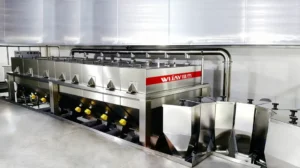
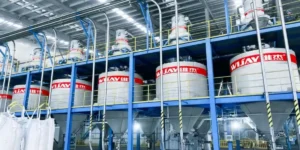
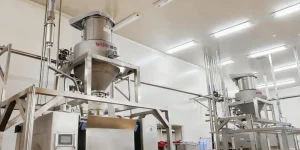
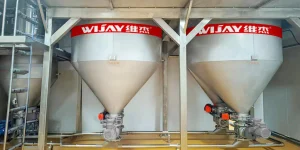
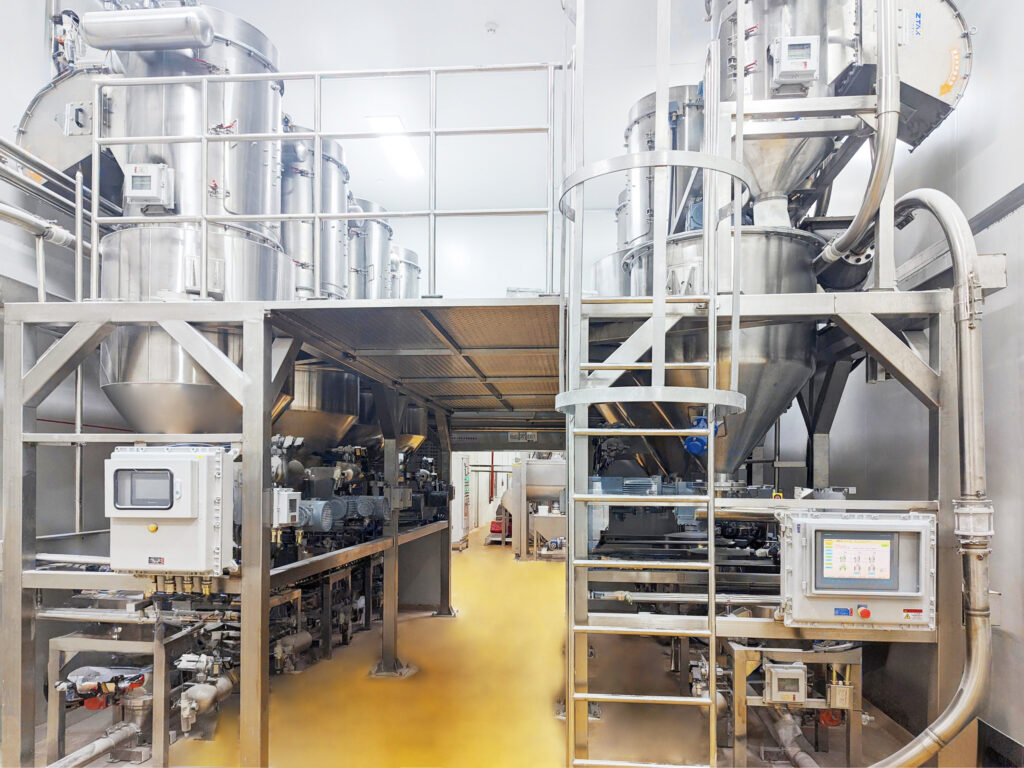
A positive-pressure, negative-pressure, or dense-phase pneumatic design moves sugar, flour, and starch through a sealed pipeline from a bulk bag or silo straight to the batching point — no open hopper, no manual dumping, no drop point where material escapes into the air. Paired with food-grade dust extraction integrated at the source, this addresses airborne powder before it becomes a housekeeping problem instead of cleaning it up after the fact. Full-line CIP (Clean-In-Place) capability removes sanitation dead zones and supports the clean-production standard that bakery and confectionery operations are held to. For sugar processing specifically, integrated grinding and drying units let sugar feeding, milling, and pneumatic transfer run as one continuous process rather than three separate manual handoffs — relevant for any high-value powder line where material handling steps multiply loss.
End-to-end automation compresses headcount without compressing output
A fully automated line — bulk bag unloading, buffer storage, automatic weighing, precision batching, and finished-product packing — removes manual material handling and manual weighing from the process entirely. In practice, that typically drops staffing to one to two operators per line for monitoring rather than manual execution, translating to roughly a 20% reduction in labor cost alongside a comparable gain in throughput efficiency. That matters most at the point most plants hit next: scaling capacity. Adding volume on an automated line means running the existing system harder, not hiring and training a new shift of manual operators — and equipment with a low fault rate and straightforward maintenance keeps that scaling path from adding a new maintenance burden of its own.
Precision metering closes the consistency gap manual weighing can’t
A purpose-built weighing and metering module holds dosing accuracy to within roughly 2%, with the system storing multiple standardized recipes and executing multi-material ratios automatically. That eliminates the operator-dependent variance that manual weighing introduces by design — every batch runs to the same formula, with the same accuracy, regardless of shift or operator. The practical result is fewer borderline batches reaching QC, less flavor and texture drift across a production run, and lower raw material waste from over-dosing as a buffer against measurement error. Paired with an industrial HMI control platform, the system supports production data traceability, automatic fault alarming, and one-touch recipe switching — keeping the operating learning curve low while giving plant management the digital record modern food safety compliance increasingly requires.
Multi-material compatibility built for real plant layouts
Sugar, powdered sugar, snowflake flour, starch, milk powder, and a range of food additives and granular ingredients all move through the same platform, configured to a plant’s actual throughput, floor layout, and conveying distance — not sold as a fixed, one-size package. That flexibility supports both a targeted retrofit on an existing line and a full greenfield plant design. Proven installations in the field run 20–30 t/h processing capacity, with horizontal conveying runs exceeding 300 meters and vertical lift up to 150 meters, feeding multiple stations simultaneously to support parallel production lines.
What This Looks Like on Your Line
For a plant currently running manual weigh-and-dump batching, the practical shift is direct: sugar, flour, and starch move from open, human-handled transfer to sealed pneumatic pipeline transfer with programmed dosing. Weighing shifts from a hand-read scale to a metering module holding sub-2% accuracy across every batch. Staffing shifts from a headcount that scales with volume to one to two operators monitoring an automated line. And the finished-product consistency question — is this batch the same as the last one — stops being something QC has to check for and becomes something the system was built to guarantee.
About WIJAY Systems
WIJAY has spent 16 years engineering pneumatic conveying and powder automation systems for bulk material handling, with direct field experience across the specific handling challenges that show up in bakery, confectionery, and snack food production. Backed by more than 100 independent patents and a substantial track record of completed installations at leading food enterprises, WIJAY designs each system around the customer’s specific material profile — sugar, powdered sugar, starch, or specialty additives — rather than deploying a generic conveying package and asking the plant to adapt to it.
FAQ
What makes a batching system suitable for bakery and confectionery powders specifically? It needs fully enclosed pneumatic transfer to eliminate dust and spillage, precision metering to hold dosing accuracy tight enough to prevent batch-to-batch flavor or texture drift, food-grade CIP-compatible construction, and the flexibility to handle multiple powder types — sugar, flour, starch, milk powder — through configurable recipes rather than dedicated hardware per material.
How much labor cost does automated batching actually save versus manual weighing? Field installations typically bring staffing down to one to two operators per line for system monitoring rather than manual material handling, translating to roughly a 20% labor cost reduction alongside a comparable throughput gain — though the exact figure depends on current staffing levels and line configuration.
Can one system handle sugar processing along with general powder batching? Yes, when the system is engineered for it. WIJAY’s platform can integrate dedicated grinding and drying units for sugar feeding, milling, and pneumatic transfer as a single continuous process, alongside standard batching for flour, starch, and other powders.
What conveying distances and throughput can a pneumatic batching system realistically handle? Proven WIJAY installations run at 20–30 t/h processing capacity, with horizontal conveying exceeding 300 meters and vertical lift up to 150 meters, supporting multiple simultaneous feed points for parallel production lines.