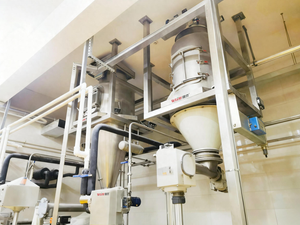
If you run a dry powder line, you already know the failure points by heart. A batch comes in slightly over-weight and QA flags it. A feeder clogs on a humid morning and the shift loses forty minutes resetting it. Dust escapes a poorly sealed transition point and now you’re filing an incident report instead of hitting your packaging target. None of this shows up in an equipment spec sheet, but it shows up on your monthly downtime log — and it’s usually traceable back to how the powder was metered, not how it was mixed or packaged.
A rotary valve built for metering, rather than simple rotary airlock duty, is one of the few components engineered specifically to close that gap. This article looks at how rotary valve metering actually works, why generic feeders fall short on fine powders and granules, and where the technology earns its keep on real production floors.
The Real Cost of Inconsistent Powder Metering
Before getting into mechanism design, it’s worth naming the problem in numbers plant managers actually track:
- Batch rework and scrap. Even a 1–2% overfill on a high-volume pharmaceutical or food-additive line compounds into meaningful raw material loss over a production year.
- Unplanned downtime. Clogged single-stage feeders and bridging in hoppers are among the most common causes of unscheduled stops on powder lines — often 20–45 minutes per incident once cleanout and restart are counted.
- Manual correction variance. Operators compensating for drifting feed rates introduce their own inconsistency, which is exactly what automated metering is supposed to eliminate.
- Compliance exposure. In pharmaceutical manufacturing, dosing outside tolerance isn’t just a yield problem — it’s a deviation report, and repeated deviations draw regulatory attention.
These aren’t hypothetical. They’re the recurring line items behind “we need better metering” requests from plant engineers, and they’re the reason rotary valve metering exists as a distinct equipment category rather than a variant of a standard airlock.
What Is a Rotary Valve Metering System?
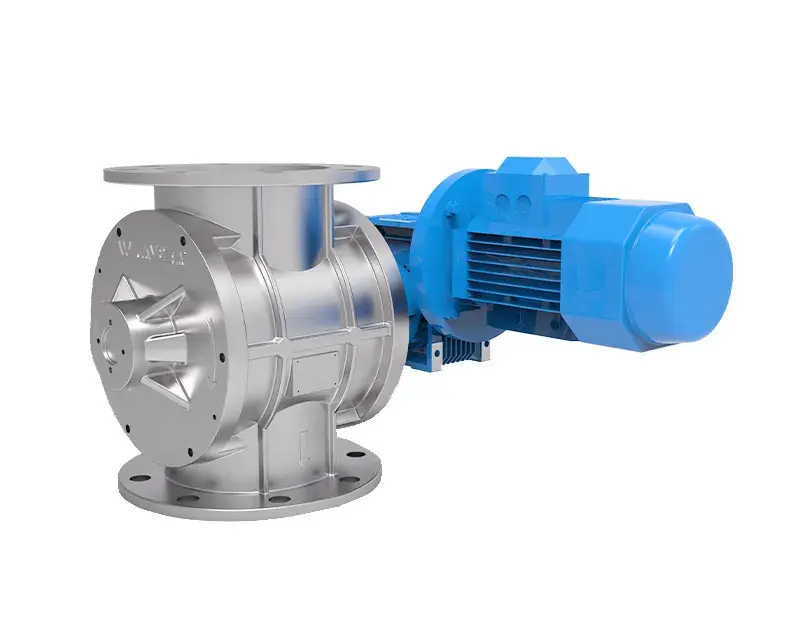
A rotary valve metering unit uses two concentric, independently driven mechanisms rather than a single rotor:
The rotor stage handles bulk material delivery — it keeps material moving into the system at a controlled, continuous rate, similar to a conventional rotary airlock valve.
The screw feeder stage (sometimes called an auger) sits inside or downstream of the rotor and handles the final, fine-tuned dose. This is where the real precision lives: because the screw feeder is decoupled from the bulk-flow stage, it can meter down to fractions of a gram without being disturbed by upstream flow variation.
The combination matters more than either stage alone. A rotor without a fine-metering stage can move volume but can’t hit tight tolerances. A screw feeder without a rotor stage struggles with consistent bulk supply, especially with poorly flowing or cohesive powders. Pairing them gives you coarse-to-fine control in a single, sealed unit — which is the actual engineering answer to “how do we stop overfilling and underfilling in the same shift.”
Why Standard Feeders Fall Short on Fine Powders and Granules
Most single-stage metering approaches were designed around free-flowing, moderate-density material. They start to lose accuracy exactly where dry powder handling gets difficult:
- Cohesive or hygroscopic powders (common with certain APIs, excipients, and food additives) bridge and rat-hole in simple feeders, causing surging rather than steady flow.
- Fine particulates generate dust at open transfer points, creating both a housekeeping problem and, in pharma and food environments, a contamination risk.
- Batch-to-batch variation in bulk density isn’t compensated for by a single fixed-speed rotor — you either overfill dense lots or underfill light ones.
A rotary valve metering system addresses this directly: the rotor absorbs bulk density variation and delivers consistent volume to the screw stage, while the screw feeder — engineered per material — handles the fine correction that fixed-speed rotors can’t.
Engineering Advantages Worth Specifying For
Precision at the gram-fraction level. The dual-mechanism design means dosing accuracy isn’t dependent on operator adjustment or on the bulk material staying perfectly consistent lot to lot.
Screw geometry customization. Pitch, diameter, and flight design can be engineered around a specific material’s cohesion, particle size, and flow index — rather than forcing the material to behave like the generic powder the equipment was designed for.
Reduced changeover and downtime. Faster, more predictable product transitions mean less time lost between SKUs on multi-product lines — a direct line-throughput gain, not just a quality improvement.
Sealed, low-dust operation. Because the rotor and screw stages operate within an enclosed housing rather than an open drop, dust generation and product loss at the transfer point are minimized — relevant both for operator safety and for GMP/food-grade housekeeping requirements.
Where It’s Actually Used
Pharmaceutical manufacturing. Active pharmaceutical ingredients and excipients often carry tight tolerance requirements tied directly to product efficacy and patient safety. A rotary valve metering system handles fine powder dosing with minimal product loss and no open-air contamination risk — which is why it shows up in tablet, capsule, and powder-fill lines where deviation reports are the metric everyone is trying to avoid.
Food processing. Seasoning blends, powdered beverage mixes, and dry additives like milk powder need consistent per-package dosing to hold flavor profile and meet declared net-weight claims. A packaging line filling powdered soup sachets, for example, can dose dry vegetables, spices, and salt into each pouch within tight tolerance — cutting manual adjustment time while keeping every pouch on-spec.
What This Means for a New or Retrofitted Line
If your current pain points are batch drift, dust at transfer points, or feeder clogging on cohesive material, the fix usually isn’t a faster feeder — it’s a metering stage engineered in two parts instead of one. That’s the core design logic behind rotary valve metering, and it’s worth specifying explicitly rather than assuming a standard rotary airlock will do the job.
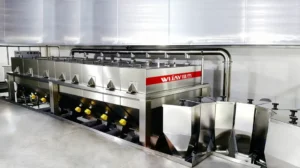
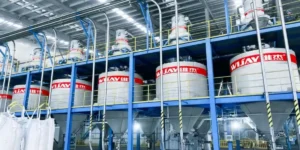
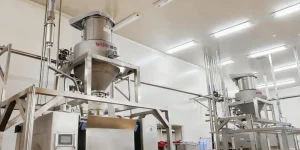
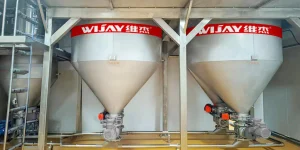
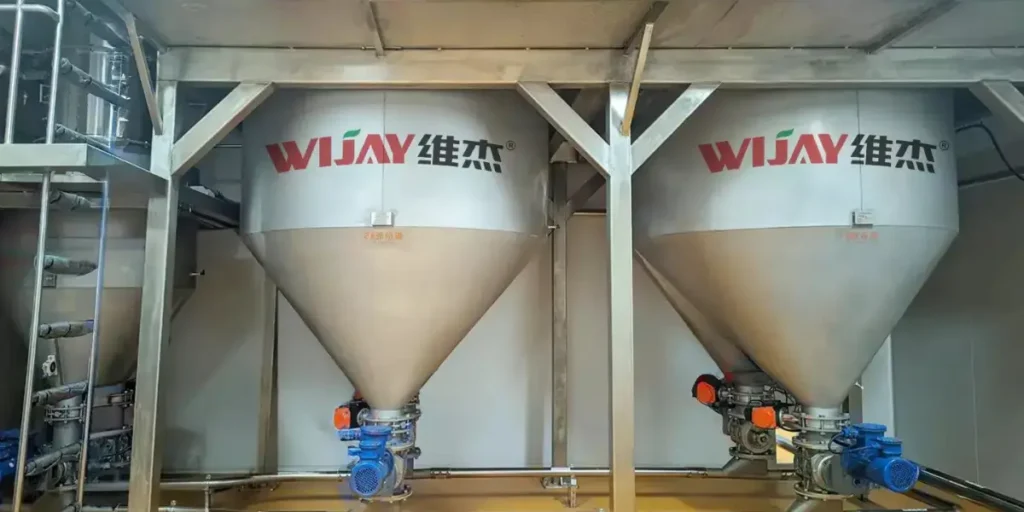
WIJAY Systems designs rotary valve metering as part of fully integrated, enclosed pneumatic conveying and powder handling lines — built for dust-free transfer, low product loss, and multi-industry adaptability across pharmaceutical, food, and chemical processing environments. If you’re evaluating a metering upgrade or a full line redesign, our engineering team can review your material characteristics and current downtime data to spec the right configuration.
FAQ
What’s the difference between a rotary valve and a rotary metering valve? A standard rotary valve (rotary airlock) is designed primarily to move bulk material between pressure zones or transfer points. A rotary metering valve adds a second, independently controlled screw-feeder stage specifically to deliver precise, small-quantity dosing — not just bulk transfer.
What accuracy can a rotary valve metering system achieve? Depending on material characteristics and screw feeder design, dosing accuracy down to fractions of a gram is achievable, which is why the technology is common in pharmaceutical and food-grade dosing applications.
Can the screw feeder be customized for difficult materials? Yes. Screw pitch, diameter, and flight geometry can be engineered around cohesive, hygroscopic, or fine-particulate materials to prevent bridging and maintain consistent dosing.
Does rotary valve metering reduce dust exposure? Yes. Because bulk and fine-dose stages operate within an enclosed housing, open-air transfer points — the primary source of dust generation — are eliminated or significantly reduced.
Is rotary valve metering suitable for both pharmaceutical and food applications? Yes. The same dual-mechanism principle applies across industries; the screw feeder and material-contact components are typically customized per application to meet the relevant hygiene and compliance standards.