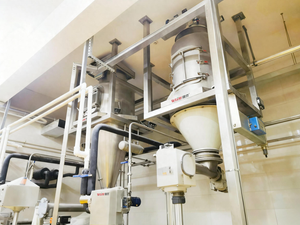
Receiving raw material is the first operation in any food powder production run, and it’s also the one most plants still haven’t automated. If that intake step is inconsistent, dusty, or contamination-prone, everything downstream — blending, dosing, packing — inherits the problem. For most food manufacturers, the processing of food powder ingredients still begins the same way it did twenty years ago: a 25 kg kraft-paper or multi-wall bag, a hand knife, and an operator standing over an open dump station.
That’s the gap this article addresses — not the theory of bulk handling, but what actually breaks down on the receiving floor, and what a properly engineered line does differently.
Why 25 kg Bags Still Dominate Food Powder Receiving
Not every ingredient supplier offers bulk truck, rail car, or FIBC (super sack) delivery. For a large share of dry ingredients — starches, proteins, flavor powders, mineral blends — the 25 kg bag remains the standard unit of shipment. That means someone has to depalletize, carry, open, dump, and dispose of empty bags, bag after bag, shift after shift.
This is where the labor problem compounds. Recruiting for physically demanding, repetitive manual-handling roles has gotten harder across food manufacturing, and retention is worse — turnover on bag-dumping stations is consistently higher than on cleaner, less repetitive lines. Plants that depend entirely on manual bag processing are, in effect, staking throughput on a labor pool that’s shrinking.
The Real Cost of Manual Powder Ingredient Handling
Beyond labor availability, manual bag opening creates three recurring cost centers:
- Contamination exposure. Every point of direct operator contact with an open bag is a potential contamination vector — hands, knives, clothing fiber, ambient dust. Food safety teams treat manual dump stations as a standing risk, not an occasional one.
- Product loss. Hand-cut bags routinely leave residual powder trapped in folds and seams. Multiply that loss per bag across a full production year and it’s a measurable yield hit.
- Capacity ceiling. A manual station can only move as fast as its operators, and fatigue slows cut-and-dump cycle times over a shift.
Where Off-the-Shelf Automated Bag Openers Fall Short
Automated bag-opening equipment exists, but a lot of it wasn’t designed for food-grade duty. The two failure points we see most often on plant audits:
Cutting mechanism damage. If the blade shreds through the paper or polyethylene layer instead of cleanly slicing it, fragments end up in the product stream — a direct food safety and foreign-material risk, not a cosmetic issue.
Poor cleanability. Machines built around chains, roller conveyors, or tumbling drums accumulate residual powder in hard-to-reach geometry. Every crevice that traps powder is a microbial risk if it isn’t cleaned to spec on every changeover.
Dust emission. When air filtration on the dump station isn’t sized correctly, cutting releases a visible dust cloud into the room — an operator exposure issue and, depending on the powder’s dust explosibility index, a genuine explosion hazard. Fully enclosing the machine to control dust also makes it harder to access for cleaning, so plants end up trading one risk for another unless the enclosure is designed with cleaning access built in from the start.
A Modular Path: Semi-Automatic Bag-Tilt-and-Cut Stations
Not every plant is ready for a full robotic line, and not every SKU volume justifies one. A modular approach lets a plant automate the highest-risk step first — the cut — without re-engineering the whole receiving area.
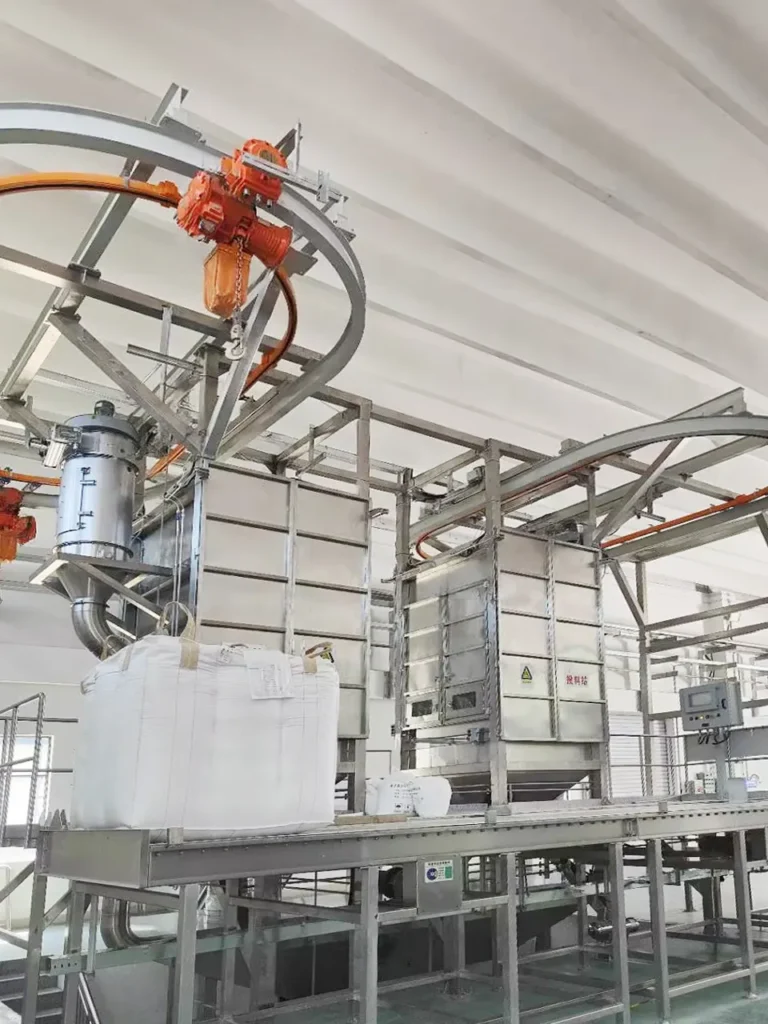
A well-designed semi-automatic station tilts the bag into position and cuts it with a multi-blade, non-serrated cutting head engineered specifically to produce a clean shear through the paper layer, minimizing shredded fragments and residual powder trapped in the bag. The operator no longer manually carries the bag to a dump hopper or cuts it by hand — they load it, and the station does the rest. That single change removes direct hand-to-bag contact from the process, which is the contamination control food safety auditors actually want to see.
Full-Line Automation: Vision-Guided Robotic Depalletizing
For higher-volume operations, robotic depalletizing extends automation upstream of the cut station. Vision-guided robotic arms read the bag pattern on each pallet layer — even when the layer pattern changes from row to row — and pick bags accurately without a fixed, hard-coded pick sequence.
Taken further, a recipe-driven pallet management system lets a forklift operator stage pallets of different raw materials at the infeed. The system scans and sequences pallets automatically, and the robot pulls the exact bag count each formulation requires — no manual tallying, no operator walking bag counts against a batch sheet. Once a pallet is empty, it exits automatically and the next one indexes into place. A second robot station can then shake out each cut bag to recover trapped residual powder before the empty bag goes to compaction, recovering yield that a manual line would simply lose.
At that point, the only manual labor left in the receiving line is a forklift operator staging pallets and a line supervisor — a meaningful reduction from a full manual crew.
Hygienic Multi-Layer Cutting: What Changes for High-Sensitivity Products
Industry practice generally allows cutting up to four bag layers together — kraft paper plus polyethylene — in a single pass. But for categories with stricter contamination controls, like infant formula, that shortcut isn’t acceptable: kraft paper simply cannot enter a high-hygiene dump room, because paper dust and fiber are treated as a contamination source in their own right.
Historically, that meant a manual step — stripping the kraft layer by hand before the bag ever reaches the dump station. It’s exactly the kind of task that drives injury claims: repetitive, physically demanding, and hard to standardize operator to operator.
The alternative is an automated kraft-removal stage that strips the outer paper layer without piercing the inner polyethylene bag, so outer dust and packaging waste are handled before the bag ever enters the clean zone — without sacrificing throughput. In practice, this typically removes two to three kraft layers automatically. The PE-wrapped bag then moves into the high-hygiene room for tilt-and-cut, while the stripped kraft layers are pneumatically conveyed to a bag compactor located in a lower-hygiene zone, keeping paper fiber and its contamination risk fully out of the clean side of the line.
Handling Non-Standard Bags Without Stopping the Line
No automated system handles every bag geometry. Oversized, overlength, or underweight bags can fall outside a robot’s or cutter’s designed tolerance. The right engineering answer isn’t to force every SKU through automation — it’s to build a fallback into the same station: an operator can still access the dump point to manually cut and dump a non-conforming bag, with safety light curtains covering the front of the unit instead of physical fencing. Because there’s no fixed guarding around the robot cell, the line can flex between automated and manual operation on the same shift without a changeover or downtime.
UV and Enhanced Dust Control for Ultra-High Hygiene Applications
For the most sensitive applications, additional sanitation stages are available before the bag is even opened: UV tunnels to sanitize the outer bag surface, and automated air-cleaning systems that remove surface dust from the top, sides, and outer layer of the bag prior to cutting — reducing the bioburden entering the clean room, not just the visible dust.
Choosing the Right Equipment for Your Product Mix
Food manufacturers rarely process a single bag format. Ingredient packaging varies in size, layer construction, and material across suppliers, and that variability is exactly what makes receiving-line design difficult to standardize — but it’s also where a properly engineered, modular system pays off, because it’s built to flex across formats rather than lock a plant into one.
At WIJAY Systems, this is the problem we specialize in: integrated pneumatic conveying, dust-tight bulk material handling, and automated powder ingredient processing lines engineered specifically for food-grade hygiene, low product loss, and multi-industry adaptability. We design receiving lines around the actual bag formats and contamination controls a plant runs today — not a generic spec sheet.
If your current receiving line is still bottlenecked by manual bag handling, talk to WIJAY’s process engineering team about a modular upgrade path, starting wherever your operation is today.
FAQ
What is the biggest hygiene risk in processing food powder ingredients on a receiving line? Direct operator contact with an open bag — hands, tools, and ambient dust — is the most consistent contamination vector, followed by residual powder trapped in poorly cleanable equipment geometry.
Can automated bag-opening systems handle non-standard bag sizes? Yes, when the line is designed with a manual fallback station. Oversized or underweight bags outside the automated system’s tolerance can still be cut and dumped manually at the same station without stopping the line.
How many bag layers can be cut together safely? Industry practice generally allows up to four layers (kraft paper plus polyethylene) in a single cut for standard applications. High-hygiene categories like infant formula require the kraft layer removed automatically before the bag enters the clean dump room.
What’s the difference between semi-automatic and fully robotic bag dumping? A semi-automatic station automates the cut itself, removing hand-to-bag contact, while robotic depalletizing automates bag handling from the pallet forward — including vision-guided picking and recipe-based sequencing — reducing manual labor to pallet staging and supervision.