A pneumatic conveying line that runs clean on day one and plugs on day ninety is not a maintenance problem. It is a material-property mismatch that was never caught at the design stage. In plant after plant, the same pattern repeats: a system is sized on throughput and pressure drop, the blower is selected with margin, and commissioning goes smoothly — until the powder changes, the ambient humidity shifts, or the line reaches a bend that has been quietly eroding since startup. The operators blame the air supply. The air supply is rarely the culprit.
The properties that govern how a powder behaves in a pipe — particle size distribution, bulk density, gas permeability, cohesion, abrasiveness, attrition resistance and segregation tendency — do not show up on a typical process datasheet. They have to be measured, interpreted and translated into velocity, pressure, line geometry and feeder selection. This is where powder properties for pneumatic conveying stop being an academic checklist and become the difference between a system that tolerates variation and one that fails at the first upset.
WIJAY has spent enough time on commissioning floors and in post-mortem line inspections to know that the expensive problems are almost never the ones the P&ID highlights. They are the ones buried in the material behavior between the feeder and the receiver.
The First Fork in the Road: Dilute Phase or Dense Phase
Before individual properties are examined, they have to be read against the two operating regimes that define every pneumatic conveying system.
Dilute-phase conveying keeps particles suspended individually in a high-velocity air stream. The air-to-solids ratio is high, the line runs above the material’s saltation velocity — the gas velocity at which fully suspended particles begin to drop out of the horizontal pipe and settle on the bottom — and almost any dry material can be conveyed this way provided it can be fed into the line. The trade-off is velocity. Dilute-phase systems typically operate in the range of roughly 4,000 to 6,000 ft/min, and that velocity is paid for in elbow wear, particle degradation and energy consumption.
Dense-phase conveying operates below the saltation velocity. The material moves as a concentrated bed — plugs, dunes or fluidized slugs — rather than as individually suspended particles, with solids loading ratios that can reach 20 to 150 kg of solids per kg of gas. Lower velocity means less wear and less breakage, which is why dense phase is often the right answer for fragile, abrasive or already-friable products. But dense phase is not a universal upgrade. It depends on the material’s ability to retain air, form a stable plug and release air at the receiving end. A material with poor permeability or poor fluidization behavior may simply not support dense-phase operation, no matter how attractive the wear numbers look on paper.
The practical rule is this: the choice between dilute and dense phase is not a preference. It is a material-property verdict. Everything that follows — velocity setpoint, feeder type, bend material, receiver size — hangs off that verdict.
Particle Size and Distribution: The Property That Controls Everything Downstream
Particle size is the most visible material characteristic and the most frequently oversimplified. The average particle size tells you something about the air velocity required to suspend the material. The distribution tells you what will actually happen in the line.
Finer particles have a higher surface-area-to-volume ratio. That increases cohesion between particles and adhesion to pipe walls, and it raises the minimum pickup velocity needed to re-entrain material that has settled during a transient or a shutdown. A powder with a narrow, fine distribution can be more difficult to convey than a powder with a broader distribution, because the fine fraction dominates the cohesive behavior while offering few coarse particles to act as natural turbulence generators.
The reverse is also true, and it is one of the less intuitive failure modes in pneumatic conveying. A highly uniform material — consistent particle size, consistent shape — can pack so evenly that conveying air channels through the voids between particles instead of suspending them. What looks like ideal material consistency becomes a conveying liability. Systems that were sized on the assumption of “uniform flow” end up with a line that conveys in bursts, or not at all.
Particle size distribution also sets the attrition baseline. Every bend, diverter and feeder introduces impact, shear and rubbing. A material that resists breakage will maintain its distribution through the line. A friable material will generate fines as it travels, and those fines change the cohesive behavior of the entire batch. Attrition is not a cosmetic issue; it is a feedback loop that degrades conveyability with every pass.
Bulk Density: Not a Single Number, but a Range
Bulk density is usually reported as a single value from a loose-pour test. That number is a starting point, not a design input.
The volume of air required to move a material — the CFM basis for the blower and the receiver sizing — depends on bulk density, but it depends on the compressible bulk density across the pressure range the material will actually see. Granulated sugar and sawdust illustrate the split: sugar is essentially incompressible under conveying pressure, while sawdust compresses significantly, changing its void fraction and its interaction with air as it moves through the line. A system designed on a loose-pour density for a highly compressible material will be oversized in some sections and starved in others.
Fine, low-bulk-density powders present a separate problem. A material like fumed silica can have a bulk density low enough that it behaves more like a gas-entrained cloud than a granular solid. These materials often require more filtration area and larger vacuum receivers than medium-density powders, because the air-to-solids separation is harder and the material does not settle cleanly. Low density does not mean easy to convey. It often means the opposite: higher velocity is needed to keep the material moving, and higher velocity brings the wear and attrition penalties back into play.
Gas Interaction: Permeability, Fluidization and Deaeration
How a powder interacts with air is where dilute-phase intuition breaks down and dense-phase design begins.
Gas permeability is the ability of a packed bed of solids to resist air flow through it. A permeable material allows air to pass through the bed, which is essential for forming a stable dense-phase plug: air must be able to travel through the material rather than around it. A low-permeability material will not form a plug; the air will find a path of least resistance and the material will either stall or discharge erratically.
Fluidization is the material’s ability to take on fluid-like characteristics as air is incorporated. Dense-phase systems often rely on controlled fluidization to achieve high solids-to-air ratios, but fluidization is a double-edged property. The same material that fluidizes well in the line may fluidize excessively in the receiving silo, creating dusting and segregation at the discharge point. Deaeration time — how long the material takes to settle after fluidization — determines whether the receiver can actually separate the material from the conveying air at the rate the line is delivering it.
The practical consequence is that a material can be perfectly conveyable in dilute phase and completely unsuitable for dense phase purely on gas-interaction grounds. This is why a bench-scale permeability and fluidization test is not optional when dense phase is on the table.
Cohesion: The Silent Capacity Killer
Cohesion is the tendency of particles to stick to each other and to system surfaces. It is influenced by particle size, shape, moisture content and interparticle forces, and it manifests in ways that are easy to misdiagnose.
A cohesive powder does not simply flow slower. It builds up on pipe walls, reduces the effective line diameter, and creates the conditions for a blockage that appears spontaneous but has been developing for weeks. In fine-powder operations handling materials such as titanium dioxide or milled phosphates, restricted conveying rates and recurring plugging are often traced directly to cohesiveness rather than to insufficient air.
Cohesion also changes with time and condition. A powder that tests as free-flowing at ambient laboratory humidity can become aggressively cohesive in a plant where the material is exposed to humid air during transfer or storage. Moisture content belongs in the same conversation as particle size, because it can move a material across the threshold from “conveyable with margin” to “conveyable only with heat tracing and dry-air purging.”
Abrasiveness and Particle Breakage: The Two Wear Pathways
Abrasive wear and particle attrition are often treated as the same problem. They are not. One wears the equipment; the other degrades the product. Both are velocity-dependent, and both are predictable from material properties.
Abrasiveness is a function of the particle’s hardness relative to the surface it contacts, the impact velocity, and the solids loading. In a pneumatic line, wear concentrates at bends, diverters and any geometry that changes the particle trajectory. The dominant wear mechanism depends on the impact angle: a particle striking a bend at a shallow angle can produce more severe metal loss than a direct perpendicular impact, and the wear pattern on a single elbow is not uniform. This is why “upgrade the elbow” without understanding the impact angle is not a solution. The bend geometry, the velocity at that bend, and the particle shape all have to be read together.
Particle breakage is the product-side counterpart. A friable material that fractures on impact will generate fines, and those fines change the particle size distribution, the cohesive behavior and the dust load in the receiving filter. In food, chemical and polymer applications, attrition can turn an on-spec product into an off-spec one without any visible equipment failure. The line runs, the pressure drop looks acceptable, and the product quality quietly declines.
Both pathways are minimized by the same design logic: keep velocity as low as the material’s saltation and pickup requirements allow, and select bend geometry and surface material against the actual impact conditions rather than against a generic “abrasive service” label.
Segregation: When the Line Delivers a Different Material Than It Received
Segregation is the separation of particles by size, shape or density. It can occur in the silo before conveying, in the line during conveying, and at the receiving point after conveying. Pneumatic conveying is particularly effective at driving segregation because it subjects the material to air flow, acceleration and deceleration — all of which create opportunities for different particle populations to follow different paths.
Sifting segregation occurs when fine particles percolate through the voids between coarser particles during filling or discharge. Fluidization segregation occurs when a fluidized fine fraction remains suspended and settles as a separate layer, often producing vertical stratification in the receiving vessel. In a pneumatic line, the discharge stream entering a silo can keep the bed fluidized long enough for the fines to migrate independently of the coarse fraction, so the silo receives a segregated batch even though the line conveyed a well-mixed one.
Segregation matters most when the product is a blend or when the fine fraction is the functional component. A line that meets its tonnage target while delivering a stratified product is not a successful installation. It is a quality deviation waiting to be discovered downstream.
Health and Environmental Hazards: The Property That Changes the System Architecture
Many bulk solids that are benign in their settled state become hazardous when suspended as fine particles. Fine powders have high surface-area-to-volume ratios, which increases chemical reactivity, biological exposure potential and the risk of dust deflagration. A material safety data sheet is the starting point, but the hazard assessment for a pneumatic conveying system has to account for the particle size that will actually exist in the line — including the fines generated by attrition — and for the containment boundary of the system.
This is where the equipment architecture, not just the operating setpoints, becomes a safety decision. An open mechanical conveyor handling a combustible dust and a fully enclosed pneumatic line handling the same material are not equivalent from a risk perspective. The enclosed line contains the dust, but it also concentrates it; the design has to manage the concentration, the ignition sources and the pressure relief strategy together.
What This Means for System Design — and Where WIJAY Fits
Powder properties for pneumatic conveying are not a list to be checked off at the proposal stage. They are the design basis. A system that ignores them can be made to work in the short term with extra air, extra maintenance and extra patience. It will not hold that performance when the material supplier changes, the product specification tightens or the line is pushed to its rated capacity.
WIJAY’s engineering approach starts with the material, not the blower. We work from particle size distribution, bulk density across the pressure range, permeability and fluidization behavior, cohesion tendency and abrasiveness data to select the conveying regime, set velocity targets and specify line geometry and bend materials. The goal is a system that matches the powder’s actual behavior — not a system that relies on operating margin to compensate for a property that was never measured.
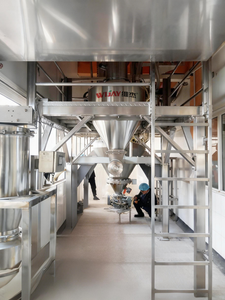
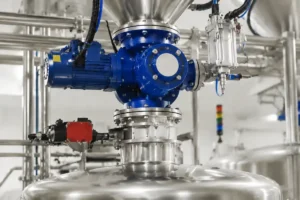
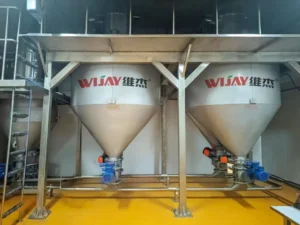
The equipment side follows the same logic. WIJAY builds fully enclosed pneumatic conveying systems that contain the material from feed point to receiver, eliminating the open transfer points where dust, spillage and contamination enter the process. Positive-pressure and dilute-phase configurations are available for long-distance and high-capacity duty, with custom layouts that accommodate multi-point loading and discharge. For materials that justify dense phase, the system architecture is matched to the permeability and fluidization data rather than assumed. Automation — batch weighing, dosing and sequence control — is integrated at the system level so that the conveying regime, the feeder and the receiver operate as one control loop rather than as independent skids.
WIJAY has seen the alternative play out across enough plants to be direct about the cost: a system selected on price and air margin typically returns the savings as unplanned downtime, elbow replacements and off-spec product within the first two years. A system selected against measured powder properties does not.
FAQ
Can I use the same pneumatic conveying system for two different powders?
Only if both materials have been characterized and the operating envelope covers the more demanding of the two. A setting that works for a free-flowing, coarse material may salt out or plug on a fine cohesive material, and a velocity that protects a fragile product may be too low to re-entrain a dense abrasive one. Dual-material service requires a velocity and pressure window, not a single setpoint.
Why does my line plug only at startup or after a weekend shutdown?
The most common cause is a settled bed that the pickup velocity cannot re-entrain. Fine or cohesive materials are especially prone to this because the surface-area effects increase the force required to lift the settled layer. The fix is usually in the pickup velocity and the line-clearing sequence, not in increasing the blower size.
Does a higher bulk density always mean more air is needed?
Not in a simple linear way. The required air volume depends on the material’s behavior across the pressure range, not just the loose-pour density. A compressible material can change its void fraction significantly under conveying pressure, and a low-density fine powder can require more filtration and receiver volume than a medium-density granular material.
How do I know whether dense phase is feasible before I commit to the system?
Bench-scale permeability, fluidization and deaeration testing is the minimum. A material that will not retain air or form a stable bed will not support dense-phase conveying regardless of how attractive the wear and attrition numbers are. Dense-phase feasibility is a material verdict, not a design preference.
My product is abrasive. Is a wear-resistant elbow enough?
Not by itself. Wear is a function of impact angle, velocity and particle hardness. The bend geometry, the local velocity and the upstream line layout all influence how the particles strike the surface. A wear-resistant material in the wrong geometry can still fail early; the right geometry with a moderate material can last significantly longer.
CTA: If you are sizing a new line or troubleshooting a system that has never matched its nameplate, send WIJAY the material data — particle size distribution, bulk density, moisture, and any permeability or fluidization results you have. We will translate those properties into a conveying regime and a system configuration built around the powder you actually run.