Ask any additive manufacturing operations manager what keeps them up at night, and it’s rarely the print itself. It’s the fact that up to 85% of the metal powder loaded into a build chamber never becomes part of a finished part — it has to be recovered, sieved, blended with virgin powder, and reloaded, over and over, without contaminating a batch that might cost more per kilogram than the machine time itself. Add in oxidation-sensitive alloys, a minimum ignition energy low enough to make static discharge a genuine hazard, and an operator standing over an open hopper trying to shovel overflow into a collection bin — and “powder handling” stops being a footnote and becomes the actual bottleneck limiting throughput.
If you’re scaling AM production past a single machine and a lab bench, the honest question isn’t “how do we print faster.” It’s “how do we move powder in and out of the process without losing material, contaminating batches, or exposing operators to risk.” And that question has a more specific answer than most equipment vendors are willing to give you.
Six Real Handling Challenges Nobody Solves With a Generic Conveyor
Metal powder handling in AM isn’t one problem — it’s six, and each one breaks a different class of conventional material handling equipment.
Loading fresh powder into the machine. Dense metal powder is harder to move than most solid feedstocks. A common workaround is lifting a powder container by forklift and gravity-feeding it into the hopper inlet — which works, but doing it repeatedly while maintaining an inert atmosphere to prevent oxidation is where things get complicated fast.
Unloading overflow from the build chamber. As production volume climbs, “shoveling” overflow powder into a collection hopper at the end of the build platform stops being a viable process — it’s slow, it’s inconsistent, and it puts operators in direct contact with fine metal dust.
Removing unused powder from around finished parts. This can happen inside the machine or at a dedicated unloading station. Because unused powder in the build chamber can represent up to 85% of total powder used, finding a reliable way to remove and recover it isn’t optional — it’s the difference between a viable cost-per-part and a losing one. Most shops today rely on basic suction or vacuum extraction from the build chamber, or physically move the chamber to an unloading station.
Sieving excess and unused material. Every batch of reclaimed powder has to be screened to remove agglomerates before it’s reusable, which means a reliable path to move powder to a sieving station and back to the build process.
Blending reclaim with virgin powder. There’s active research into how different reclaim-to-virgin ratios affect part quality — but regardless of the ratio a given shop settles on, blending only works if there’s a repeatable way to move powder to and from the blending unit without cross-contamination.
Returning blended, sieved powder to the AM machine. Same requirements as the original load-in step — clean, sealed, and oxidation-controlled.
Any one of these steps done with an open-air, mechanical, or dilute-phase conveying method introduces contamination risk, material loss, or operator exposure. Solve all six with the same technology, and you’ve actually fixed the bottleneck.
Why Dense-Phase Vacuum Conveying Is the Technology That Fits
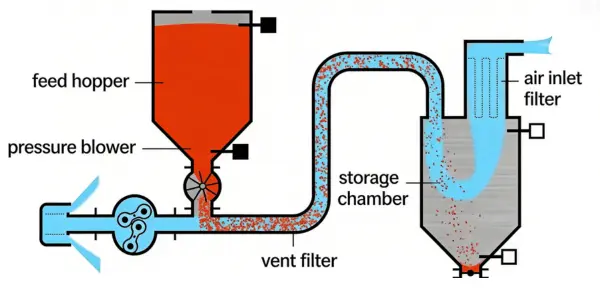
Given those six requirements, dense-phase vacuum pneumatic conveying is one of the few technologies genuinely suited to metal powder handling — and the reasons come down to specific engineering characteristics, not general marketing claims.
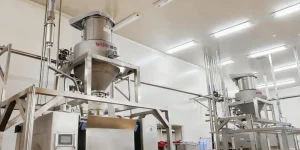
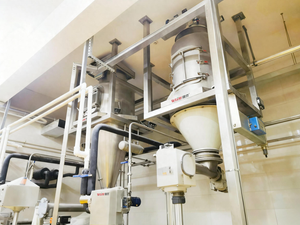
Receivers integrate directly into the process. Vacuum receivers mount directly onto AM machines or integrate with sieving systems, effectively sealing the powder from the surrounding environment and keeping the work area clean. Certified systems can safely handle materials with a minimum ignition energy (MIE) as low as 1 mJ — a sensitivity level where a stray static spark is a real explosion risk, not a theoretical one — without introducing that risk into the process.
The Vacuum Level That Actually Matters
Not all vacuum conveying is created equal for this application. A conveying system designed for dense metal powders needs to be easy to clean, leave minimal residual material in the line, filter down to sub-micron particulate, and run on vacuum-based conveying specifically.
The ideal approach uses low-velocity, dense-phase conveying — which requires high vacuum, typically in the 15 to 22 inches of mercury (in. Hg) range. That vacuum level rules out side-channel (regenerative) blowers and Roots-type units, which can’t reach it. It matters because dense-phase, low-velocity movement eliminates the line wear and material degradation that dilute-phase (high-velocity) conveying causes when abrasive metal particles repeatedly impact pipe walls at speed — a real concern when the material you’re conveying costs significantly more per kilogram than most bulk solids.
A Smaller Footprint as Production Scales
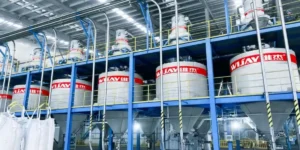
Vacuum conveying also keeps the physical footprint small as production scales up. A single main conveying line can loop between multiple AM machines’ vacuum receivers, while bulk powder supply stays stored in a separate room — eliminating the need for forklift traffic inside the build area entirely. The same logic applies to moving reclaimed powder to a sieving unit: vacuum conveying handles this without metering valves, pulling material directly from the build chamber, unloading station, or overflow area and routing it to sieving, then back to the supply hopper for blending or reuse.
Cycle Time Depends on Unloading Speed, Not Just Sieving Speed
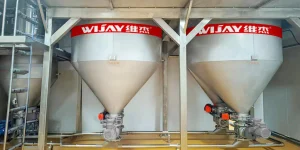
Increasing throughput ultimately comes down to minimizing unloading time so the next build can start sooner. Metal powder’s physical characteristics — particle size and screen mesh size — make that timing harder to control, because sieving is typically slower than the actual unloading step. That’s why a buffer hopper system matters: it allows fast unloading to happen independently of the slower sieving process, instead of forcing the whole line to wait on the sieve.
Inside WIJAY’s AM Powder Handling System
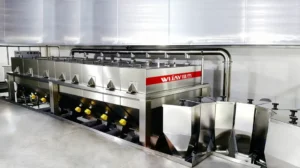
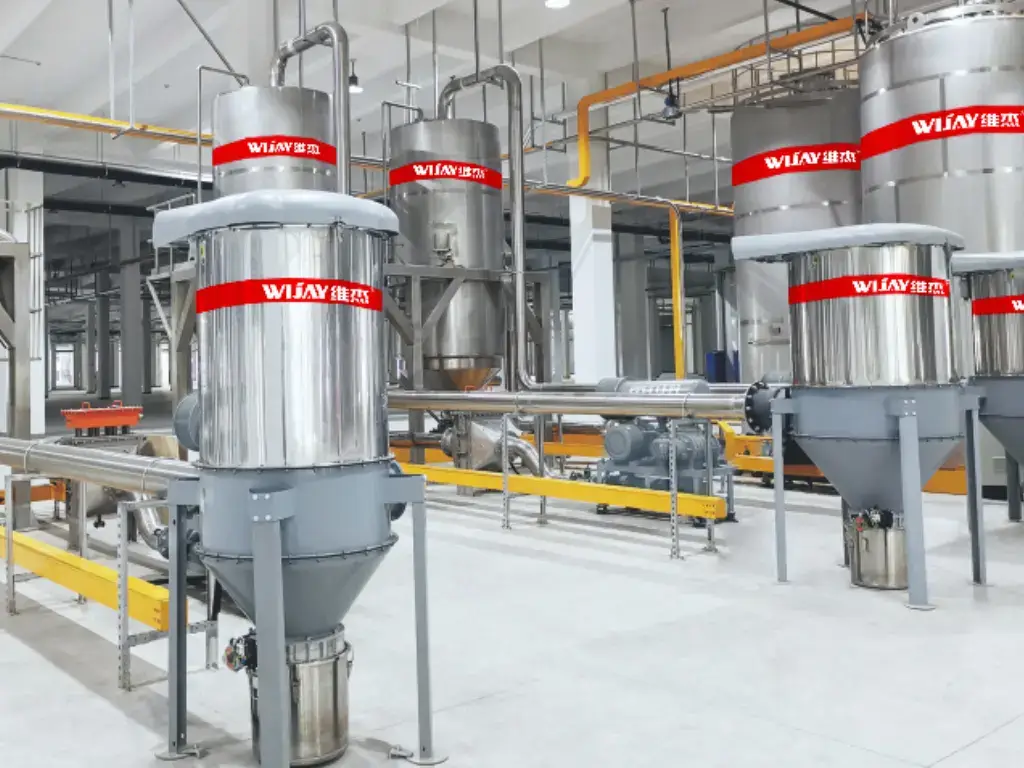
WIJAY’s additive manufacturing powder conveying, recovery, and extraction system was built specifically to give AM operations this level of process control when handling metal powders or other hazardous materials.
The system runs on three integrated units covering the full material loop:
- Conveying powder into the machine — in either ambient air or inert gas environments
- Recovering unused powder and routing it to sieving
- Returning processed powder to the machine or a storage vessel for future use
Two Environment Configurations
Both configurations maintain full enclosure — the difference is whether the application requires an inert atmosphere.
- Ambient air conveying: used when an inert atmosphere isn’t required.
- Inert gas conveying: for applications requiring an inert environment, the system runs as a closed loop, containing and recirculating inert gas rather than continuously consuming it — avoiding the ongoing cost of high-volume inert gas consumption. This configuration uses specially sealed electric pump units to maintain both system temperature and gas containment.
Technical Specifications
| Category | Specification |
|---|---|
| Sieve motor | 230/460/3/60 Hz or 110/1/60 Hz (other voltages available on request) |
| Control power | 110/1/60 Hz |
| Pneumatic supply | 6 bar, max. 1,500 NL/min |
| Wetted materials | 304, 316L stainless steel (powder-contact parts) |
| System weight | 380 kg (electric pump +90 kg / +200 lb) |
| Compatible metal powders | Stainless steel, aluminum alloys, titanium, Inconel/chrome-nickel alloys, copper, and others (inert-system dependent) |
| Sieving mesh | Down to 63 microns |
| Conveying distance | Up to 8 meters total line length (longer distances available on request) |
| Stainless steel powder throughput | 500+ kg/hour |
| Aluminum powder throughput | 300+ kg/hour |
What This Actually Solves
For an AM operation weighing pneumatic conveying against manual handling or mechanical alternatives, the practical differences show up in five places: enclosure and cleanliness that meet AM’s strict contamination requirements; explosion safety through certified systems (such as ATEX) rated for MIE as low as 1 mJ; modular integration that lets one main line serve multiple machines while cutting forklift traffic and floor space; material-preserving low-velocity dense-phase transport that avoids the wear, degradation, and contamination risk of high-velocity dilute-phase systems; and valve-free automated routing between build chamber, sieving, and reload that cuts manual handling out of the loop.
Put together, dense-phase vacuum pneumatic conveying isn’t just a fit for metal powder handling in additive manufacturing — for the six real-world challenges every scaling AM operation runs into, it’s the technology built to solve all of them at once.
Frequently Asked Questions
Why can’t a standard dilute-phase pneumatic conveying system handle metal powders? Dilute-phase systems move material at higher velocity, which causes more particle-to-pipe-wall impact — leading to line wear, powder degradation, and contamination risk. For metal powders, where material cost and purity both matter, dense-phase, low-velocity conveying at high vacuum avoids that damage.
Is inert gas conveying required for all metal powders? No — it depends on the oxidation sensitivity of the specific alloy. Titanium and aluminum powders, for example, are typically far more oxidation-sensitive than certain stainless steel grades, which is why WIJAY’s system offers both ambient air and closed-loop inert gas configurations.
How does vacuum conveying reduce contamination risk between different powder batches? Sealed receivers and enclosed line paths prevent powder from being exposed to the surrounding environment, and systems designed for easy cleaning with minimal residual material reduce cross-contamination risk when switching between materials.
What conveying distance can this system realistically support on a production floor? The standard configuration supports up to 8 meters of total line length, with longer-distance configurations available depending on layout — which is typically enough to run a single main line looping between multiple AM machines while keeping bulk powder storage in a separate room.
Scaling metal powder handling past what manual loading and shoveling can support? Talk to a WIJAY process engineer about a dense-phase vacuum conveying system sized to your AM machines and powder chemistry, or explore our full range of pneumatic conveying systems for hazardous and high-value powders.