If you run an edible oil or blended-oil line, you already know the failure points before an auditor ever walks in. Sugar powder or starch additive drifting off a manual scale station. A film of oil creeping across the floor near the blending tank. A batch log that’s really just a clipboard someone filled in from memory at the end of shift. None of these show up on a process flow diagram — but they’re the reason plants fail sanitation walkthroughs and lose production days to “corrective action” paperwork.
We’ve spent 16 years building fluid and powder conveying systems for plants running exactly this profile: liquid oil combined with powdered food additives in the same batching step. The problems repeat across almost every facility we visit, and they’re solvable with the same engineering fixes. Here’s the breakdown.
The Real Cost of Manual Oil-Powder Batching
Open, manually-fed batching lines carry three compounding costs that rarely show up in a single line item on a P&L:
- Material loss. Powder additive spillage during manual dosing typically runs in the low single digits as a percentage of throughput — small per batch, but compounding across a full production year into a meaningful raw material cost.
- Unplanned downtime. Oil seepage from unsealed transfer lines forces floor cleaning and re-inspection mid-shift. Each stoppage for a leak or contamination event can cost a plant several hours of line time, not counting the wasted product in the line at shutdown.
- Labor variance. Manual dosing accuracy depends entirely on the operator on shift that day. Batch-to-batch variation from hand-scaled powder additions is one of the most common root causes we see cited in internal QA deviation reports.
None of this is a one-time expense. It’s a recurring tax on every batch a plant runs until the transfer and dosing process is re-engineered.
Why Open-Line Blending Doesn’t Meet Current Food Safety Standards
The root cause isn’t operator error — it’s line architecture. Three structural gaps show up consistently in legacy batching setups:
No sealed transfer path. When liquid oil and powder additives move through open troughs, gravity feeds, or manual scoops, both dust generation and oil seepage are built into the process, not incidental to it.
No standardized cleaning protocol. Oil residue and powder buildup accumulate in hard-to-reach transfer points. Without a defined clean-in-place (CIP) cycle, these become microbial risk zones that manual wipe-downs can’t reliably reach.
No batch-level data trail. Oil ratio, powder dosing, and transfer duration recorded by hand on paper logs are difficult to reconstruct accurately during a traceability audit, and nearly impossible to cross-reference against sensor data because none exists.
Regulatory food-safety frameworks for edible oil processing increasingly expect enclosed, contamination-controlled transfer and dosing — with digital batch records to match. A line built around open transfer and paper logs is structurally out of step with where enforcement is heading, regardless of how carefully operators are trained.
What an Integrated Fluid-Powder Pneumatic Conveying System Actually Solves
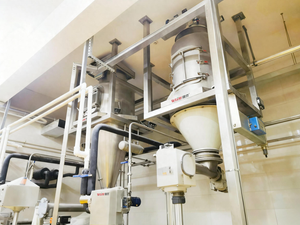
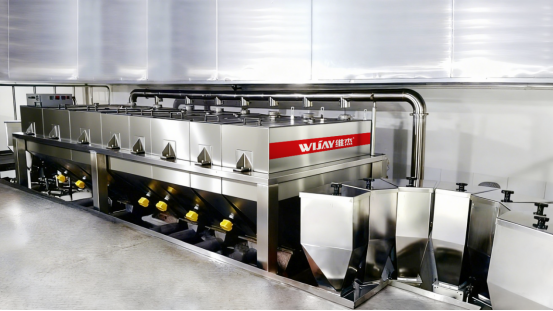
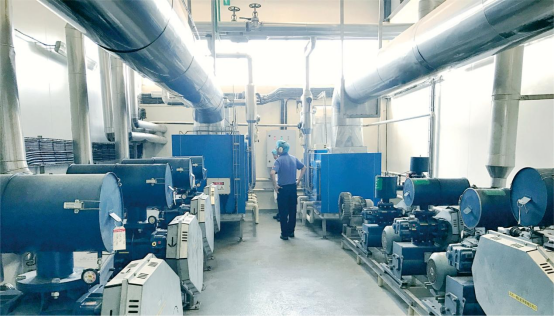
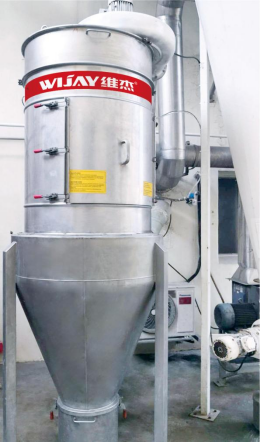
An engineered pneumatic conveying system built for edible oil applications has to do two things most conveying equipment isn’t designed for simultaneously: move liquid oil and move dry powder additive, in the same batching cycle, without cross-contamination or leak points.
Fully Enclosed Conveying Line
Both the liquid oil stream and powder additive stream run through a fully sealed pipeline, eliminating the open-air transfer points where dust generation and oil seepage originate. This isn’t a dust collector bolted onto an existing line — it’s a conveying architecture designed from the intake point to the blending vessel with no open interface.
Food-Grade CIP Cleaning
A standard clean-in-place module runs scheduled or on-demand wash cycles through the full transfer path, removing oil film and powder residue from internal surfaces without disassembly. This directly closes the microbial risk gap that manual cleaning can’t reach and gives plants a documented cleaning record for sanitation audits.
Smart Central Control and Batch-Level Traceability
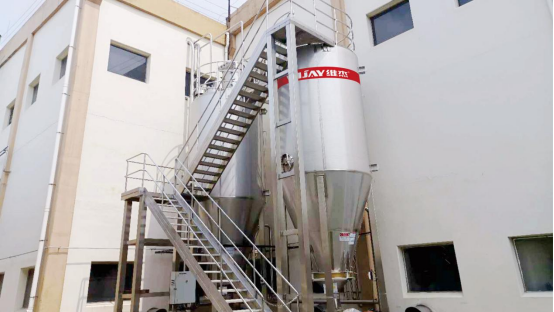
A central control platform logs oil flow rate, powder dosing ratio, and equipment status in real time, and flags leaks, dosing imbalance, or line blockages as they happen rather than after a batch is already compromised. Production data can feed directly into a plant’s existing digital management system, giving quality teams a complete, timestamped batch record instead of a handwritten log.
Configurable Dosing for Different Oil and Powder Profiles
Refined oil, blended oil, and specialty oil additives don’t all convey the same way — viscosity, particle size, and flow characteristics vary by product. A properly engineered system supports both positive-pressure and dense-phase conveying configurations, tuned to the specific combination of liquid and powder material a plant is running, rather than a single fixed transfer setting applied across every product line.
Most facilities run this configuration with one to two operators overseeing the full batching cycle, down from the multi-person manual dosing teams legacy lines typically require.
What This Looks Like on the Plant Floor
The plants that get the most value from this retrofit are the ones already feeling the cost in three places: repeated corrective-action findings from sanitation audits, raw material variance that doesn’t reconcile at month-end, and QA teams that spend more time reconstructing batch history than reviewing it.
An enclosed pneumatic conveying system doesn’t just clean up the production floor — it changes what a plant can prove to a regulator or a customer auditor. Sealed transfer paths remove the contamination pathway. CIP cycles create a documented cleaning record. Automated batch logging replaces a clipboard with a data trail that holds up under review.
WIJAY Systems has engineered fluid-and-powder pneumatic conveying lines for grain, oil, and seasoning producers for 16 years, holding more than 100 material-handling patents developed specifically for combined liquid-and-powder processing environments. Our systems are built to be configured — not replaced — as a plant’s product mix or throughput requirements change, which keeps long-term retrofit and maintenance costs down relative to a full line rebuild.
If your batching line still depends on open transfer and manual logs, the compliance gap isn’t going to close on its own — the retrofit path exists, and it’s a smaller project than most plants expect.
FAQ: Pneumatic Conveying Systems for Edible Oil Production
Can one pneumatic conveying system handle both liquid oil and powder additives? Yes, when the system is specifically engineered for combined fluid-powder transfer. A single-purpose powder conveying system or a standard oil transfer line typically can’t handle both without cross-contamination risk — the conveying architecture needs to be designed for the combination from the start.
How much does enclosed conveying reduce material loss compared to manual batching? Loss reduction varies by product and current line condition, but sealed transfer eliminates the two largest sources of loss in open lines: powder dust-off during dosing and oil seepage at transfer points. Most plants see the clearest reduction in the first full production cycle after retrofit.
Does a pneumatic conveying system replace the need for manual batch record-keeping? It replaces manual logging with automated, timestamped batch data — flow rate, dosing ratio, and equipment status recorded continuously rather than transcribed after the fact. This data can be exported to a plant’s existing digital quality management system.
Is retrofitting an existing line for pneumatic conveying disruptive to production? Retrofit scope depends on existing line layout, but systems are generally designed to integrate with a plant’s current blending and storage infrastructure rather than requiring a full facility rebuild. A site assessment is the standard first step to scope actual downtime.
Ready to evaluate your current batching line? WIJAY Systems’ engineering team reviews plant layouts and product profiles to scope a fluid-powder pneumatic conveying configuration built for your specific throughput and compliance requirements. [Talk to a WIJAY process engineer →]