Two rotary valves can sit next to each other on a supplier’s catalog page, look nearly identical from the outside, and behave completely differently once they’re bolted into a live pneumatic conveying system. That’s usually where the trouble starts — a valve gets specified based on price or availability rather than on how it actually handles material, and the plant ends up managing product buildup, uneven feed rate, or degraded particles that trace straight back to a mismatched valve design.
The two most common rotary valve configurations in bulk material handling are the drop-through valve and the blow-through valve. They share a rotor housing and a basic operating principle, but their internal geometry and flow path exist to solve two genuinely different problems. Understanding which problem you actually have is what determines system performance — not the valve’s price tag.
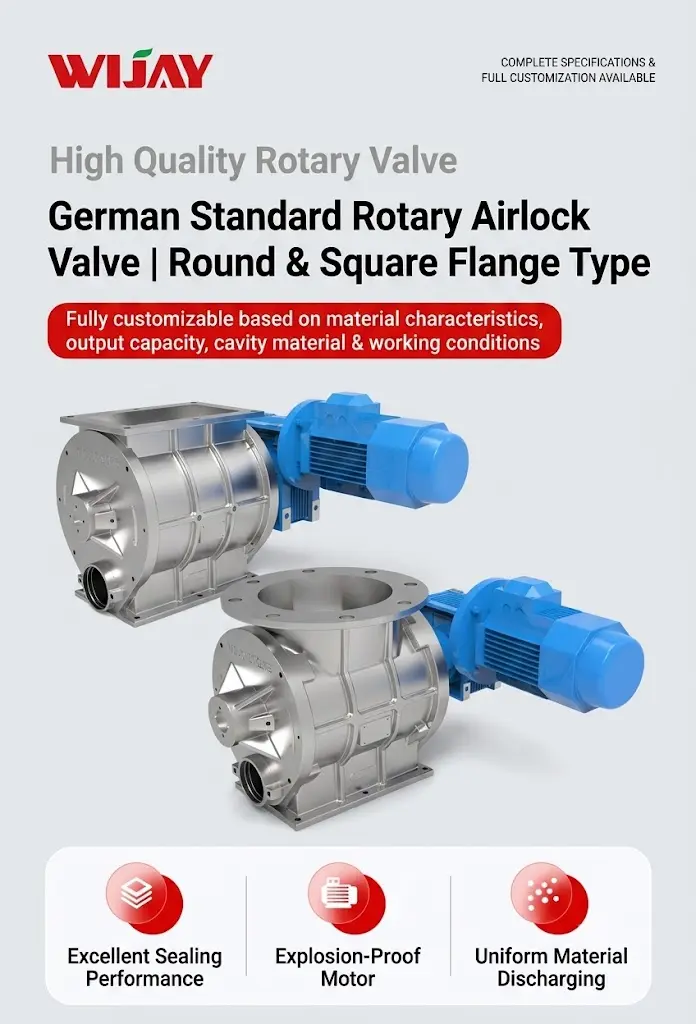
Drop-Through Valves: Precision Control for Gravity Discharge
A drop-through valve is built for applications where material needs to exit straight down under gravity. The inlet and outlet are vertically aligned, so bulk material moves freely through the rotor’s pockets and drops into the equipment below by gravity alone — no forced air entrainment involved.
This design fits a specific set of conditions well:
- Feeding screw conveyors, mixers, or hoppers where the receiving equipment is directly below the valve
- Handling free-flowing, non-cohesive products that don’t need help moving through the rotor pockets
- Systems with low pneumatic pressure differential, where gravity discharge is sufficient on its own and forced conveying isn’t required
Where a drop-through valve typically falls short is in any application that actually needs the material entrained into a conveying airstream — the geometry simply isn’t built for that job, and forcing it there tends to show up as inconsistent discharge or material hanging up in the rotor pockets.
Blow-Through Valves: Built for Efficient Pneumatic Conveying
A blow-through valve is engineered specifically for pneumatic conveying duty. The inlet is vertical, but the outlet is horizontal, feeding material directly into the conveying airstream rather than dropping it by gravity. Air from the conveying line passes straight through the rotor pockets, sweeping material into the pipeline as it goes — a discharge method typically referred to as forced discharge.
That geometry change delivers real, measurable advantages in a conveying-line context:
- Continuous, stable feed rate into the conveying pipeline, without the surging that can come from gravity-fed systems
- Reduced product buildup inside the valve, since airflow is actively clearing the rotor pockets rather than relying on gravity alone
- Lower energy loss and reduced overall system consumption, because material transitions into the airstream more efficiently
- Better suited to fine powders or shear-sensitive materials, since the entrainment method is gentler on particles than forcing them through a gravity drop into a high-velocity line
This is why blow-through valves show up most often in applications where conveying efficiency and tight integration with the pneumatic system actually matter — plastics, chemical processing, and food production are three of the most common. In these industries, inconsistent feed or excessive product degradation isn’t just an efficiency problem; it’s a quality and yield problem.
Choosing the Right Rotary Valve for Your System Design
The decision between a drop-through and blow-through valve comes down to two things: what your material actually does under handling stress, and what your process configuration actually requires.
Material type. Start with whether you’re handling powder, granules, or pellets, and how the material behaves. Free-flowing products with good bulk density generally work fine with a drop-through valve — there’s no real advantage to paying for forced discharge they don’t need. Fine powders, or anything prone to clumping or bridging, are a better match for a blow-through valve, where active airflow through the rotor prevents the buildup that a gravity-only design would struggle with.
Process requirements. The bigger question is how material actually needs to move through your system — fed, discharged, or conveyed. Valve geometry directly affects flow behavior, conveying pressure, and how often the system needs maintenance attention. A drop-through valve sized for a conveying application will fight the process every cycle; a blow-through valve installed where gravity feed was all that was ever needed adds cost and complexity without a corresponding performance gain.
Getting this wrong rarely shows up as a dramatic failure on day one. It shows up gradually — as rotor wear that’s faster than expected, as maintenance intervals that keep shrinking, or as feed rate that drifts and forces operators to compensate manually. By the time it’s diagnosed, the valve has usually been running in the wrong role for months.
Why This Decision Deserves More Than a Spec Sheet Comparison
Neither valve type is inherently “better” — they’re built to solve different problems, and the correct choice is entirely dependent on your material’s real behavior and your process layout, not on a generic recommendation. A valve that performs flawlessly on one plant’s abrasive, free-flowing pellets can underperform badly on another plant’s fine, cohesive powder — same valve family, completely different result.
That’s the part a lot of supplier spec sheets skip over: they’ll list drop-through and blow-through side by side without explaining which failure mode each design is actually protecting against, which leaves the buyer guessing at exactly the point where the decision matters most.
FAQ
What’s the main functional difference between a drop-through and blow-through rotary valve? A drop-through valve discharges material straight down by gravity through vertically aligned inlet and outlet ports. A blow-through valve discharges horizontally into the conveying airstream, using airflow through the rotor to actively entrain material — a fundamentally different discharge mechanism, not just a different port layout.
Can a blow-through valve be used for gravity-fed applications? It can, but it’s generally not worth the added cost and complexity if gravity discharge alone would do the job. Blow-through valves earn their keep specifically in pneumatic conveying applications where forced entrainment and stable in-line feed rate matter.
Which valve type handles fine powders better? Blow-through valves are generally the better fit for fine or cohesive powders, since the active airflow through the rotor pockets reduces buildup and clumping in a way gravity-only discharge can’t.
Does valve choice affect energy consumption in a pneumatic conveying system? Yes. Blow-through valves are engineered for smoother transition into the airstream, which reduces the energy losses that come from turbulent or inconsistent material entry into the conveying line.
How do I know if my current rotary valve is the wrong type for my process? Common warning signs include material buildup inside the rotor housing, feed rate that drifts or surges, faster-than-expected rotor and seal wear, or maintenance intervals that keep getting shorter. Any of these is worth investigating against your actual material properties and process layout, not just the valve’s original spec.
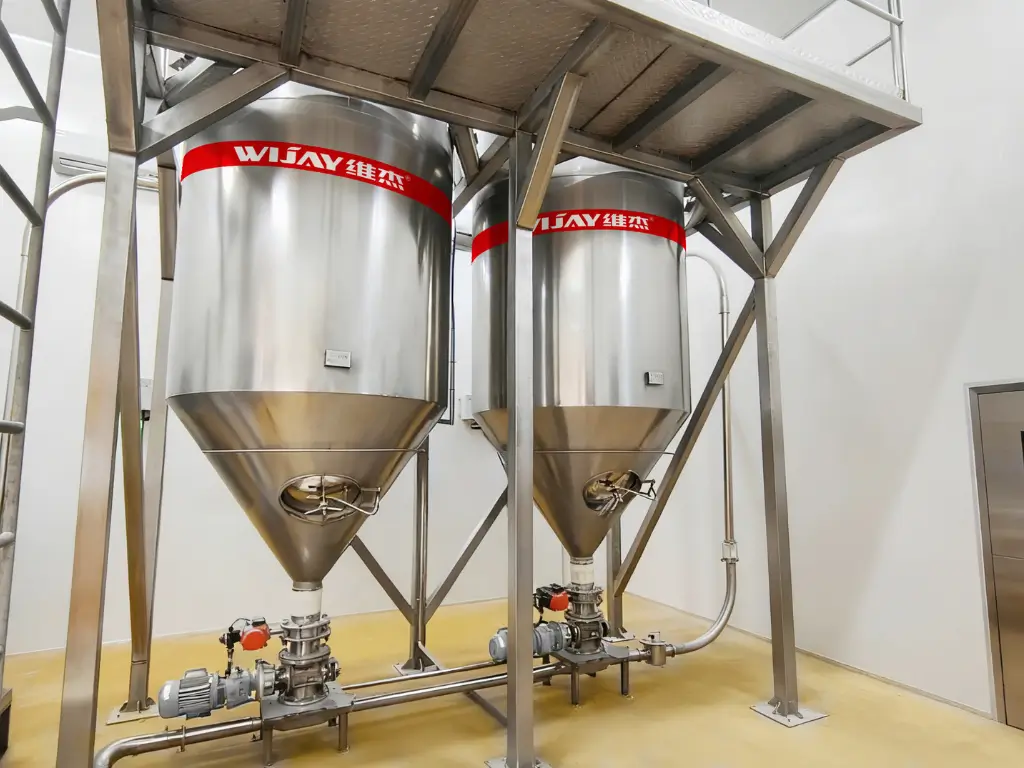
WIJAY Systems engineers rotary valve selection as part of a fully integrated pneumatic conveying system — enclosed, dust-free, low-degradation material handling matched to your actual product behavior across food, chemical, plastics, and other bulk-material industries. If your current valve is running into buildup, wear, or feed-rate issues that don’t match its spec sheet, that’s worth a conversation with our process engineering team before the next scheduled shutdown.