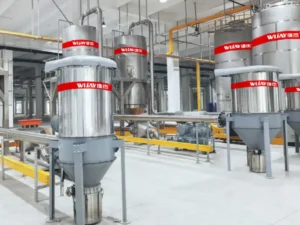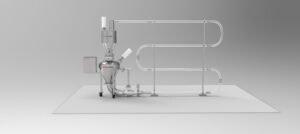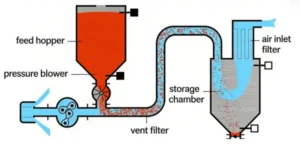
Best hygienic pneumatic conveying equipment for food use is a search that usually points people toward pipe material, filtration, and sealed transfer points — and those things genuinely matter. But hygienic food handling starts before material ever reaches a conveying line. If the storage silo upstream is letting ingredients sit stagnant against the walls for weeks or months, no amount of stainless steel piping downstream will undo the spoilage, contamination, and traceability gap that’s already been created before conveying even begins.
Pet food manufacturing is a useful lens for this, because the raw ingredients involved — corn, soybean meal, poultry, cattle, and swine meal — vary widely in particle density, shape, size distribution, moisture content, chemical composition, and how they behave after sitting at rest. Every one of those properties affects how material actually moves through a bin or silo, and that flow behavior directly determines final product quality and food safety outcomes. This article walks through a real case where a silo’s flow pattern — not the conveying equipment downstream — was the actual source of a recurring spoilage and cleaning problem, and what genuinely hygienic bulk solids handling requires as a result.
Why Hygienic Equipment Has to Start With Flow Pattern, Not Just Pipe Material
The instinct when evaluating food-grade conveying equipment is to check the boxes that are easy to verify: is the pipe stainless steel, is the system enclosed, is there a filter. Those checks matter, but they miss the stage that determines whether the material entering the conveying system is actually clean in the first place. A silo or hopper with poor flow characteristics can let raw ingredients sit motionless against the walls for extended periods — long enough to spoil, cake, or become a contamination source — regardless of how well-engineered the downstream conveying equipment is.
This is the gap a lot of food safety evaluations miss: hygienic design is a whole-system property, and the storage vessel feeding the conveying line is as much a part of that system as the pipe itself.
The Case: A Pet Food Silo That Was Losing $5,000 Every Time It Was Cleaned
We worked with a premium dry pet food manufacturer storing raw ingredients in large silos — each holding roughly 180 to 230 tons. Because only one silo was available per ingredient, and ingredients occasionally spoiled inside the vessel, cleaning required a full production stop. On average, that happened three times a year. In the worst stretches, it happened every two weeks.
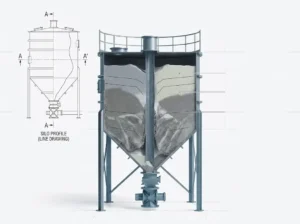
One representative silo was 4.5 meters in diameter and 17 meters tall, discharging through a carbon steel conical hopper at a 60-degree incline down to a 1.5-meter opening, then through a circular-to-rectangular transition ending in a discharge slot 0.3 meters wide and 1.5 meters long, fed to a 0.2-meter-diameter screw feeder. Because production consumed the ingredient steadily, operators kept the silo topped up — which meant material stored along the walls below the current fill line simply never moved. It sat there indefinitely, and it spoiled.
Cleaning it out meant removing the screw feeder, hammering on the silo walls to dislodge caked material, letting it fall to the plant floor, and shoveling it up by hand — a job that took three workers roughly eight hours and cost the plant about 3.9 tons of lost material every time. Between labor and material loss, each cleanout ran approximately $5,000, not counting the lost production during the downtime itself.
Diagnosing the Actual Cause: Funnel Flow, Not a Conveying Problem
An engineer investigated the empty silo directly rather than assuming the fix would be found downstream in the conveying line. Two details stood out immediately: material remained clinging to the walls even after a full cleanout, and the conical hopper walls were visibly rusted — a clear sign that material wasn’t sliding along them at all. The silo was operating in a classic funnel-flow pattern, where material discharges through a narrow central channel while the surrounding material along the walls stays essentially frozen in place.
Further investigation traced the discharge behavior specifically to the screw feeder: material was only being drawn from the back end of the feeder, in a narrow channel extending straight up to the top of the bin, while the rest of the silo’s contents sat undisturbed. This is a well-documented pattern with constant-pitch screw feeders — they don’t draw material evenly across the full discharge opening, which is exactly the geometry mismatch that lets funnel flow develop in the first place.
A sample of the material was tested to determine its actual flow properties against different surfaces and angles. The results were specific and, in one respect, genuinely useful: the material would not achieve mass flow against the rusty carbon steel surface at the existing 60-degree angle, but it would flow reliably against ultra-high-molecular-weight polyethylene (UHMW-PE) at that same 60-degree angle — meaning the hopper’s existing geometry didn’t need to change, only its surface.
The Fix: Three Targeted Changes, Not a Full Silo Replacement
The recommendation was to convert the silo to genuine mass flow — where the entire contents move together whenever the screw feeder extracts material, rather than only the material in a narrow central channel. That shift eliminates stagnant material at the source, which directly addresses both the spoilage problem and, as a secondary benefit, improves raw material traceability across production lots — a meaningful food safety improvement in its own right.
Three specific changes achieved it:
A UHMW-PE liner on the conical hopper. Based on the flow property testing, this alone was enough to enable mass flow at the hopper’s existing 60-degree angle — no structural change to the hopper geometry was required, just a surface material change.
An epoxy coating on the transition hopper. The circular-to-rectangular transition section also needed a smoother surface to support consistent flow through that geometry change.
Replacement of the constant-pitch screw feeder with a mass-flow feeder. This was the change that actually corrected the underlying withdrawal pattern — a 0.25-meter-diameter feeder with varying shaft diameter and pitch, engineered to draw an increasing amount of material along the direction of travel so that material is extracted across the entire discharge slot rather than just the back end. Without this change, even a perfectly smooth hopper would still funnel-flow, because the feeder itself was the root cause of the uneven withdrawal.
Before implementation, the silo’s structural capacity was verified against the different stress pattern mass-flow discharge creates, since converting flow pattern changes the loading the vessel walls actually experience.
The Result: Problem Solved at the Source, Not Managed Downstream
After the modifications, the silo operated in mass flow, and more than a year later, the plant had experienced no further spoilage inside that vessel. The company saved a minimum of $20,000 annually in cleaning costs alone, on top of maintaining continuous production, improving product quality consistency, and gaining genuine lot-level traceability — a food safety benefit that funnel flow had been quietly undermining the entire time, since material of unknown age and condition had been mixing unpredictably with fresh material during discharge.
Why This Matters for Anyone Evaluating “Hygienic” Food Equipment
Mass flow doesn’t just solve spoilage and cleaning cost — it reduces sifting segregation, improves blend uniformity, strengthens raw material traceability, and delivers steady discharge at consistent bulk density with genuinely controlled flow. Every one of those outcomes is a food safety and quality outcome, not just an operational efficiency one, which is exactly why silo and hopper design belongs in the same conversation as pipe material and filtration when evaluating hygienic food handling equipment.
A pneumatic conveying system downstream of a funnel-flow silo can be built entirely from food-grade stainless steel, fully enclosed, and properly filtered — and still be receiving spoiled, inconsistently aged material because the vessel feeding it was never designed around the material’s actual flow properties. Genuinely hygienic equipment evaluation has to look at the whole system, storage through conveying, not just the segment that’s easiest to inspect from the outside.
FAQ
Why would a silo cause food safety problems if the conveying system itself is fully enclosed and food-grade? Because contamination and spoilage can develop upstream of the conveying system entirely. A funnel-flow silo lets material sit stagnant against the walls indefinitely, where it can spoil or degrade before it ever reaches the conveying equipment — no amount of downstream containment can undo that.
What’s the difference between funnel flow and mass flow in a storage silo? In funnel flow, material discharges through a narrow central channel while material along the walls stays essentially motionless. In mass flow, the entire contents move together whenever material is withdrawn, which eliminates stagnant zones and produces genuine first-in, first-out discharge.
Can a funnel-flow silo be converted to mass flow without replacing the entire vessel? Often, yes. In the case described here, a liner change on the hopper surface, a coating on the transition section, and a feeder replacement were sufficient — the hopper’s structural geometry and angle didn’t need to change, because testing showed the existing angle would support mass flow against a different, smoother surface.
Why did a constant-pitch screw feeder contribute to the flow problem? Constant-pitch feeders draw material unevenly across the discharge opening — typically concentrated at one end — which creates a narrow flow channel rather than pulling material evenly across the full outlet. A mass-flow feeder, with varying pitch and shaft diameter, is engineered specifically to correct this.
Does converting to mass flow affect anything beyond spoilage and cleaning cost? Yes. Mass flow also reduces particle segregation, improves blend uniformity, strengthens lot-level raw material traceability, and produces more consistent bulk density during discharge — all of which affect product quality and food safety, not just maintenance cost.
WIJAY Systems evaluates hygienic food handling as a complete system — storage silo flow pattern, feeder design, and enclosed pneumatic conveying engineered together, not assessed in isolation — across food, pet food, and other bulk material industries. If your facility is accepting recurring cleaning, spoilage, or flow problems as a normal cost of doing business, that’s worth a conversation with our process engineering team before the next cleanout.