A batching system that’s passed every calibration check and still produces batches that drift off spec is one of the more frustrating problems a process engineer runs into. The feeder reads correctly on the bench, the setpoint is programmed right, and yet finished product keeps trending slightly light or slightly heavy in a way that shows up as scrap, rework, or excess raw material consumption long before anyone can pin down why. Maintenance checks the feeder. Nothing’s wrong with it. The problem gets escalated, re-tested, and often never fully resolved — because the fault usually isn’t in the feeder itself. It’s in what’s happening around it.
Loss-in-weight (LIW) feeders are the workhorse of batching accuracy across powder and bulk material processing, and they’re built to do one specific thing extremely well: continuously measure a hopper’s weight loss over time and adjust discharge rate to hold a precise setpoint, typically expressed in units like kilograms per hour. That precision, though, depends on the weighing signal being clean — and a feeder mounted in a real production environment is constantly exposed to forces that have nothing to do with the material it’s actually weighing. Vibration from nearby equipment, rigid connections to upstream or downstream process equipment, and pressure or vacuum fluctuations at the inlet or outlet all distort the weight signal in ways that look, on paper, exactly like a feeder that’s out of calibration.
Understanding these three external factors — and what actually compensates for each — is the difference between a batching system that holds tight tolerance for years and one that generates a slow, hard-to-diagnose accuracy problem that quietly inflates material cost every single shift.
Why Small Accuracy Errors Compound Fast in a Batching System
A loss-in-weight feeder has to detect small changes in weight against a relatively large total load — the hopper, the feed mechanism, and the material itself — which makes it inherently sensitive to any force that isn’t the material settling out of the hopper. On a single feeder, a small mass-flow deviation might look negligible. Across a full batching line running multiple feeders continuously, even a modest, consistent accuracy drift compounds into a measurable shift in product quality and a real increase in raw material cost — the kind of loss that rarely shows up as a single line item, but adds up steadily across every batch run.
The Three External Factors That Quietly Distort Feeder Accuracy
Vibration from Nearby Equipment
Vibration transmitted from other machinery on the production floor gets picked up by a feeder’s weighing system and misread as part of the load. Left uncorrected, that vibration produces a weight signal that’s constantly fluctuating around the true value, which the controller then tries to compensate for — introducing exactly the kind of instability the feeder was designed to prevent.
Rigid or Improperly Tensioned Process Connections
Because a loss-in-weight feeder’s entire function depends on measuring the hopper’s true weight, it has to be mechanically isolated from upstream and downstream equipment. If an inlet hopper, pneumatic receiver, or intermediate bulk container is rigidly connected to the feeder rather than isolated through a flexible connector, the feeder effectively weighs part of that connected equipment along with the material — producing a persistently inflated reading that has nothing to do with actual material flow. The flexible connectors used to prevent this, typically elastomeric bellows, introduce their own failure mode if installed incorrectly: a connector installed too tight pulls downward on the feeder and distorts the reading in one direction, while a connector that collapses inward under pressure distorts it in the other. This is also one of the most common sources of post-maintenance accuracy problems — a flexible connection reinstalled slightly wrong after a shutdown is often the very first thing worth checking when a feeder that worked fine before maintenance suddenly doesn’t.
Pressure and Vacuum Fluctuations at the Inlet or Outlet
When a feeder discharges into a non-ambient pressure environment — a pressurized conveying line, for example — pressure pulses can leak back through the discharge tube to the weighing mechanism and apply an upward force that partially offsets the true downward weight of the hopper. The controller reads that as less material than is actually present and reduces output to compensate, creating a real, sustained underfeed that has nothing to do with the feeder’s mechanical performance. The same dynamic works in reverse at the inlet: as material refills the hopper, air pressure inside briefly increases and pushes upward on the hopper lid and inlet valve unevenly, which the controller reads as reduced mass flow and compensates for by increasing output — creating a feed-rate error in the opposite direction. One of the most common root causes of this kind of pressure disturbance is a clogged or restricted dust-collection vent filter, and in facilities running several feeders off a shared dust-collection or nitrogen-blanketing system, one feeder’s refill cycle can transmit a pressure pulse through the shared air lines to every other feeder on the same system.
What Actually Compensates for Each Factor
Filtering Algorithms and Proper Isolation for Vibration
Modern weighing controllers use signal-filtering algorithms designed to distinguish the true load signal from the transient frequency components introduced by vibration, effectively separating the noise from the actual weight measurement. That filtering isn’t a substitute for correct mechanical installation, though — vibration-isolation mounts and platform-level vibration measurement, specified according to the feeder manufacturer’s recommendations, remain necessary even with good filtering in place, and eliminating strong nearby airflow matters specifically in low-feed-rate applications, where even a light draft across the weighing platform can distort the reading.
Correctly Tensioned Flexible Connections for Process Isolation
The fix for rigid or mis-tensioned connections is straightforward in principle and easy to get wrong in practice: flexible bellows connectors installed with the correct tension — not so tight that they pull on the feeder, not so loose that they collapse inward under pressure — combined with adequate clearance for maintenance access. Given how often this specific issue surfaces after a shutdown, checking flexible connections should be the first troubleshooting step whenever feeder accuracy degrades following maintenance.
Electronic Pressure Compensation for Pressure and Vacuum Fluctuations
Pressure-related errors have historically been corrected mechanically, but mechanical compensation is vulnerable to manufacturing tolerance, connector alignment drift, and material aging over time — all of which erode its effectiveness and often make an expensive mechanical solution underperform in practice. Electronic pressure compensation addresses the same problem more reliably: high-precision pressure sensors mounted on the hopper lid, the outlet tube, or both continuously measure pressure and feed that signal directly to the feeder’s control system, which dynamically adjusts for pressure fluctuations before they can distort the weight reading. Electronic compensation is generally more reliable, requires little to no ongoing maintenance, and is straightforward to retrofit onto an existing batching system — often at lower long-term cost than a mechanical solution that needs periodic realignment.
Building These Safeguards Into the Batching System From the Start
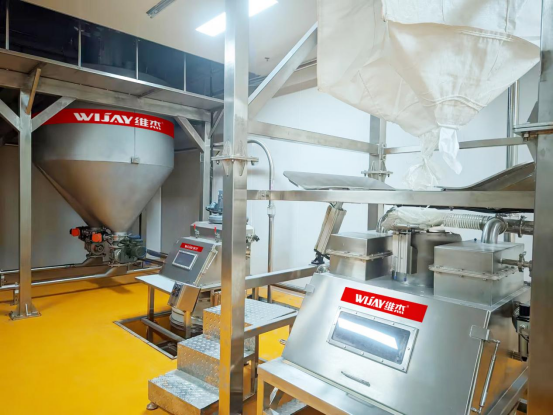
The plants that avoid this problem entirely tend to be the ones where vibration isolation, correctly specified flexible connections, and pressure compensation were engineered into the batching system’s design from the outset, rather than added as after-the-fact fixes once an accuracy problem surfaces on the production floor. WIJAY Systems designs its batching systems with this reality built in: weighing modules specified with vibration isolation appropriate to the plant’s actual floor conditions, flexible process connections sized and tensioned correctly during installation rather than left to field guesswork, and pressure-stable conveying design that minimizes the inlet and outlet fluctuations that distort feeder readings in the first place.
For any plant running loss-in-weight feeding as part of a batching system, the diagnostic priority when accuracy drifts is the same: check vibration isolation, check flexible connections — especially after any maintenance event — and check for pressure fluctuations at the inlet and outlet before assuming the feeder itself is at fault. In most cases, it isn’t.
FAQ
Why does a batching system’s feeder drift off accuracy even after passing calibration? Calibration checks typically test the feeder under controlled conditions, not the vibration, rigid connections, and pressure fluctuations present in actual production. WIJAY designs its batching systems to account for these external factors at the engineering stage, rather than relying solely on calibration to catch problems that originate outside the feeder itself.
How can I tell if feeder accuracy problems are coming from vibration versus a connection issue? Vibration typically produces a weight signal that fluctuates rapidly around the true value, while a rigid or mis-tensioned connection tends to produce a persistent, one-directional offset. WIJAY’s weighing modules are specified with vibration isolation and correctly tensioned flexible connections from installation, which removes both variables as a starting suspect.
Why do flexible connections so often cause problems right after maintenance? A bellows connector reinstalled slightly too tight or too loose after a shutdown is one of the most common sources of post-maintenance accuracy drift, since even a small change in tension shifts the force applied to the feeder. WIJAY recommends checking flexible connections first whenever a feeder that performed correctly before maintenance shows accuracy problems afterward.
What’s the difference between mechanical and electronic pressure compensation? Mechanical pressure compensation is vulnerable to manufacturing tolerance, connector alignment drift, and aging, all of which reduce its effectiveness over time. Electronic pressure compensation uses pressure sensors feeding directly into the control system for continuous, dynamic correction, and WIJAY specifies electronic compensation on batching systems where pressure-related accuracy risk is significant, since it’s more reliable and requires less ongoing maintenance.
Can pressure fluctuations from one feeder affect the accuracy of other feeders on the same line? Yes. Feeders sharing a dust-collection or nitrogen-blanketing system can transmit pressure pulses to each other through connected air lines whenever one feeder’s hopper refills. WIJAY accounts for this shared-system interaction when designing batching lines that run multiple feeders off common auxiliary systems.