A hazy patch on a molded part. A gel defect in a film that shouldn’t be there. A fiber line that keeps breaking for no obvious reason. A scrap rate that’s been quietly running a few points higher than it should for months without a clear root cause. Ask most plastics processors where these problems actually start, and the honest answer is usually the same: somewhere in the pneumatic conveying line, long before the material ever reached the extruder or injection molding machine.
Pneumatic conveying is the backbone of bulk solids handling across polymer, petrochemical, and plastics processing — it moves pellets, granules, and flake efficiently over long distances and complex routing that would be impractical any other way. But every foot of that travel comes at a cost most plants underestimate: pellet-to-pellet and pellet-to-pipe friction generates dust and streamers as a structural byproduct of the process itself, not an occasional malfunction. That contamination doesn’t stay where it’s created. It travels with the material stream straight into the machines that turn pellets into finished product.
Where Dust and Streamers Actually Come From
Dilute-Phase Conveying: High-Velocity Impact
In dilute-phase systems, pellets move at high velocity and repeatedly collide with pipe walls and elbows along the route. That impact is exactly what breaks off fine particulate and generates the thin, hair-like fragments known as streamers — a direct byproduct of the speed that makes dilute-phase conveying efficient in the first place.
Dense-Phase Conveying: Pressure and Particle Interaction
Dense-phase systems run at lower velocity, which reduces wall impact but introduces a different mechanism: higher pressure and more frequent particle-to-particle interaction generate fine dust and micro-contaminants even without the same degree of high-speed collision.
Material and Process Conditions That Make It Worse
Pellet shape, moisture content, softening temperature, and the temperature of the conveying air all influence how much contamination a given run generates. A material prone to softening slightly under conveying air temperature, for example, is more prone to smearing and streamer formation than a harder, more thermally stable pellet under identical conveying conditions.
Why This Is a Structural Problem, Not a Cosmetic One
Once dust and streamers form, they don’t disperse evenly — they travel through the system and concentrate at specific points: buffer hoppers, extruder throats, and packaging lines, where they cause both visible surface defects and hidden processing inefficiencies that are harder to trace back to their source. In high-precision manufacturing — optically clear film, wire insulation, automotive components, and medical-grade polymer applications in particular — this kind of contamination isn’t a quality tolerance issue to manage around. It’s a defect category that’s simply not acceptable, which is exactly why in-line pellet cleaning belongs in the conveying system design, not on a list of optional upgrades.
What Effective In-Line Pellet Cleaning Actually Requires
Solving this at the process level, rather than accepting a certain baseline scrap rate as the cost of doing business, comes down to four connected requirements:
- Static charge neutralization before cleaning, since static buildup during conveying increases dust adhesion to pellet surfaces
- Controlled air-wash cleaning that removes surface dust and streamers without mechanical abrasion or degrading the pellets themselves
- Reliable separation and extraction of the contaminated air stream, so captured dust doesn’t simply re-enter the process downstream
- Flexible integration at multiple points along the conveying line, since contamination risk doesn’t originate at just one location
A system that addresses one or two of these — a basic filter with no static elimination, for example — typically reduces visible dust without solving the underlying adhesion problem that keeps generating it batch after batch.
How In-Line Pellet Cleaning Fits Into a Pneumatic Conveying System
Static Elimination Ahead of the Cleaning Stage
Static charge generated during conveying is one of the primary reasons dust clings to pellet surfaces instead of separating cleanly. Positioning a static eliminator immediately upstream of the cleaning section neutralizes that charge before the material reaches the air-wash stage, which meaningfully improves separation efficiency at the next step rather than fighting against a charged material stream.
Controlled Air-Wash Cleaning
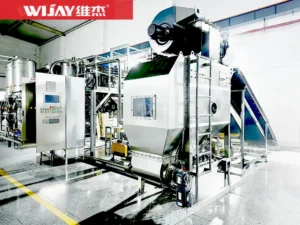
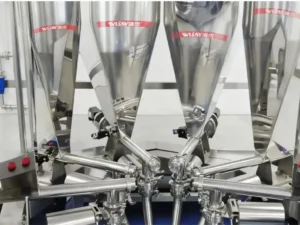
The core of an effective cleaning stage is a precision-engineered fluidizing plate with specially designed slots, positioned so cleaning air flows upward through the pellet bed. That upward airflow fluidizes the pellets and strips surface dust and streamers away without mechanical contact, which avoids the pellet degradation risk that comes with abrasive or high-friction cleaning methods.
Separation and Controlled Discharge
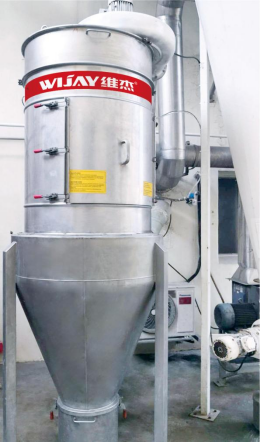
Cleaned pellets exit through a lower discharge point while the contaminated air stream is routed through a dedicated extraction system into a dust collector or cyclone separator, where particulate is captured before the air is either vented or recirculated. This staged approach keeps the process continuous — pellets move through cleaning without interruption, and captured contaminants don’t have a path back into the material stream.
Open-Loop and Closed-Loop Configurations
An open-loop configuration draws in fresh filtered air and routes contaminated exhaust through dust collection, which makes it well suited to operations changing products or colors frequently, since it avoids any risk of cross-contamination between runs carried over in recirculated air. A closed-loop configuration recirculates air through the cleaning stage after dust removal, which fits applications running similar product grades consistently or requiring an inert atmosphere — oxygen-sensitive polymers, for example, where minimizing fresh-air exchange matters for material stability. Both configurations are designed for energy efficiency and low maintenance, and scale to different throughput requirements within the same basic architecture.
Integration at Multiple Points Along the Line
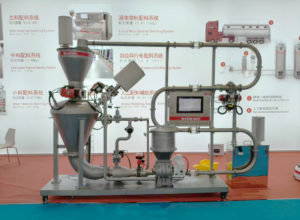
A modular cleaning station can be positioned wherever contamination risk actually matters in the process, rather than at a single fixed point:
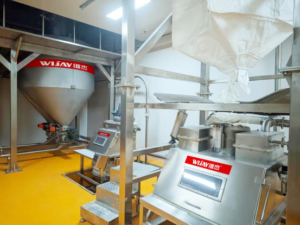
- Central buffer bins or day tanks, ensuring clean pellets are distributed consistently to multiple downstream processing machines
- Extruder and injection molding hoppers, preventing dust-related defects, surface blemishes, or gel formation right at the processing throat where contamination has the most direct impact on part quality
- Packaging systems, integrated at the hopper outlet to keep packaged material dust-free
- Recycling operations, cleaning regrind or flake ahead of optical sorting equipment, where dust buildup on sensors is a common cause of sorting errors
What This Delivers in Production
In pilot trials of this kind of in-line cleaning approach, dust concentration measured before and after treatment showed a reduction from roughly 3,631 ppm to about 59 ppm — a removal efficiency near 98%. Results like that translate directly into fewer film and fiber defects, lower scrap rates from dust and streamer scorching in molds, reduced downstream maintenance, and measurably lower dust exposure risk on the production floor, which matters directly for both worker safety and combustible dust compliance.
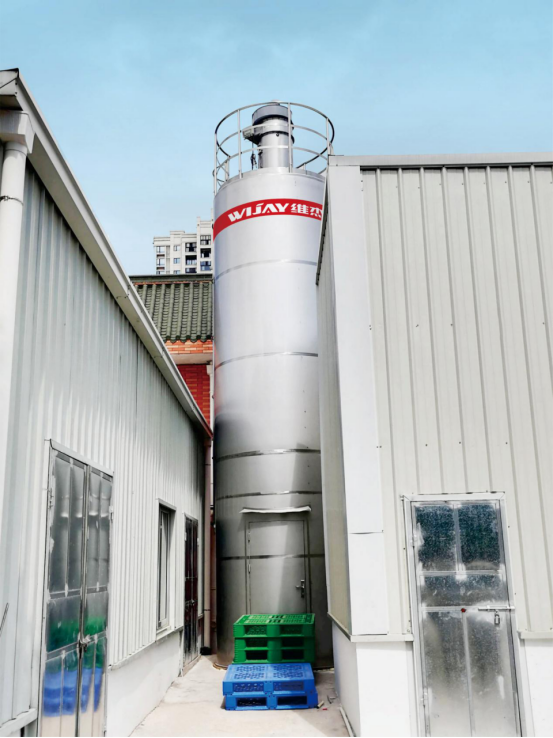
The broader takeaway for any plant running pneumatic conveying on plastic pellets, granules, or flake is that dust and streamer contamination isn’t an occasional nuisance to manage reactively — it’s a predictable, structural byproduct of the conveying process itself, and it needs to be engineered out at the system level rather than filtered out downstream after it’s already caused a defect. WIJAY Systems designs pneumatic conveying lines with contamination control built into the process architecture from the start — matched to the specific material’s abrasiveness, moisture sensitivity, and softening behavior, rather than treating cleanliness as an accessory added after the conveying system is already specified.
FAQ
Is dust and streamer formation avoidable in pneumatic conveying, or does it always happen? It’s a structural byproduct of pellet-to-pipe and pellet-to-pellet friction in both dilute-phase and dense-phase conveying, so it can’t be fully eliminated at the source — which is why in-line cleaning, rather than prevention alone, is the practical solution. WIJAY designs conveying routing and velocity to minimize contamination generation in the first place, while still specifying cleaning capability for what remains.
How much dust reduction can in-line pellet cleaning actually achieve? Pilot trial data for this cleaning approach showed dust concentration dropping from roughly 3,631 ppm to about 59 ppm, a removal efficiency near 98%. WIJAY recommends validating cleaning performance on actual material samples before committing to full-scale integration, since results vary by pellet type and process conditions.
Should pellet cleaning use an open-loop or closed-loop air configuration? Open-loop configurations suit operations changing products or colors frequently, since fresh air avoids cross-contamination between runs. Closed-loop configurations suit consistent product runs or oxygen-sensitive materials that benefit from a controlled, recirculated atmosphere. WIJAY specifies the configuration based on a plant’s actual product mix and material sensitivity rather than defaulting to one setup.
Where in a pneumatic conveying line does pellet cleaning need to be integrated? Effective cleaning is typically positioned at central buffer bins, extruder or injection molding hoppers, packaging hopper outlets, and ahead of optical sorting in recycling operations — wherever contamination has the most direct impact on downstream quality or equipment. WIJAY designs conveying systems with cleaning integration points matched to a plant’s specific process layout.
Does removing dust and streamers actually reduce downstream maintenance and safety risk? Yes. Lower dust loading reduces buildup-related maintenance inside conveying and processing equipment and lowers airborne dust exposure on the production floor, which directly affects both combustible dust risk and worker safety. WIJAY factors dust control into conveying system design specifically to reduce these downstream costs, not just to improve visible product quality.