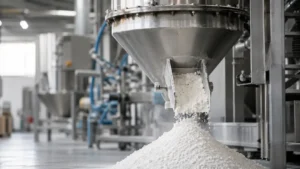
Walk into most food production plants during a batching shift, and you’ll see the same thing: an operator hand-scooping flour or sugar from an open bag, eyeballing a scale, and dumping it into a mixer while fine powder drifts across the floor and settles on every surface within reach. It looks routine. It is also the single most common root cause cited when a food safety audit goes wrong.
If you run production, quality, or plant engineering, you already know the symptoms. Airborne dust that triggers housekeeping non-conformances. Additive overages that trip a deviation report. A batch record that’s really just a clipboard entry someone filled in from memory an hour after the fact. None of it looks dangerous day-to-day — until an auditor asks for traceability on a specific lot, or a customer complaint traces back to cross-contact between an allergen-containing ingredient and a “clean” line.
This is the operational reality behind a growing wave of food safety enforcement. Regulators worldwide have shifted from reactive penalties toward source-level control, and batching — the point where raw ingredients first combine — has become the most scrutinized step in the entire process. Plants relying on manual, open-air dosing are increasingly the ones failing inspections, not because the recipe is wrong, but because the process can’t prove it was executed correctly.
Why Manual Batching Still Fails Modern Food Plants
Manual batching carries four structural weaknesses that no amount of operator training fully eliminates:
Airborne cross-contamination. Every open transfer of flour, sugar, or powdered additive releases fine particulate into the air. That dust settles on adjacent lines, conveyors, and exposed product — a documented vector for allergen cross-contact even when ingredients never physically touch.
Weighing drift. Manual scale readings depend on operator attention, scale calibration discipline, and consistent technique across shifts. Dosing accuracy on hand-weighed lines commonly drifts well outside ±1%, which is enough to push a minor additive over regulatory limits or throw off a sensitive formulation.
Sanitation gaps. Open hoppers, scoops, and exposed transfer points create surfaces that are difficult to clean between batches. Manual teardown-and-wash cycles are time-consuming, inconsistent, and frequently skipped under production pressure — creating conditions for microbial growth in residual product film.
Missing or unreliable batch records. Paper logs and after-the-fact data entry cannot reconstruct a precise timeline of what was added, when, and by whom. When a recall investigation needs lot-level traceability within hours, incomplete records turn a contained issue into a full-line shutdown.
The downstream cost is rarely a single event — it’s compounding. A single unplanned line stoppage in food processing typically costs several thousand dollars per hour once cleanup, requalification, and lost throughput are counted, and that’s before recall logistics, retailer chargebacks, or reputational damage enter the picture.
What a Batching System Actually Needs to Solve
A batching system isn’t just a scale with a hopper on top. To close the gaps that manual processes leave open, it has to address ingredient handling from intake to record-keeping as one connected system — not four separate fixes bolted together.
Enclosed Material Transfer
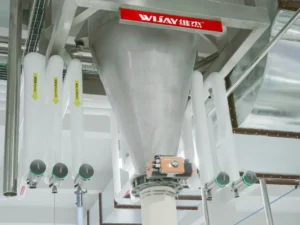
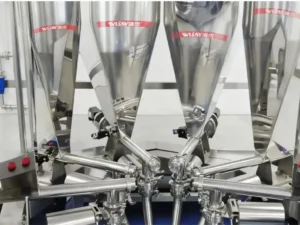
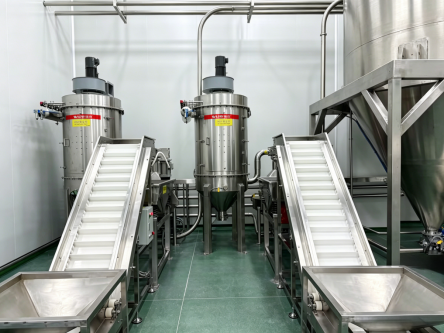
Ingredients should move through fully sealed pneumatic piping — positive-pressure, negative-pressure, or dense-phase, depending on the material — from storage through to the batching point. Flour, sugar, and additive powders never contact open air. Dedicated, non-shared piping per ingredient eliminates the cross-contact risk that shared chutes and scoops introduce.
Precision Weighing and Formula Locking
Dosing accuracy should be measurable, not estimated. A properly engineered gravimetric weighing module holds batch accuracy within ±0.3%, and locking approved formulations into the control system removes the possibility of an operator adding the wrong quantity — by design, not by reminder.
Automated CIP Sanitation
Clean-in-place systems that circulate food-grade acid and alkaline solutions through piping and storage vessels eliminate manual teardown entirely. No exposed surfaces, no missed corners, and a documented, repeatable sanitation cycle every time — a requirement under HACCP and GB 14881-aligned food production standards, and expected under BRCGS and comparable international frameworks.
Digital Traceability
Every batch — weight, timing, ingredient lot, and cleaning cycle — should be logged automatically to an industrial control system, encrypted, and exportable on demand. When an auditor or customer asks for a specific batch history, the answer should take minutes, not a warehouse search through binders.
Engineering It Across Different Product Lines
Food ingredients don’t behave uniformly, and a batching system built for one material profile often fails on another. Powdered sugar clumps under humidity and needs integrated grinding and dehumidification ahead of dosing. Oil and flour operations require dual-line handling — liquid fat and dry powder moving through separate, leak-proof piping that never lets oil contaminate a dry product stream. Snack and confectionery lines often run multiple micro-ingredients simultaneously, which demands tight formula-locking to prevent recipe drift batch to batch.
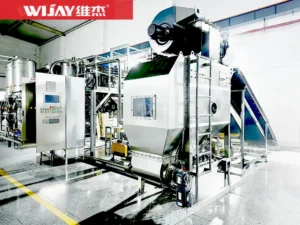
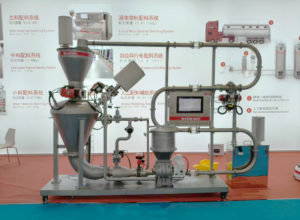
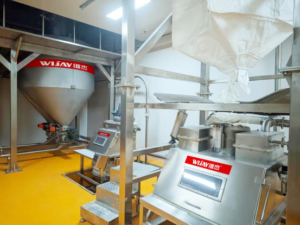
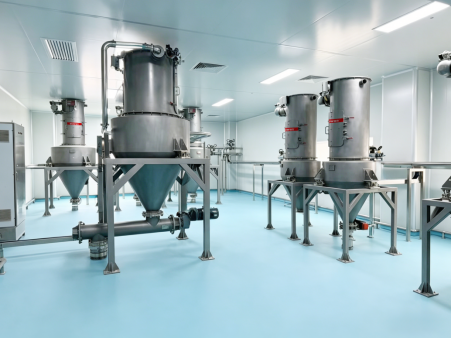
WIJAY Systems designs enclosed pneumatic batching platforms specifically around this variability — supporting throughput from 15 to 30 tons per hour, with conveying distances up to 300 meters horizontal and 150 meters vertical. Contact parts are built in 304 or 316 food-grade stainless steel throughout. The platform is deployed both as a full turnkey line for new plant builds and as a modular retrofit for existing facilities that need to upgrade batching without a full production shutdown.
In practice, this consolidation changes staffing math as much as safety math: production lines that previously required multiple operators per shift for manual weighing and cleanup typically run with one to two people once batching, transfer, and CIP are automated — while cutting raw material loss from spillage and over-dosing.
Where This Leaves Plant Decision-Makers
Food safety enforcement isn’t trending toward more paperwork — it’s trending toward provable process control. A batching system that physically prevents cross-contact, locks formulations against error, automates sanitation, and logs every batch isn’t a convenience upgrade. It’s becoming the baseline expectation for any plant that wants to pass audits without relying on a clean inspection day.
If your current batching process still depends on an operator’s attention and a clipboard, the risk isn’t hypothetical — it’s sitting in your next audit cycle.
FAQ
What is a batching system in food manufacturing? A batching system is an automated setup that transfers, weighs, and combines raw ingredients — typically powders and liquids — according to a locked formulation, replacing manual scooping and hand-weighing with sealed, measurable, repeatable dosing.
How accurate is automated batching compared to manual weighing? Manual weighing commonly drifts beyond ±1% depending on operator technique and scale calibration. Engineered gravimetric batching systems, like WIJAY’s, hold accuracy within ±0.3% consistently across shifts.
Can an existing production line be retrofitted with a batching system? Yes. Enclosed batching platforms can be installed as modular upgrades on existing lines without a full facility rebuild, which is typically the fastest path for plants under audit pressure to close compliance gaps.
Does a batching system help with allergen and cross-contamination control? Yes. Because ingredients move through dedicated, sealed piping rather than open scoops or shared chutes, a properly designed batching system removes the airborne and surface cross-contact pathways that manual handling creates.