If you run a bulk solids line, you already know the bulk bag isn’t the problem — how it’s handled is.
Walk any plant moving dry bulk material in FIBCs (flexible intermediate bulk containers, or “bulk bags”) and the same four failure points show up: bags filled unevenly because the operator eyeballed the fill weight, bags shifted or tipped in transit because the lifting loops weren’t seated right, floor space eaten up by bags stacked loose and wide because nobody trusted a second tier, and product left caked in the bottom corners because the discharge chute wasn’t built for the material. None of these show up as a single dramatic failure. They show up as margin — 2% here, 3% there, a pallet position lost, an hour of cleanup after a bag tips on a forklift run. By the end of a quarter, it’s real money.
We’ve spent years designing pneumatic conveying and bulk bag handling systems for petrochemical, rubber and tire, plastics compounding, food, pharmaceutical, battery material, and agricultural producers. The pattern is consistent: plants don’t lose value on the bag itself. They lose it in the three touchpoints around the bag — fill, transport, and discharge — where the process wasn’t engineered as a system.
Why Bulk Bags Dominate Dry Bulk Logistics — and Where They Still Fall Short
Bulk bags earn their place in the material flow for good reasons. Woven polypropylene construction gives them tear and abrasion resistance that 25 kg paper or poly bags can’t match at scale. They’re light relative to load capacity, chemically resistant enough for most industrial powders and pellets, and — increasingly relevant for procurement teams under sustainability pressure — reusable and recyclable, which lowers total cost of ownership compared to single-use small-format packaging or bulk truck delivery that requires dedicated loading infrastructure.
But a bulk bag is only as good as the system handling it. Four technical challenges consistently limit the return on a bulk bag program:
| Challenge | What Actually Happens on the Floor |
|---|---|
| Load safety | 500–1,500 kg per bag means a poorly seated lift or an off-center pallet load creates real tip-over risk during forklift transport |
| Hygiene control | Food and pharma lines need contamination control that generic bag material and open-air filling can’t guarantee |
| Stacking stability | Loose stacking wastes warehouse footprint; single-tier storage on a 1.21 m² bag footprint adds up fast at volume |
| Equipment compatibility | Lifting loop position and discharge spout geometry vary bag to bag, which breaks compatibility with automated filling and discharge equipment |
Most bulk bag suppliers stop at the bag. That’s the gap. The bag is one component in a filling-transport-storage-discharge chain, and the chain is only as strong as its weakest link.
Engineering the Full Cycle: Fill, Transport, Store, Discharge
A properly engineered bulk bag handling system is designed around the full material cycle, not just the bag itself — and it needs to work in nearly any environment where bulk material is transported or processed.
1. Consistent, Repeatable Filling
Fill consistency starts before the bag touches the filling station. An empty bag is positioned under the fill spout, the lifting loops are seated onto the support frame, and the bag is moved into place under the filling system by forklift — no manual holding, no guesswork on load balance. That single step removes the most common source of uneven fill weight: an operator manually managing a bag under load. In high-throughput operations, that inconsistency compounds — batch-to-batch weight variance that shows up later as under- or over-filled shipments and reconciliation headaches for QA.
2. Stable Internal and External Transport
Once filled, the bag needs to move — around the warehouse by forklift or pallet truck, and out the door by truck. Because the bag stays connected to the handling frame via its lifting loops throughout transport, it holds its shape and center of gravity instead of shifting mid-move. That stability is what makes high-density stacking possible: a properly engineered frame system supports stacking to 6–7 meters, which can create up to 4x the usable storage density compared to single-tier, loose-stacked bulk bags on the same floor footprint. For a plant paying by the square meter for warehouse space, that’s not a minor efficiency gain — it’s a direct line to lower carrying cost per ton stored.
3. Clean, Controlled Discharge
Discharge is where residual product loss usually hides. A bowl-shaped base plate — engineered like a funnel rather than a flat pan — keeps material flowing toward the discharge point instead of settling in dead corners. A slide gate at the base opens and closes on demand, giving operators controlled, repeatable discharge instead of an all-or-nothing dump. For powders prone to bridging or caking, this geometry matters: a flat-bottom bag or generic liner routinely leaves 1–3% of product trapped at the corners — material that’s already been paid for, processed, and packaged, then written off as waste.
Case in Point: Bringing Bulk Bag Filling In-House
One useful way to see the cumulative effect of these gaps is a compounding operation that had, for years, outsourced its bulk bag filling to a third-party logistics provider. Bags of modified compound material had to be trucked out, filled at the 3PL site, and trucked back — an extra transport leg that added time, cost, and — more critically — a loss of control over product integrity. Every external handoff is a contamination and quality-control risk that the plant itself can’t fully audit.
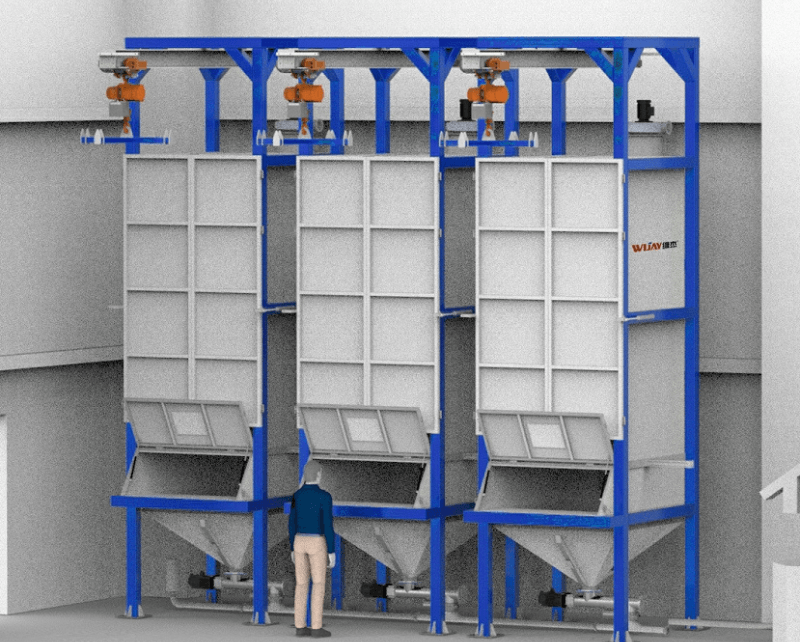
The fix was to bring filling in-house using a stackable bulk bag handling system built around the plant’s existing stacker-crane infrastructure. An open-side frame design, modified for horizontal stacker compatibility, was installed on a custom platform above the plant’s rail tank cars. Filled bags now discharge directly into the tank car below through a slide gate — no intermediate handling step, no third-party contact point.
The storage math alone justified the change. A standard bulk bag occupies roughly 1.21 m² of floor space (110 x 110 cm footprint). The stackable frame system, at 120 x 120 cm (1.44 m²), stacks two bags high — cutting the effective footprint nearly in half and freeing over 60 m² of warehouse floor compared to single-tier, side-by-side storage. Empty bags stay in the frame after discharge, ready for immediate refilling without teardown, which shortens turnaround time on high-frequency SKUs.
Net result: full in-house control of the fill-to-transport cycle, elimination of third-party contamination risk, and a projected payback period of roughly four years on the system investment.
What Made the Project Work
- A frame configuration engineered specifically for the plant’s existing stacker-crane operation, not a generic retrofit
- Gravity-fed, top-down filling with direct discharge into transport vehicles — no intermediate handling
- Stackable frames for space-efficient, orderly warehouse storage
- Fewer material touchpoints, which directly lowers contamination and quality risk
- Time saved at fill and discharge translating directly into lower per-unit handling cost
Additional Engineering Details Worth Knowing
Smart filling infrastructure:
- Automated empty-bag positioning at the fill station
- Precision lifting-loop docking mechanism for consistent bag orientation
- Forklift-compatible base chassis for fast staging and repositioning
Transport reliability:
- Omnidirectional forklift pocket design for access from any approach angle
- Patented anti-sway stabilization geometry to prevent load shift in transit
- Stacking capability to 6–7 meters, supporting up to 4x storage density gains
Discharge precision:
- Bowl-shaped funnel base plate to maintain continuous material flow
- Adjustable slide-gate discharge for controlled flow rate
- Bridge-breaking mechanism to address powder caking and arching at the outlet
FAQ: Bulk Bag Storage and Transport
How much floor space can stackable bulk bag systems actually save? In documented cases, moving from single-tier to two-tier stackable bulk bag storage has freed over 60 m² of warehouse floor space for the same inventory volume — roughly cutting the effective footprint per bag in half.
What’s the typical payback period on an integrated bulk bag handling system? Payback varies by throughput and labor cost, but plants that eliminate third-party filling and reduce product loss at discharge have seen payback periods around four years, driven mainly by labor, transport, and material-loss savings.
Can bulk bag systems handle hygienic or pharmaceutical-grade requirements? Yes — with bag materials and closed-transfer discharge designed to limit open-air exposure, bulk bag systems can meet the contamination-control standards required in food and pharmaceutical environments, provided the filling and discharge equipment is engineered for those requirements rather than adapted from general industrial use.
What causes product loss during bulk bag discharge? Flat-bottom bag geometry and fixed, non-adjustable outlets are the most common causes. Material bridges or settles in the corners instead of flowing to the outlet, leaving residual product that’s effectively written off as waste.
Get a Bulk Bag Handling Assessment for Your Line
Bulk bag value isn’t determined by the bag — it’s determined by the system around it: how consistently it’s filled, how stably it transports, how densely it stores, and how cleanly it discharges. WIJAY Systems designs integrated bulk bag handling, pneumatic conveying, and powder automation systems for petrochemical, plastics, rubber and tire, food, pharmaceutical, battery material, and agricultural producers who need enclosed, low-loss, automated material flow across the full cycle.
If your plant is losing floor space, cycle time, or product to an unoptimized bulk bag process, talk to our process engineering team about a line assessment.