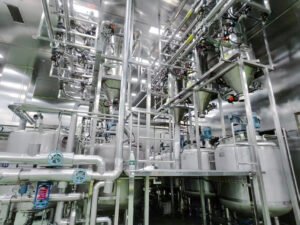
Walk into most food processing plants running on aging metal silos and storage tanks, and the signs are familiar: condensation dripping onto ingredients during seasonal temperature swings, welded seams that trap residue no CIP cycle fully clears, corrosion pitting that shows up during a routine audit, and a maintenance team that spends more hours patching tanks than running production. None of this shows up on a spec sheet — it shows up on a downtime report.
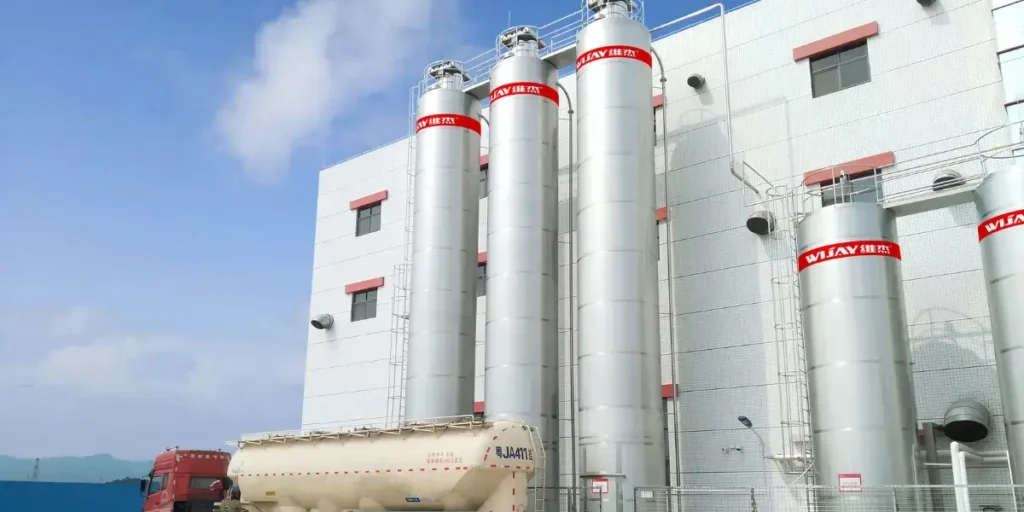
We’ve walked enough production floors to know the pattern: a single storage tank failure — a seam leak, a contamination flag, a structural repair — can shut down a line for days. In food manufacturing, where batch integrity and traceability are non-negotiable, the storage tank isn’t a passive vessel. It’s a control point in the process, and when it fails, everything downstream fails with it.
That’s why a growing number of food manufacturers are moving away from carbon steel, stainless steel, and aluminum tanks toward composite GFRP (glass-fiber reinforced polyester) storage tanks — a material category that has been standard practice in European food production for over 50 years, and is now gaining ground globally as plants look for a better balance of hygiene, durability, and cost control.
Why Metal Storage Tanks Struggle in Food Production
Metal tanks aren’t inherently bad — they’re simply mismatched to some of the realities of modern food processing:
- Seam and weld vulnerabilities. Welded joints create micro-gaps where product residue accumulates, increasing contamination risk and complicating sanitation validation.
- Corrosion under acidic or high-moisture conditions. Sauces, brines, dairy, and fermentation environments accelerate metal degradation over time.
- Poor thermal stability. Metal’s high thermal conductivity means condensation forms readily on interior walls during temperature shifts, directly affecting product quality and shelf stability.
- Heavy structural loads. Metal tanks require reinforced foundations, longer installation timelines, and higher rigging costs — all of which add up before a single batch is produced.
None of these are edge cases. They’re the everyday operating conditions of a food plant, and they explain why composite storage tanks have moved from a niche alternative to a mainstream engineering decision.
What a Composite Storage Tank Actually Solves
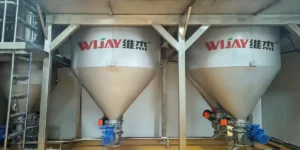
A composite storage tank is built from GFRP — a material selected specifically because it balances mechanical strength, chemical resistance, and cost-efficiency in a single monolithic structure. The tank is formed as one continuous shell, without the seams or welds that create hygiene liabilities in metal construction.
Hygienic, Seamless Storage
Because the tank body doesn’t corrode, oxidize, or react with stored product, and is molded without joints, there are no crevices where residue can collect. That translates directly into cleaner CIP validation results and a lower risk of cross-contamination between batches.
Thermal Performance Without Cold Bridging
Composite material has naturally low thermal conductivity, which limits condensation and helps hold stored product at a stable temperature — a meaningful factor for flowability and freshness in powders, grains, and liquids alike. When additional insulation is required, composite tanks can be fully insulated with a sandwich-panel structure at the factory, with no cold-bridging points, so the tank is ready for immediate use on-site. As a reference point: a composite tank insulated with 50mm PU foam delivers roughly the same thermal performance as a metal tank insulated with 100mm rock wool plus an aluminum cladding layer — at a fraction of the added weight and installation labor.
Engineering Flexibility
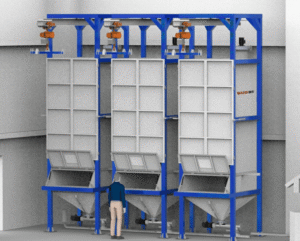
Composite construction gives design engineers far more freedom to match a tank to the actual process — custom volumes, geometries, load-cell weighing integration, and full RAL color matching for corporate branding. For powder handling environments, composite silos are also available in ATEX-rated configurations, capable of reducing explosion pressure by up to 1 bar, which directly benefits required pressure-relief area calculations.
Corrosion and Weather Resistance
Composite tanks resist chemical exposure, weathering, and abrasion far better than metal over a multi-decade service life, and UV-stabilized coatings prevent surface degradation outdoors. The practical result is a longer replacement cycle and minimal maintenance spend — instead of annual recoating or patch-welding, plants are looking at years of low-intervention operation.
Lightweight, Faster Installation
A composite tank’s strength-to-weight ratio means lighter foundations, shorter crane time, and faster installation than an equivalent metal structure — a real advantage for plants trying to minimize construction downtime. The material also dampens sound and vibration, which matters for facilities operating in noise-restricted urban zones.
Lower Environmental Footprint, Lower Total Cost
Many composite tanks are manufactured using recyclable materials with a lower carbon footprint than traditional metal fabrication. Combined with reduced maintenance and energy costs over the tank’s service life, the total cost of ownership consistently comes in below comparable metal installations — even when the upfront quote looks similar.
Where Composite Storage Tanks Fit in a Food Production Line
- Raw material storage — flour, sugar, rice, salt, grains, and glucose, stored without contamination or quality loss risk from a corroding surface.
- Liquid storage — oils, juices, dairy, sauces, and syrups, held in a chemically resistant, hygienic environment.
- Fermentation — beer, wine, sauces, yogurt, cheese, and fermented vegetables benefit from the chemical resistance, insulation, and temperature control composite tanks provide.
- Processing stages — mixing, blanching, pasteurizing, cooling, and freezing operations that require tanks capable of handling both high- and low-temperature extremes.
Composite storage tanks and silos used in food production are typically manufactured to comply with EU food-contact regulations (EG 1935/2004 and the associated materials-in-contact-with-food requirements), with suppliers certified to EU 10/2011 through TÜV and Eurofins — a compliance baseline worth confirming with any supplier before specification.
Beyond Food: Where Else Composite Tanks Are Proving Out
The same properties driving adoption in food plants are showing up across other bulk material industries:
- Animal feed — efficient, contamination-resistant storage at scale
- Chemical processing — corrosion resistance in aggressive environments
- Water treatment — durable, sustainable system design
- Road salt storage — better weather resistance, lower environmental impact
- Construction materials — cement, sand, and aggregate storage
- Renewable energy — biomass, biogas feedstock, and related material storage
Where the Storage Tank Fits Into the Bigger System
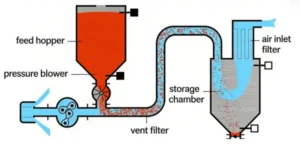
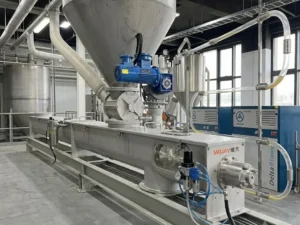
A storage tank rarely operates in isolation — it’s one link in a material handling chain that includes conveying, dosing, and process integration. At WIJAY Systems, we’ve seen firsthand how a well-specified tank can still underperform if the surrounding material transfer isn’t engineered with the same rigor. That’s the gap we focus on: pairing storage infrastructure with enclosed, dust-free pneumatic conveying and full-line automation, so material moves from intake to storage to process with minimal manual handling, minimal product loss, and full batch traceability.
For plants running multiple raw materials across different hygiene and explosion-risk zones, that means one integrated system — rather than a tank purchased separately from the conveying equipment feeding it — with automation controls that reduce the human error and batch variance that come from manual transfer.
FAQ
Q: How long does a composite storage tank typically last compared to metal? With proper UV-stabilized coating and standard maintenance, composite storage tanks are engineered for multi-decade service life, generally outperforming carbon steel tanks in corrosive or high-moisture environments.
Q: Are composite storage tanks suitable for ATEX (explosion-risk) environments? Yes. Composite silos are available in ATEX-rated configurations, with explosion pressure reduction of up to 1 bar, which benefits pressure-relief area requirements for powder handling.
Q: Do composite storage tanks meet food-contact compliance standards? Reputable manufacturers produce composite food-storage tanks to EU 1935/2004 and EU 10/2011 requirements, with third-party certification such as TÜV and Eurofins. Always confirm certification documentation before specification.
Q: Is a composite storage tank more expensive than a metal tank? Upfront costs are often comparable, but total cost of ownership is typically lower due to reduced maintenance, faster installation, and a longer service life with minimal degradation.
Talk to an Engineer, Not a Salesperson
If your plant is evaluating a storage tank upgrade — or looking to integrate storage with conveying and automation into a single closed-loop system — WIJAY Systems can walk through your material characteristics, hygiene requirements, and throughput targets to spec a solution built for your actual production conditions, not a generic catalog fit. [Contact our process engineering team] to start the conversation.