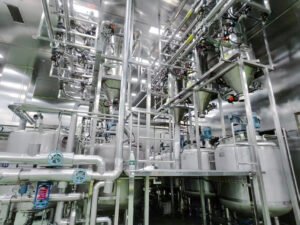
Picture a formulation with forty-plus minor ingredients, each dosed in grams, each with its own allergen profile, each pulled from a warehouse that stocks over a thousand SKUs. Now picture running that formulation twelve times an hour, alongside eleven other formulations that don’t share a single ingredient. That’s the operating reality on modern soup, sauce, seasoning, and ready-meal lines — and it’s exactly the scenario that breaks a conventional raw material transfer and proportioning system before it ever reaches full capacity.
If your plant has ever pulled a batch for a suspected cross-contact event, watched a pneumatic line clog on a hygroscopic powder mid-shift, or spent a weekend reconciling a manual weighing log after an audit flag, you already know this isn’t a hypothetical. It’s Tuesday.
Why Multi-Component Batching Breaks Conventional Transfer Systems
The Cross-Contamination Problem With Multi-Pipe Pneumatic Systems
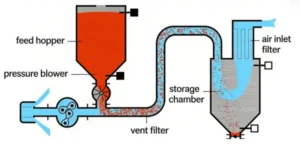
The textbook answer to moving hundreds of different powders is a dedicated pneumatic line per ingredient, or per ingredient family. In practice, that answer collapses fast. A plant handling a few hundred medium- and small-volume ingredients would need a corresponding wall of pipework, valves, and filters to keep every allergen and every formulation isolated — and even then, shared header sections, imperfect purge cycles, and human error at manual add points leave real cross-contact risk. For allergen-controlled or halal/kosher-segregated production, that risk isn’t a quality issue. It’s a recall issue.
Moisture-Sensitive Powders and the Hidden Cost of Line Blockages
Seasoning blends, stock powders, and dessert mixes are full of hygroscopic ingredients — the kind that pick up ambient moisture and cake solid inside a pipe run. Once a line blocks, it doesn’t just stop that ingredient; it stops the batch, and often the mixing line behind it. Multiply that across dozens of ingredient-specific lines and the maintenance burden becomes a full-time job rather than an occasional callout.
Capex and Maintenance Costs Nobody Puts in the RFP
A dedicated multi-pipe pneumatic network scales in cost roughly with the number of ingredients it has to isolate — not with production volume. For a plant running a thousand-SKU raw material list, that means an enormous upfront investment in redundant pipework, plus an ongoing maintenance load of valves, filters, and purge systems that grows every time a new formulation is added to the menu.
What the Data Says About Hidden Batching Losses
Process teams running high-mix, small-batch lines typically report the same categories of hidden loss, even when they haven’t put a number on them yet:
- Changeover and purge time eaten up by cleaning shared transfer paths between allergen-sensitive formulations
- Manual weighing variance on sub-kilogram minor ingredients, where hand-scooped or manually dosed additions are the most common source of formulation deviation
- Blockage-driven downtime concentrated on the same handful of hygroscopic ingredients, batch after batch, quarter after quarter
- Traceability gaps when container movement and dosing events aren’t automatically logged against a batch record, turning audit prep into a manual reconciliation exercise
None of these show up as a single dramatic failure. They show up as a plant that’s structurally capped on how many SKUs and batches per hour it can safely run — regardless of how much floor space or headcount gets added.
Industry Standard: What a Modern Transfer and Proportioning System Must Deliver
For a high-mix, small-batch production environment, a raw material transfer and proportioning system needs to satisfy requirements that a single fixed-pipe network structurally cannot:
- Segregated transfer paths by ingredient class — bulk, medium, and minor ingredients each need a handling method matched to their volume and risk profile, not one pipe network stretched across all three
- Hygienic, CIP-capable contact surfaces wherever ingredient containers or transfer equipment touch product
- Automated weighing with tight tolerance — for medium-volume ingredients this typically means gram-level accuracy without manual intervention
- Full batch traceability, with container movement, weighing events, and operator actions logged against the order automatically, not reconstructed after the fact
- Flexibility to add SKUs without adding pipework — the system needs to scale by adding containers and routing logic, not by re-piping the plant
- Parallel order processing, so multiple formulations can be staged and proportioned simultaneously without one batch blocking the next
Field Example: A 1,000-SKU Food Manufacturing Line Built on Mobile Transfer and Proportioning
A useful reference point comes from a major European long-life convenience food manufacturer — a producer of soups, sauces, stocks, seasonings, desserts, and ready meals supplying restaurants, caterers, and retailers across multiple countries, with roughly 1,500 employees. Since 2017, the company has operated a purpose-built plant in southern Germany producing dry-mix soups, sauces, stocks, and seasonings at a target output of 40,000 tons per year — 12 batches per hour, 2,000 liters per batch — while sourcing from a raw material list of up to 1,000 different ingredients across small, medium, and large batch sizes.
Running that combination on a conventional fixed-pipe pneumatic and metering setup would have meant a multi-pipe network sized for hundreds of medium and minor ingredients, with the associated cross-contamination risk, blockage exposure from moisture-sensitive powders, and escalating capex and maintenance cost. Instead, the plant was built around a mobile IBC-based transfer and proportioning system, engineered by Daxner (Austria):
- Bulk ingredients are stored in 10 outdoor silos and pneumatically conveyed directly to four mixing lines
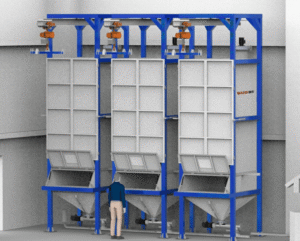
- Medium-volume ingredients are held in 30 day bins, fed by bag stations and FIBC (bulk bag) unloading stations, and metered through 40 automated weighing stations positioned beneath stainless steel day bins — achieving roughly ±50 gram accuracy without manual weighing
- Minor ingredients — over a thousand SKUs, each dosed under 1 kilogram — are stored in an automated warehouse with 9,000 bins. The order system automatically retrieves the required containers to four manual dosing stations, where operators add barcode-verified ingredients into transfer trays that then return to storage
- Fifty 1,200-liter hygienic, CIP-washable IBC totes, moved by four laser-guided AGVs, circulate through the plant. Empty totes are automatically positioned under the correct weighing station, docked, and filled — pre-weighing logic allows a fill rate of up to 12 totes per hour
- After automated weighing, each tote moves to one of four manual addition stations for minor-ingredient dosing, then travels via AGV to a lift platform above the mixing line, where an electric forklift positions it at a self-centering discharge station equipped with a vibration motor for residue-free unloading
- Four heavy-duty plow-blade mixers complete fast, uniform blending before the finished product is packed into bulk bags
The system spans three floors and roughly 4,000 square meters, integrating outdoor silo storage, day-bin transfer, weighing, six independent mixing lines, and IBC discharge into one continuous automated flow — engineered specifically to eliminate the cross-contamination and blockage risks that a fixed multi-pipe network could not avoid at this ingredient count.
How This Translates Into WIJAY’s Approach to Raw Material Transfer and Proportioning
Cases like this reflect a consistent pattern across food, chemical, and industrial powder processing: once an operation crosses a certain threshold of ingredient count and batch variety, fixed-pipe transfer stops scaling safely. The fix is systemic — matching transfer method to ingredient class, engineering hygienic and dust-free handling at every transfer point, and building traceability into the control layer rather than bolting it on afterward.
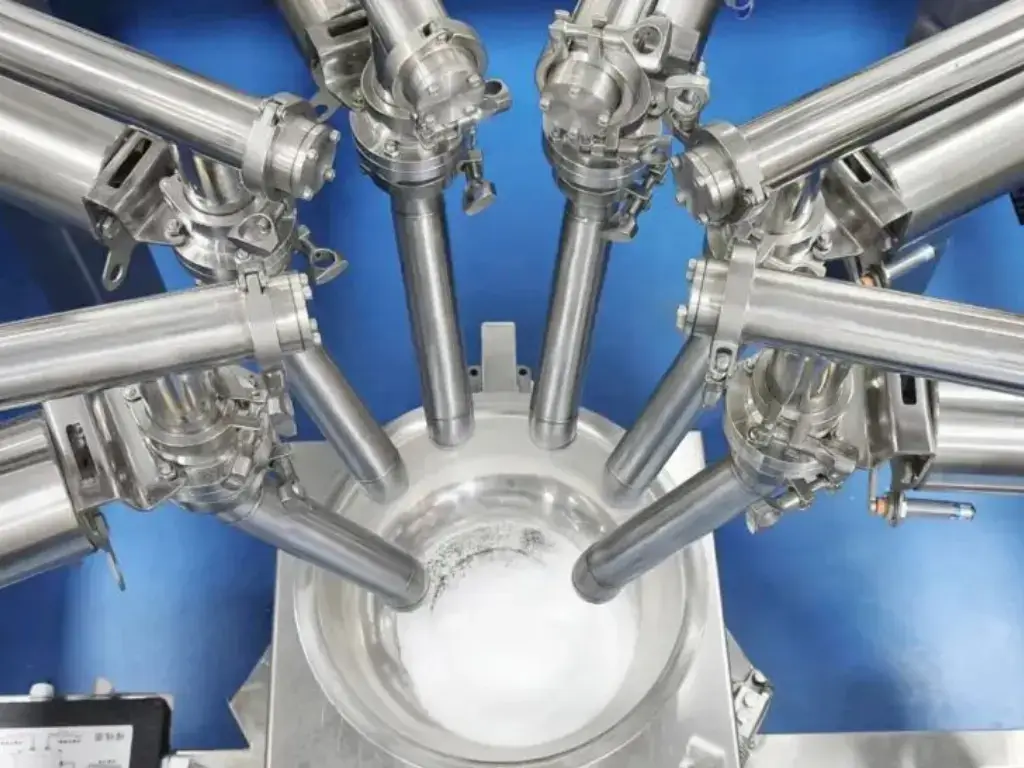
That’s the same design logic behind WIJAY Systems’ approach to bulk material handling and powder automation:
- Integrated line design — bulk storage, transfer, weighing, and mixing engineered as one coordinated system rather than isolated equipment purchases
- Enclosed, dust-free transfer at every stage, from silo discharge to final mixing, protecting both product integrity and worker exposure
- Low-degradation, low-cross-contamination transport paths, with segregation built into the routing logic rather than relying on cleaning cycles alone
- Automated proportioning and batch control, with digital systems that interface directly with plant ERP to log container movement, weighing events, and order status in real time
- Multi-industry adaptability — the same transfer-and-proportioning architecture applies to food ingredients, chemical powders, or industrial minerals; what changes is the hygienic spec and container design, not the underlying automation logic
FAQ
What’s the difference between material transfer and proportioning in a batching system? Transfer refers to moving raw material from storage to a process point — via pneumatic line, mobile container, or mechanical conveyor. Proportioning refers to metering the correct quantity of each ingredient for a specific formulation. A modern raw material transfer and proportioning system combines both functions under one control layer so that movement and dosing are tracked as a single traceable event.
Why use mobile IBC or tote-based transfer instead of fixed pipework for high-mix production? Fixed pipework scales in cost and contamination risk with the number of ingredients it has to isolate. Mobile containers scale by adding routing logic and container count instead, which makes it far easier to add new SKUs or formulations without re-engineering the plant’s transfer network.
How does an automated system prevent cross-contamination across hundreds of minor ingredients? By segregating ingredient handling at the container level — each batch of material travels in its own hygienic, cleanable tote or bin rather than sharing a pipe network with other ingredients — combined with barcode verification at manual dosing points and CIP cleaning between uses.
What weighing accuracy is realistic for automated proportioning of medium-volume ingredients? Gram-level accuracy — commonly in the range of ±50 grams for medium-volume ingredients metered through automated weighing stations — is achievable without manual intervention when weighing is integrated directly into the container-handling and control system.
If your plant is running into cross-contamination risk, blockage-driven downtime, or a traceability gap on a high-mix, small-batch formulation list, that’s a transfer and proportioning system design problem — not a staffing problem. WIJAY Systems engineers integrated raw material transfer, weighing, and proportioning systems for food, chemical, and industrial powder producers — talk to our process engineering team about auditing your current material flow.