If you’ve ever watched a high-volume coffee roasting facility operate, you know the production floor is relentless. Green beans arrive in bulk bags. Roasted beans need to move to grinders. Ground coffee has to reach packaging lines — fast, cleanly, and without breaking the product. And somewhere in that chain, someone is probably still running a drag chain conveyor or a screw conveyor that jams every third shift, leaves residual grounds impossible to clean out, and chips the roasted beans you spent good money developing.
That’s exactly the problem a coffee pneumatic conveying system is built to solve.

What Is a Coffee Pneumatic Conveying System?
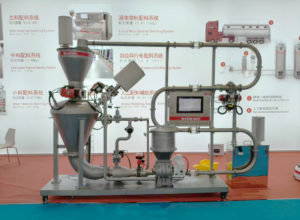
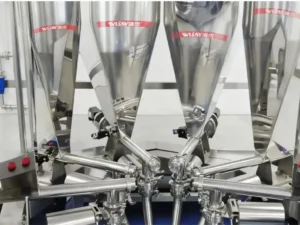
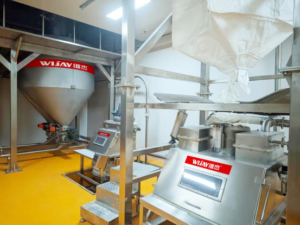
A coffee pneumatic conveying system uses air pressure — either positive pressure or vacuum — to transport coffee beans, ground coffee, or green beans through sealed pipework from one point in the production line to another. Unlike mechanical conveyors, there are no chains, flights, or augers touching the product. The material moves inside a closed tube, suspended or pushed by an airstream.
At its core, the system consists of five main components:
- Pick-up point (hopper, bag dump station, or silo outlet)
- Convey tubing (typically food-grade stainless steel or aluminum)
- Vacuum receiver or pressure vessel
- Air mover (blower, compressor, or venturi)
- Control panel / PLC
The system operates in either dilute phase (high velocity, low pressure — ideal for moving material quickly over longer distances) or dense phase (low velocity, high pressure — gentler on fragile roasted beans prone to fracturing).
Why Coffee Processing Demands a More Engineered Solution
Coffee isn’t a forgiving material to handle. Consider what’s actually happening on a typical production line:
Four distinct transfer steps exist in most coffee manufacturing operations: green bean intake → roaster feed → grinder feed → packaging line. Screw conveyors and drag chain conveyors can handle one, maybe two of these steps before layout constraints or hygiene requirements make them impractical. Pneumatic conveying can serve all four from a single integrated design.
Roasted beans are fragile. After roasting, coffee beans become structurally brittle. High-velocity impacts against elbows and tube walls cause fractures, generating excess fines that throw off grind consistency and increase dust — a combustion hazard in enclosed spaces. A properly specified dense phase system, combined with long-radius elbows, significantly reduces breakage rates compared to dilute phase or mechanical handling.
Residual product is a real cost. Screw and drag chain conveyors trap grounds in crevices. Every changeover between coffee origins or roast profiles requires disassembly and manual cleaning — downtime measured in hours. Pneumatic systems convey cleanly; the pipeline can be purged dry between batches in minutes.
Food safety requirements are tightening. Closed pipeline systems eliminate open product exposure to airborne contaminants, pests, and foreign material. For processors seeking BRC, SQF, or FSSC 22000 certification, sealed pneumatic conveying is far easier to validate than open mechanical equipment.
Selecting the Right System: Dilute Phase vs. Dense Phase
This is where engineering judgment matters most. The wrong choice costs money — either in product degradation, energy consumption, or both.
| Parameter | Dilute Phase | Dense Phase |
|---|---|---|
| Air velocity | 15–35 m/s | 1–10 m/s |
| Pressure | Low (vacuum or low-positive) | Higher (2–6 bar) |
| Best for | Ground coffee, flour, fine powders | Whole/roasted beans, fragile granules |
| Bean breakage risk | Higher | Significantly lower |
| Energy use | Moderate | Moderate–higher |
| Conveying distance | Short to medium | Short to long |
For green bean intake, dilute phase vacuum systems work efficiently — beans are robust and need to move quickly from bulk bags or silos to the roaster feed hopper.
For roasted whole bean transfer to grinders or packaging, dense phase pressure conveying is the engineering-preferred choice. Lower velocity means less impact, fewer fines, and a more consistent grind downstream.
For ground coffee to packaging, the selection depends on particle size distribution and moisture content. Fine espresso grinds can become compacted or aerate differently than coarse filter grinds — a factor that affects receiver design and filter sizing.
Common Problems Wijay Systems Solves
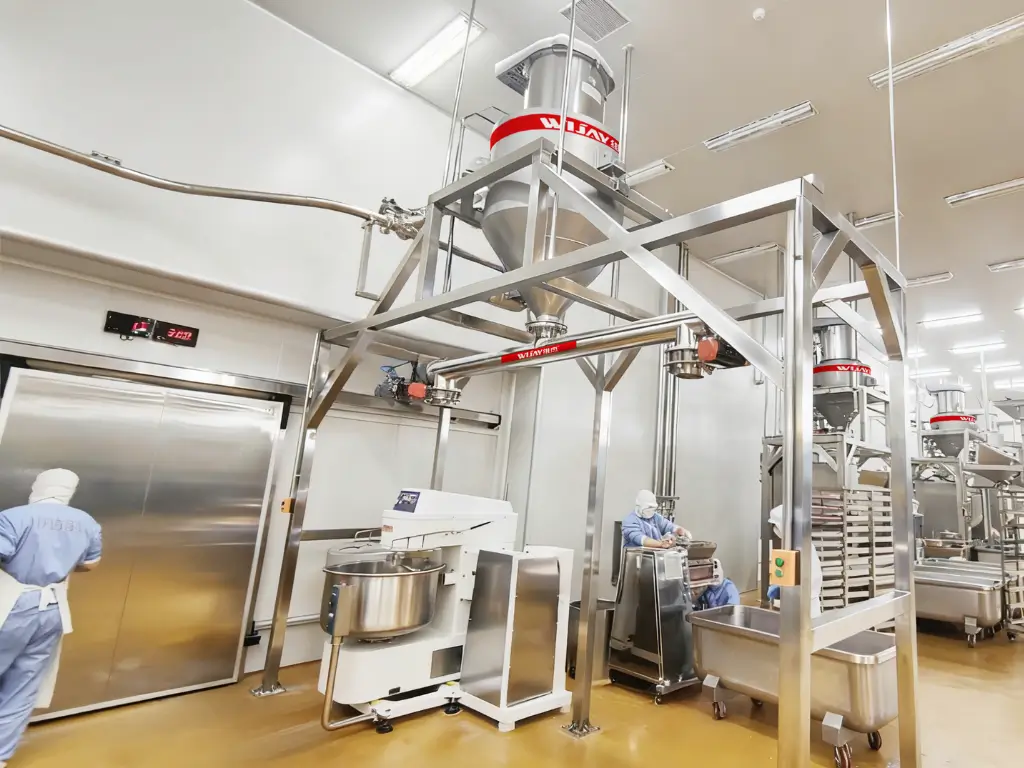
At Wijay Systems, our engineers work with food and beverage processors to design bulk material conveying systems that match actual production conditions — not theoretical minimums. In coffee applications, the issues we see most frequently are:
Elbow wear and product contamination. High-throughput lines wear out standard pipe elbows quickly. Worn elbows create leak points and introduce metal contamination risk. We specify wear-resistant elbow geometries appropriate to each transfer step.
System undersizing. Many facilities inherit pneumatic conveying systems that were specified for original line speeds, then expand production volume without upgrading the conveying capacity. An undersized system runs hot, increases bean breakage, and struggles to maintain consistent feed rates to grinders or roasters. We conduct material testing and flow simulations before specifying equipment.
Hygiene dead zones. Poorly designed receiver geometries or filter housings create areas where ground coffee accumulates between shifts. We design for full drainability and CIP compatibility where required.
Integration with the Full Food & Beverage Production Line
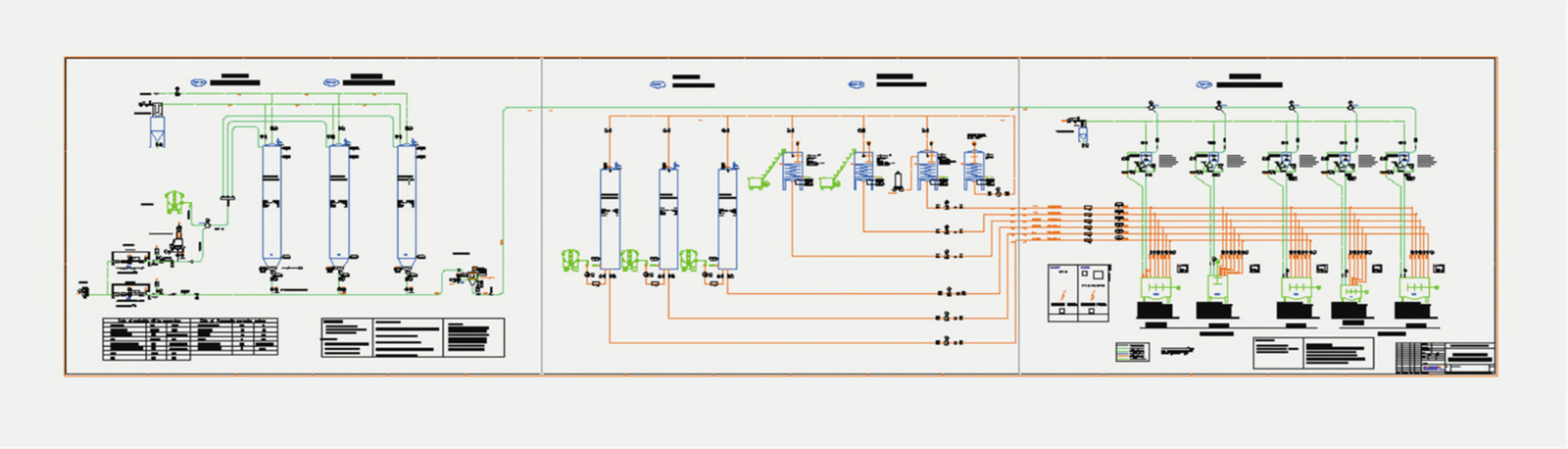
A standalone conveyor is rarely enough. Coffee processing facilities benefit most when pneumatic conveying is engineered as part of an integrated material handling system — connected to weigh batching, blending, and packaging equipment.
Wijay Systems designs food and beverage industry solutions that span the full production workflow, from intake through packaging. Our project experience in food and beverage applications demonstrates how integrated system design reduces total installed cost, simplifies validation, and shortens commissioning timelines.
Key Specifications to Define Before You Buy
Whether you’re comparing coffee pneumatic conveying system manufacturers or evaluating a first-time installation, pin down these parameters before any vendor conversation:
- Material properties — bulk density, particle size range, moisture content, abrasiveness, fragility rating
- Throughput requirement — kg/hour at peak production, not average
- Transfer distance and elevation change — horizontal run, vertical lifts, number of bends
- Number of pickup and discharge points — single-source/single-destination vs. multi-point routing
- Cleaning and changeover requirements — batch frequency, allergen segregation needs
- Regulatory standards — applicable food safety certifications, ATEX/dust explosion zoning
- Utilities available — compressed air supply pressure/flow, electrical supply
Getting these right before specification prevents the most common and most expensive mistakes: undersized blowers, inadequate filtration, and pipework layouts that can’t be cleaned to food safety standards.
Why the Best Coffee Pneumatic Conveying Systems Are Engineered, Not Catalog-Selected
The coffee processing industry is not uniform. A specialty single-origin micro-roaster handling 500 kg per day has fundamentally different requirements from a contract packer running 24/7 at 5,000 kg per hour. Catalog systems — pre-packaged units specified by generic sizing charts — work for simple, single-step transfers. Complex multi-step production lines need a systems engineer who understands both the material behavior of coffee at different roast levels and the operational realities of food manufacturing.
At Wijay Systems, that’s how we approach every project: with material data, process flow analysis, and equipment selection driven by engineering calculations, not assumptions.
Talk to a Sale Engineer
If you’re evaluating a new coffee pneumatic conveying system installation, troubleshooting an existing line, or planning a capacity expansion, our team can help you define the right system architecture from the start.
Contact Wijay Systems to discuss your application. Bring your throughput requirements, your floor layout, and your biggest conveying headache — we’ll bring the engineering.
Wijay Systems provides bulk material conveying systems for the food and beverage, chemical, plastics, and advanced materials industries. Our engineering team specializes in pneumatic conveying, screw conveyors, and integrated material handling solutions.