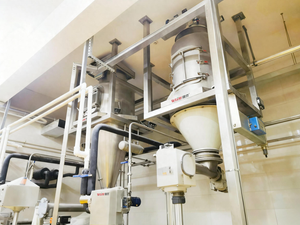
Walk into most commercial bakeries and the ingredient handling workflow looks the same: workers hauling 50-lb flour bags, white dust settling across every surface, supervisors struggling with inconsistent batch weights at the mixer. It looks like a staffing problem. It is actually a conveying system problem — one with compounding consequences for food safety, production throughput, worker health, and regulatory compliance.
This guide is written for bakery engineers, plant managers, and procurement leads who need to make informed decisions about bulk ingredient conveying systems — not just learn that vacuum conveyors exist.
What Machines Are Used in a Bakery — and Where Conveying Fits
Before specifying any conveying equipment, it helps to map where bulk ingredient handling sits in the full production sequence. A typical industrial bakery production line runs from bulk ingredient intake through mixing, dough division and forming, proofing, baking, cooling, slicing, and packaging — with mixers forming the backbone of the early process stages and ovens defining final product quality.
The conveying system is the connective tissue between bulk storage and the mixer inlet — and it is the stage most frequently left to improvisation. Every mixer, dough divider, proofer, and oven downstream depends on receiving correctly weighed, uncontaminated ingredients at the right time. A poorly designed ingredient conveying system creates variance that no downstream machine can correct.
Key conveying touchpoints in a bakery production line:
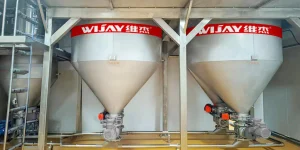
- Bulk delivery (silo fill from tanker or rail car) → day bins or buffer hoppers
- Day bin / bulk bag → pre-weighing or loss-in-weight feeder
- Weighing system → mixer inlet
- Mixer → intermediate storage or dough processing
- Seasoning/sprinkling stations → topping applicators
- Scrap / rejects → reclaim systems
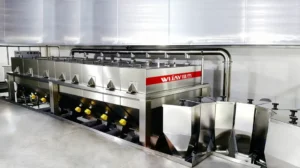
Pneumatic conveying systems are used for precise batching of ingredients for recipes, allowing accurate transfer of measured quantities to mixing or blending equipment and ensuring consistency in the final product. This is the zone where automated conveying systems pay for themselves fastest.
The Combustion Risk Nobody Talks About Plainly Enough
Sugar may seem like a simple, benign material — but fine sugar particles suspended in air at certain concentrations become highly combustible. Regulatory bodies including OSHA, NFPA 61, and ATEX classify sugar processing facilities as high-risk environments.
The 2008 Imperial Sugar explosion in Georgia killed 14 workers and injured 36. The initial explosion in an enclosed conveyor triggered a massive secondary explosion of accumulated sugar dust throughout the facility — contributing factors included extensive dust accumulation on elevated surfaces, inadequate housekeeping, and a lack of comprehensive hazard assessment.
Flour carries equal risk. Wheat flour has a Kst of 145 bar·m/s and Pmax of 7.7 bar, demanding dust collection at all transfer points and explosion venting. Its minimum explosive concentration ranges from 20–150 g/m³, meaning even small accumulations present ignition risk.
The implication for system selection is direct: open mechanical conveyors — belt systems, bucket elevators, open screw augers — are structurally incompatible with flour and sugar handling at industrial scale. From feed point to destination, product should travel entirely within sealed stainless steel or food-grade pipework. Automated CIP cycles circulate cleaning solution through the pipeline without disassembly — a hygiene standard that open mechanical systems simply cannot match.
Automated vs. Manual Handling: An Honest Comparison
In a typical bakery, a worker picks up a heavy bag of flour, carries it to the mixer, cuts it with a knife to empty the flour, then returns for the next ingredient. This process repeats day and night — it is one reason many bakers suffer from back injuries, hand cuts, and respiratory issues from inhaling ingredient dust over time.
The productivity math is straightforward. A pneumatic vacuum conveying system operating at 2,000 lbs/hour runs continuously without fatigue, without spillage, and without error. On a dual-shift operation processing 30,000 lbs of flour daily, the difference in direct labor cost between manual bag-breaking and automated silo-to-mixer conveying typically exceeds $150,000–200,000 annually — before accounting for ingredient waste, cleaning labor, or the cost of a single reportable dust incident.
High-speed commercial bakeries have automated ingredient handling for four proven reasons: labor cost reduction, weighing accuracy (tighter tolerances for consistent product quality), allergen control through segregated handling paths, and regulatory compliance with FSMA and OSHA combustible dust standards. Labor shortages remain the greatest operational challenge in bakery production, making automation essential for continuity.
For smaller operations, the calculation is still favorable. Compact modular vacuum conveying systems now scale to batch sizes under 300 lbs/hr — making automation accessible well below the industrial bakery threshold.
Comparing Bulk Powder Handling Solutions for Bakery Ingredients
Not all conveying technologies suit all bakery ingredients. The right system depends on the physical properties of each material:
| Ingredient | Key Challenge | Recommended System |
|---|---|---|
| Wheat flour (all types) | Bridging, Kst 145, hygroscopic | Enclosed vacuum or dense phase pneumatic |
| Powdered/icing sugar | Explosive, caking, moisture-sensitive | Dense phase vacuum or aero-mechanical |
| Granulated sugar | Abrasive, combustible | Wear-lined vacuum or flexible screw |
| Salt | Corrosive, clumping | Stainless enclosed vacuum |
| Seeds & nuts | Fragile, breakage risk | Low-velocity dilute phase vacuum |
| Spice blends / premixes | Segregation, allergen cross-contact | Dense phase, dedicated enclosed circuits |
Pneumatic conveying systems are best suited for transferring fine or granular bulk materials that are free-flowing or semi-free-flowing — including flour and sugar — because these materials would be more difficult to convey mechanically due to their tendency to fluidize, which could lead to material loss and clogging of mechanical parts.
Mechanical systems generally have lower upfront costs but can incur higher operational expenses over time. Pneumatic systems, despite higher initial investment, may deliver better ROI in dynamic production environments due to lower long-term maintenance and greater adaptability to layout changes.
For bakeries running multiple flour types or frequent recipe changeovers, dense phase vacuum conveying offers the additional advantage of preserving premix ratios through transfer — critical for blended specialty flours where ingredient separation during conveying would directly compromise product consistency.
What Bakery Ingredient Conveying System Must Satisfy
Bakery ingredient conveying systems operate under two parallel compliance frameworks that must both be addressed at the design stage — not retrofitted later.
FSMA & FDA (United States) / BRC & FSSC 22000 (Global): Under FSMA, food processing equipment must be designed, constructed, and maintained to ensure food safety. BISSC (Baking Industry Sanitation Standards Committee) certification applies specifically to bakery conveying equipment, requiring hygienic design, easy disassembly and cleaning, and FDA-approved contact materials.
ATEX / NFPA 61: NFPA 652 and the ATEX framework require food processors to assess and control combustible dust hazards. The practical standard: assume any fine food powder is combustible until testing demonstrates otherwise. For bakeries in the US, NFPA 61 (Standard for the Prevention of Fires and Dust Explosions in Agricultural and Food Processing Facilities) is the governing document. European facilities must comply with ATEX Directive 2014/34/EU.
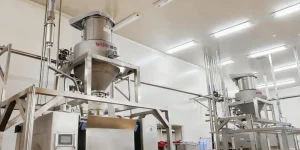
Enclosed pneumatic conveying with properly specified filter receivers, rotary airlock valves, and full system grounding is widely recognized as the primary engineering control for satisfying both frameworks simultaneously.
Sizing Your System: Small, Mid-Size, and Industrial Bakeries
Small / artisan operations (under 5,000 lbs flour/day): Compact vacuum conveying units with single-source, single-receiver configuration. Priority: quick changeover between ingredient types, minimal footprint, low-cost maintenance. Modular systems that can be expanded as output grows protect against early obsolescence.
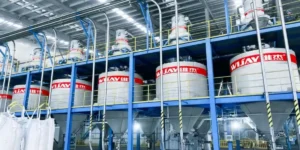
Mid-size commercial bakeries (5,000–50,000 lbs/day): Multiple dedicated vacuum conveying lines feeding each mixer, with segregated allergen-controlled circuits and day bin storage fed from outdoor silos. This is the tier where automated batching ROI is most compelling.
Industrial bakeries (50,000+ lbs/day): Building or upgrading industrial bakeries involves integrating pneumatic conveying into multiple powder handling systems simultaneously — storage, handling, processing of flour and minor ingredients, and mixing with water in precisely controlled sequences. Each project brings general requirements typical for these plant types, but specific requirements always make each one unique and challenging. Full pneumatic infrastructure from bulk tanker delivery through silo storage, with automated loss-in-weight batching systems achieving ±0.1% accuracy and full SCADA integration.
Questions to Answer Before Specifying Any Conveying System
- What are your ingredients, volumes, and physical properties? — Bulk density, Kst/Pmax, particle size, hygroscopicity, and flow class directly determine system type and material specification.
- How many pickup points and how many discharge destinations? — Multiple sources feeding one mixer favors vacuum; one silo feeding multiple lines favors pressure or combined systems.
- What is your recipe changeover frequency and allergen segregation requirement? — High-variety or gluten-free operations require quick-clean designs or fully dedicated circuits.
- What is your applicable ATEX zone classification or NFPA standard? — This is non-negotiable before any equipment is specified. NFPA 61 for US facilities; ATEX 2014/34/EU for Europe.
- What is your production capacity plan for the next five years? — Modular, scalable conveying architecture avoids full system replacement as throughput grows.
Conclusion
The right bulk ingredient conveying system for a bakery is not the cheapest conveyor per unit. It is the system that correctly handles the specific physical properties of each ingredient, satisfies both hygienic design and explosion protection requirements simultaneously, reduces the daily labor and waste costs that erode margin, and scales with the production plan.
Contact Our Mixing & Dough Handling System Experts
From mixer to marketplace, we offer custom and turnkey solutions for bakeries around the world with dedicated project managers and responsive customer care representatives to ensure flawless execution and your bakery’s enduring success.
For further technical reference:
- Spiroflow: Choosing the Right Conveyor for Bulk Bakery Ingredients
- ACME Air Equipments: Pneumatic Conveying in Food Industry
- NFPA 61: Standard for Agricultural & Food Processing Facilities
- Powder Bulk Solids: Preventing Dust Explosions from Conveying Low MIE Powders
About this article: Written by a bulk material handling wijay engineering team with hands-on experience designing and commissioning conveying systems for commercial and industrial bakeries across food, grain, and ingredient processing sectors. Intended for bakery engineers, plant managers, and capital equipment decision-makers.