Dust is the most persistent and dangerous byproduct of bulk ingredient handling in food manufacturing. It accumulates on elevated surfaces, clogs filters, contaminates product, and — in facilities handling flour, sugar, starch, or spice blends — creates the conditions for a catastrophic dust explosion.
Most articles on this topic stop at the obvious answer: “pneumatic conveying systems are enclosed, so they control dust better than open conveyors.” That is true but incomplete. The real question engineers need to answer is: which design features in a pneumatic dust conveying system actually drive dust control performance, and how do those features vary between dilute phase, dense phase, and vacuum architectures?
This article unpacks the full mechanism — component by component — and gives plant managers and process engineers a practical framework for evaluating and specifying the best pneumatic conveying system with dust control features for food processing applications.
Why Dust Control in Food Processing Is a Life-Safety Issue, Not Just Housekeeping
As of December 6, 2024, food processors in the US are required to comply with NFPA 660: Standard for Combustible Dusts and Particulate Solids. This single consolidated standard now encompasses the requirements of the former NFPA 61 (food and agriculture), NFPA 652 (fundamentals), NFPA 654, and others. Chapters 1–10 and 21 are specifically applicable to food processing facilities.
The compliance stakes are real. Fine food powders — flour (Kst 145 bar·m/s), powdered sugar, corn starch — are Class St1 to St2 combustible dusts. A concentration of just 20–150 g/m³ in the air is enough to reach the minimum explosive concentration for wheat flour. At that level, a single ignition source — a static discharge, a worn bearing, a spark from metal contact — is sufficient to trigger a primary explosion. Accumulated surface dust can then fuel a secondary explosion that destroys the facility.
The right pneumatic dust conveying system eliminates the accumulation pathway entirely. But “enclosed” is not a single spec — it is the result of multiple design decisions, each of which can fail independently.
How a Pneumatic Conveying System Controls Dust
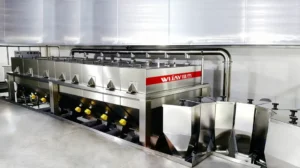
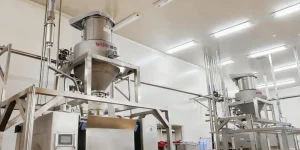
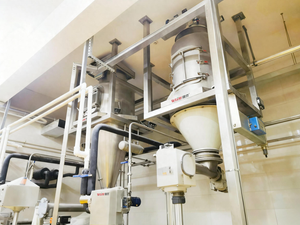
A properly specified ingredient transport system for food processing includes: a scalping screener to remove contaminants, a rare earth drawer magnet to remove metals, filtered clean air to vacuum-convey clean material to the filter receiver, a Class 1 rotary airlock valve to meter received material and provide isolation, and full bonding and grounding of the entire system. Each of these components plays a distinct dust-control role.
1. The Enclosed Pipeline
Enclosed pipeline conveying is the foundation of food-grade hygiene compliance — preventing pest ingress, airborne contamination, moisture exposure, and cross-contamination between product lines. Vacuum pneumatic systems are particularly valued in grain intake and flour milling for their ability to draw material inward, containing dust within the system rather than releasing it to the production environment.
2. The Filter Receiver
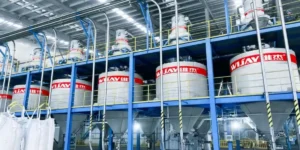
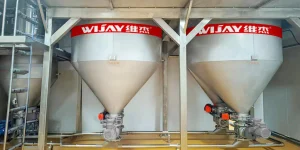
At the terminal end of every pneumatic conveying line, air and product must be separated. The filter receiver performs this separation and captures fine particles that would otherwise escape as airborne dust. Filter media selection, pulse-cleaning cycle frequency, and outlet airlock specification are the three variables that determine whether this component succeeds or fails in dust containment.
3. The Rotary Airlock Valve
To function properly as isolation devices under NFPA requirements, rotary airlock valves must maintain specific clearance tolerances between the rotor and housing, use specified materials of construction, and incorporate eight or more rotor vanes. These requirements ensure the valve prevents flame propagation between sections of the system in the event of an ignition event.
The rotary airlock is simultaneously a metering device, a pressure boundary seal, and an explosion isolation component. In food processing, it is also a hygiene-critical component that must be fully disassembled and cleaned between product changeovers.
4. Conveying Air Quality
Contaminated conveying air introduces both particulate and microbial risk to enclosed product streams. Inlet filtration — at minimum a fine particulate filter, in pharmaceutical-adjacent applications, a HEPA-grade filter — is a non-negotiable design element that most budget specifications omit.
Dilute Phase vs. Dense Phase: Which System Delivers Better Dust Control?
The system architecture itself significantly affects dust generation — not just dust containment.
In dilute phase systems, material is suspended in a high-velocity airstream (typically 18–30 m/s) and carried through the pipeline in a fully suspended state. This approach suits light, non-fragile materials such as flour, fine starch, sugar powder, and dried milk — but dilute phase systems generate more product attrition and dust, and consume more energy than dense phase alternatives.
Dense phase conveying produces significantly less attrition, dust generation, and pipe wear than dilute phase. Vacuum systems draw material into the pipeline using suction, making them ideal for intake applications where material is being pulled from multiple source points.
Dense phase systems use lower volumes of compressed gas relative to material volume. This lower gas-to-solids ratio makes dense phase systems champions of dust containment, promoting a cleaner and healthier work environment.
The practical trade-off: dilute phase systems cost less to install and suit light free-flowing powders over short to medium distances; dense phase systems require higher capital investment but deliver substantially better dust control and product integrity, particularly for fragile or high-value food ingredients.
Vacuum setups offer excellent dust control and are especially useful for shorter conveying distances and environments requiring stringent hygiene standards, particularly when picking up materials from multiple feed points — as in central dust collection systems.
Best Pneumatic Conveying Systems with Dust Control Features: Selection Matrix
The right system is not the one with the most filters — it is the one whose design addresses the specific dust generation and containment challenges of your material and process layout. Use this framework:
| Fine flour / powdered sugar, short distance | Vacuum dilute phase | Inward-leak containment, filter receiver with pulse clean |
| Fragile cereals / coated products | Dense phase vacuum | Low velocity (3–10 m/s), minimal attrition |
| Multiple pickup points → one mixer | Vacuum with central filter receiver | Single enclosed collection point, all feed points sealed |
| One silo → multiple destinations | Pressure dilute phase | Sealed diverter valves, rotary airlock at each receiver |
| Long distance, high throughput | Dense phase pressure | Higher solids loading, lower air volume, less dust generation per ton |
| Allergen-controlled facility | Dedicated enclosed vacuum circuits | Full CIP-capable design, no shared pipework |
The Checklist for Your Pneumatic Conveying System
Every food processing facility handling combustible bulk ingredients should verify the following against its current pneumatic conveying installation:
System Design
- Full enclosure from feed point to receiving vessel — no open transfer points
- The air inlet is filtered to prevent the introduction of foreign particles.
- Pipeline bonding and grounding to dissipate electrostatic charge
Dust Collection
- Filter receiver sized for actual gas volume (not estimated) at the terminal end.
- Bin vent dust collectors on all storage silos and day bins
- Pulse-jet cleaning system with adequate compressed air supply
Explosion Protection
- Rotary airlock valves meeting NFPA Class 1 isolation requirements at all receiver outlets
- Explosion venting or suppression on filter receivers where Kst data requires it
- Dust Hazard Analysis (DHA) is documented and current for all conveyed materials.
Hygiene Compliance
- All product-contact surfaces are FDA-approved, CIP-capable or fully disassemblable
- No dead zones where product accumulates between cleaning cycles
- BISSC certification for food-grade conveying equipment where applicable
For detailed DHA methodology and zoning requirements, refer to NFPA 660 (2025) and the Processing Magazine ITS compliance guide.
Three Dust Control Failures That Happen Even in “Enclosed” Systems
Even well-designed pneumatic dust conveying systems can underperform on dust control when these failure modes are overlooked:
Failure 1: Undersized filter receiver. When the receiving filter is too small for the actual gas volume, pressure builds, bypass air escapes around seals, and dust is released at the receiver outlet. This is the most common dust control failure in retrofitted systems.
Failure 2: Worn rotary airlock clearances. As the rotor-to-housing clearance opens through wear, pressurized air (and entrained dust) bypasses the valve. NFPA-compliant clearance tolerance is 0.0079 inches — beyond that, the valve is simultaneously an explosion isolation failure and a dust control failure.
Failure 3: Inadequate conveying of air quality. Ambient air drawn into the system through inadequately filtered inlets carries moisture, biological load, and particulates into the product stream — negating the contamination-control purpose of the enclosed design.
Conclusion
A pneumatic dust conveying system controls dust in food processing through five interdependent mechanisms: enclosed pipeline transport, high-quality filtered conveying air, properly sized filter receivers, NFPA-compliant rotary airlock isolation, and full system bonding and grounding. Getting any one of these wrong compromises the whole.
The best pneumatic conveying systems with dust control features are not defined by a single spec — they are defined by how coherently all five mechanisms are designed and maintained together, against the specific material properties and process layout of your facility.
For food processors and bulk ingredient manufacturers looking to upgrade their dust management infrastructure, Wijay Powders Systems provides engineered pneumatic conveying solutions designed specifically for flour, sugar, starch, and fine powder applications. Our engineering team works directly with your plant to assess material properties, conveying parameters, and compliance requirements — delivering a system specification built around your process, not adapted from a standard model. Contact Wijay Powders Systems to discuss your dust control requirements and receive a technically detailed proposal.
Further technical reference:
- NFPA 660: Standard for Combustible Dusts and Particulate Solids (2025)
- ACS Valves: NFPA 660 Guide for Rotary Airlock Selection
- Jenike & Johanson: Dilute vs Dense Phase Pneumatic Conveying Modes
- Processing Magazine: Why Food Processors Should Consider Ingredient Transport Systems
About this article: Written by a bulk material handling engineering team specializing in pneumatic conveying system for food processing. Intended for plant engineers, safety officers, and capital equipment decision-makers in food manufacturing.