Hopper and chute angle design based on flow properties sounds like an obvious engineering principle — until you walk a plant floor and see how often it’s ignored in favor of institutional habit. After years of handling the same bulk solid, plant teams develop real, hard-won intuition: they know which equipment works, where plugs tend to form, and where to keep a sledgehammer handy. That experience is valuable. But it can also harden into “accepted truths” about a material that were never actually tested — and those assumptions have a way of showing up as expensive design decisions nobody meant to make.
A Layout That Shouldn’t Have Looked the Way It Did
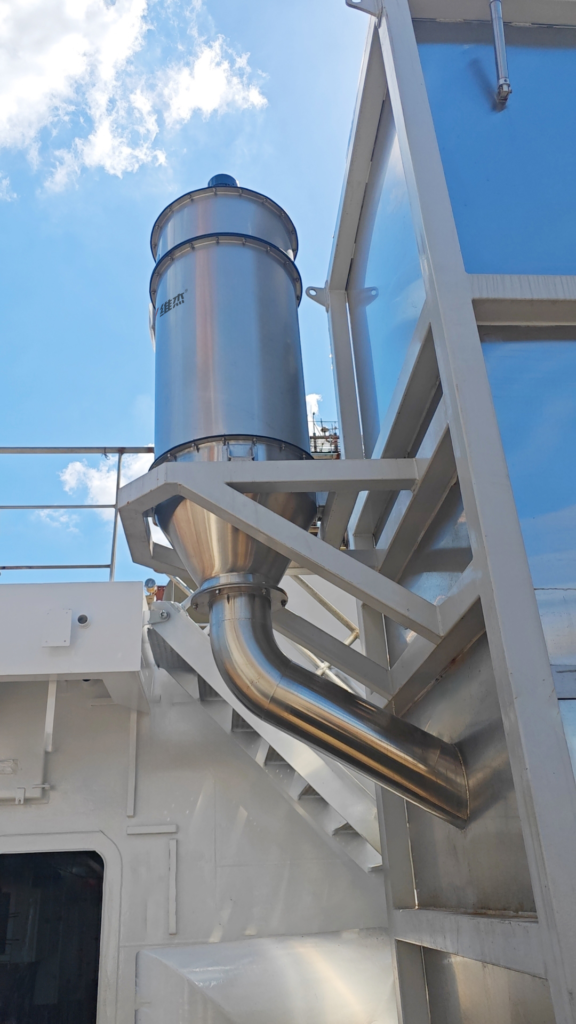
While reviewing a plant layout recently, a pair of cyclones stood out immediately — pushed up uncomfortably close against the roofline, with no functional reason apparent from the drawing. When asked why, the answer was: “At this plant, everything that slopes has to be at least a certain angle.” That single rule had been applied to the sloping pipes below the cyclones, which forced the cyclones themselves up against the roof structure. The plant had, in effect, nearly raised the roof just to make room for equipment that didn’t need to sit that high in the first place.
Nobody could point to material testing behind the angle. It was a guess, adopted at some point in the plant’s history and never revisited. And that’s the part worth pausing on: a minimum chute angle is a real, legitimate design requirement — but it’s only valid for a specific chute surface and a specific impact pressure. Apply it as a blanket rule across every chute in the plant, regardless of surface finish or material behavior, and you’re no longer designing to a requirement — you’re designing to a habit.
Slope Alone Doesn’t Determine Flow
Here’s the detail that gets missed most often: the angle isn’t the whole story. Flow pattern is determined by the combination of slope and the chute or hopper’s internal surface — not slope in isolation. A low-friction surface can achieve mass flow at a noticeably shallower angle than a rougher one would require for the same material. In the case above, a lower-friction chute surface may have allowed a less steep slope entirely, without changing the material or the flow requirement at all.
There’s a second technique that gets overlooked just as often: chute angle doesn’t have to be constant along its length. It’s generally possible to start a chute at a steeper angle where material velocity is low, and gradually decrease the slope as velocity builds — using the material’s own acceleration to maintain flow at a shallower average angle than a fixed-slope design would require. Applied to the cyclone layout above, either of these approaches — lower-friction surfacing, or a variable-slope profile — could have fit the equipment into meaningfully less headspace, without ever putting flow reliability at risk.
When “Everyone’s Hopper Has the Same Slope” Should Be a Red Flag
This isn’t an isolated case. It’s common to walk into a plant and find every hopper on site built to the same slope — an angle the team believes, based on experience, is required to keep a given material flowing. The trouble is that experience built this way can be just as misleading as the cyclone example, for the same underlying reason: slope by itself doesn’t determine flow pattern, and a single learned angle almost certainly wasn’t derived from testing every surface and material combination actually in use across the site.
The practical risk runs in both directions. An angle steeper than necessary wastes headroom, adds structural height and cost, and can force awkward equipment layouts — exactly what happened with the cyclones. An angle shallower than the material actually requires produces the opposite problem: unreliable flow, bridging, ratholing, or the kind of intermittent blockages that turn into a standing maintenance routine rather than a one-time fix.
What Actually Needs to Be Measured
Knowing your bulk material means more than watching how it behaves in your current equipment. Observing a material in action tells you where it’s currently hard to handle — but it offers limited guidance on what a correct design should actually look like, because you’re only seeing how it performs under the conditions your existing (possibly mis-designed) equipment happens to create.
To design chute and hopper angles with real confidence, the properties that actually need to be measured include:
- Cohesive strength, both during continuous flow and after a period of storage at rest — since many materials behave differently once they’ve had time to consolidate in a stationary hopper.
- Wall friction and chute angle requirements against a range of surface finishes and roughness levels — not just the one surface currently installed, since a different, lower-friction lining could change the achievable angle significantly.
- Compressibility, which affects how the material packs and how that packing changes its flow behavior under load.
- Permeability, which influences how air moves through the bulk material during filling, storage, and discharge — a factor that becomes especially relevant for fine powders.
With this data in hand, angle and surface decisions stop being a matter of institutional memory and become a matter of engineering calculation — which is exactly what prevents both failure modes at once: buildings that end up taller than they need to be, and systems that never reach their design throughput because the angle was too conservative in the wrong direction, or too aggressive in a way the material simply won’t support.
Why This Matters Beyond a Single Chute
A hopper or chute angle chosen without testing isn’t just a risk to that one piece of equipment — it tends to propagate. Once one angle becomes “the angle we use here,” it gets copied into the next layout, and the next, often without anyone revisiting whether the original assumption was correct for the specific material and surface involved. Years later, an entire plant’s worth of sloped equipment can trace back to a single untested guess, with real consequences in structural steel, building height, and floor space that could have gone toward something more productive.
The fix isn’t complicated, but it does require treating flow properties as a measured input rather than an inherited assumption. A short material test program, run against the actual surfaces and conditions your equipment will use, typically costs far less than the structural steel and headroom lost to an overly conservative angle — or the maintenance hours lost to one that’s too shallow.
FAQ
Why doesn’t slope alone determine whether a hopper achieves reliable flow? Flow pattern depends on the combination of chute angle and the internal surface’s friction characteristics, not angle in isolation. The same material can require a steep angle against a rough surface but flow reliably at a much shallower angle against a lower-friction lining — which is why a fixed “house angle” applied across every surface type is rarely accurate.
Is there a standard minimum chute angle that applies across all materials? No. A minimum chute angle is only valid for a specific chute surface and a specific impact pressure — it’s not a universal number that transfers safely from one material, surface, or application to another.
Can a chute’s angle change along its length instead of staying constant? Yes. It’s often practical to start a chute at a steeper angle where material velocity is low, then gradually reduce the slope as velocity increases — using the material’s own acceleration to maintain reliable flow at a shallower average angle than a fixed-slope design would require.
What happens if a hopper angle is steeper than necessary? It wastes headroom, adds unnecessary structural height and cost, and can force awkward equipment layouts elsewhere in the plant — exactly the pattern that shows up when a blanket angle rule gets applied without testing.
What material properties should be tested before finalizing hopper and chute angles? At minimum: cohesive strength during continuous flow and after storage at rest, wall friction and required chute angle against the actual surface finishes being considered, compressibility, and permeability. These properties, measured against real material samples, are what turn angle selection from a guess into an engineering decision.
Not sure whether your current hopper or chute angles are actually based on your material’s flow properties, or just on habit? WIJAY Systems works with plants across food, chemical, plastics, and other bulk material industries to specify enclosed, low-degradation material handling systems around real, tested flow behavior — not inherited rules of thumb. If you’d like a second look at a layout before it’s built, our process engineering team is glad to talk it through.