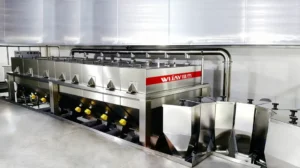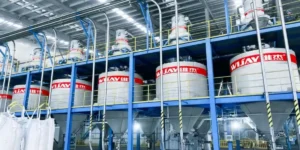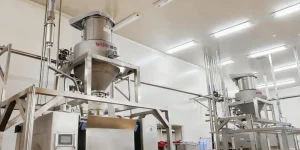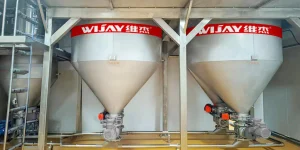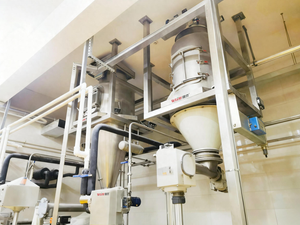
In modern industrial production, tens of thousands of tons of powdered materials—from food ingredients to chemical powders, building materials to pharmaceutical intermediates—are moved within factories every day. Among these materials, some are fragile, some are highly abrasive, and others are premixed formulas that are difficult to restore once separated. How can we transport them while preserving their original quality and achieving energyefficient operation? The dense phase pneumatic conveying system is a technology specifically designed to solve this challenge.
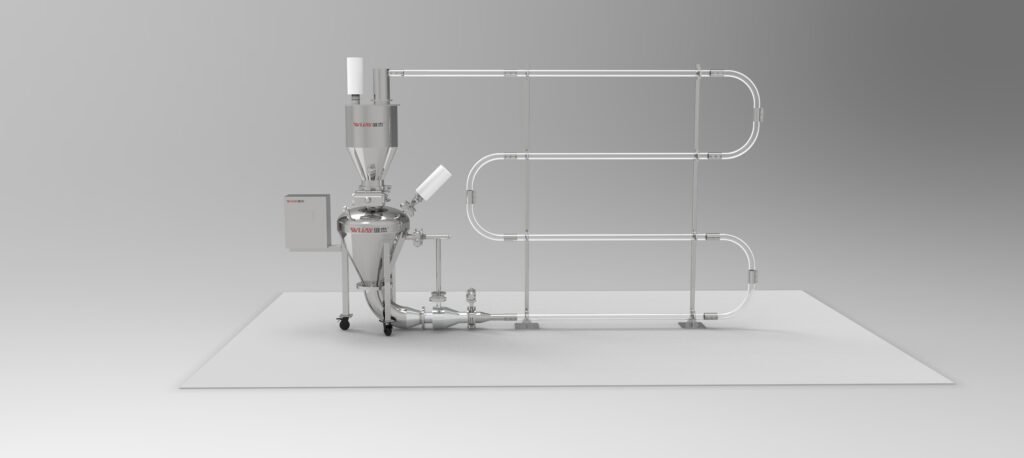
What is Dense Phase Pneumatic Conveying?
Put simply, pneumatic conveying uses compressed air to “blow” materials through a pipeline. Based on the material’s behavior in the pipe, pneumatic conveying can be divided into two main modes: dilute-phase and dense-phase.
Dilute-phase conveying works like a leaf blower lifting a feather—particles are fully suspended in high-speed airflow. It is fast and suitable for ordinary materials that are not easily damaged, but the tradeoffs are significant: air velocities typically reach 15–30 m/s, requiring large volumes of compressed air and resulting in high energy consumption. Moreover, the highspeed particles can easily break or erode the pipe.
Dense phase conveying takes a different approach. Instead of suspending the material, it moves as compact “plugs” or “dunes” at lower velocities. These systems typically operate at 3–10 m/s, using higher pressure to push the material forward—like pushing a sponge with a highpressure water jet. The material concentration in dense-phase conveying can be 20 to 400 times that in dilute-phase conveying, meaning more material is moved with much less air.
Core Advantages of Dense Phase Pneumatic Conveying
The core value of dense-phase conveying can be summarized in three key metrics: lower energy consumption, higher material integrity, and longer equipment life.
(1) Lower Energy Consumption: 30–70% Reduction in Electricity
Dense-phase conveying uses low velocity and a high solids-to-air ratio, moving more material with less air. Measured data from ELFORSK, a Danish energy research institute, show that converting from dilute-phase to dense-phase conveying for materials such as polyethylene pellets and alginate can achieve electricity savings of 50–70%. According to Chinese industry data, the specific energy consumption of dense-phase conveying is about 0.3–0.6 kWh per ton of material, compared to 1.8–2.5 kWh for traditional dilute-phase conveying—a reduction of 40–50%. For a mediumsized powder processing plant with an annual throughput of 100,000 tons, electricity savings alone can reach hundreds of thousands to over one million RMB per year.
(2) Higher Material Integrity: Quality Preserved
In high-speed dilute-phase conveying, violent collisions between particles and between particles and the pipe wall are unavoidable. The low-velocity nature of dense-phase conveying greatly reduces collision frequency, keeping the breakage rate for materials such as plastic pellets and grains below 0.2%. For high-value materials—such as lithium battery cathode/anode materials, pharmaceutical ingredients, and premium food additives—dense-phase conveying can even control metal contamination to below 5 ppm, while offering a nitrogen-blanketing option to prevent oxidative degradation.
(3) Longer Equipment Life: Drastically Lower Maintenance Costs
Wear rate is proportional to the cube of velocity. Data from Macawber Engineering shows that when velocity is reduced from 10 m/s to 2.5 m/s, the pipe wear rate becomes only onefortieth of the original. This means the same pipeline can last over five years in dense-phase mode, whereas in dilute-phase mode it may need replacement every one to two years. Extended equipment life directly translates into less downtime for repairs and lower maintenance costs.
Which Applications Are Best Suited for Dense Phase Pneumatic Conveying?
Dense phase conveying is particularly suitable for three types of materials and scenarios:
Fragile or highvalue materials – e.g., milk powder, grains, lithium battery materials, pharmaceutical powders, where any particle damage results in economic loss.
Abrasive materials – e.g., cement, fly ash, quartz sand, where highspeed conveying rapidly erodes pipe bends.
Blended materials – after multiple components are uniformly mixed, dilute-phase conveying can cause segregation due to differing particle velocities; dense-phase conveying moves the mixture as a coherent “plug,” effectively maintaining homogeneity.
Consequently, dense-phase pneumatic conveying systems are widely used in the food & beverage, plastics & chemicals, and new energy materials industries. The global market for high-pressure dense-phase pneumatic conveying systems was approximately RMB 4.25 billion in 2024 and is projected to reach about RMB 5.93 billion by 2031. The overall pneumatic conveying system market is also growing steadily, with a global value of about USD 33.65 billion in 2025. These figures indicate that as industrial automation advances and energy savings become essential, dense-phase conveying is increasingly the technology of choice for many enterprises.
WIJAY Automation: Making Dense Phase Conveying Smarter and More Reliable
As a specialist in automated material handling, Guangdong WIJAY Material Automation System Co., Ltd. has extensive practical experience in dense-phase pneumatic conveying technology. The company’s proprietary low-speed dense-phase conveying technology operates at conveying velocities below 8 m/s and can be flexibly equipped with auxiliary features, such as nitrogen protection, based on material characteristics. In the environmental materials sector, WIJAY customized a urea pellet feeding system for a client, achieving a conveying efficiency of at least 98% and a material breakage rate below 0.1%. The system has been running continuously for over 6,000 hours with a failure rate of less than 0.5 times per month.
In terms of energy savings, WIJAY combines digital simulation with intelligent control. By creating 3D models of conveying pipelines and performing computational fluid dynamics analysis, the company accurately identifies highresistance areas and optimizes pipeline layouts, helping customers achieve significant energy reductions. WIJAY has successfully delivered customized dense phase pneumatic conveying solutions across multiple industries, including food & beverage, plastics & chemicals, and new energy materials.
Conclusion
The dense phase pneumatic conveying system trades “low speed” for “high efficiency” and uses “gentleness” to protect “quality.” As industrial manufacturing shifts toward greater precision, intelligence, and green practices, this technology is creating tangible value for an increasing number of enterprises. If you wish to bring lower energy consumption, higher quality assurance, and more reliable operation to your material conveying process, the WIJAY Automation team is ready to provide professional consultation and customized services.