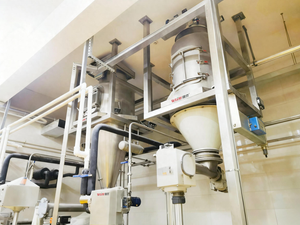
The pet food industry is no longer a simple commodity business. Walk into any premium pet supply store today, and you will find grain-free kibble, freeze-dried raw diets, single-protein formulations, functional supplement chews, and veterinary prescription foods occupying more shelf space — and commanding higher price points — than ever before. Behind every one of those products lies a manufacturing process that must be flexible, hygienic, precise, and fast.
Global pet food sales are projected to reach $290 billion by 202. This growth is fueled by rising pet ownership, increasing humanisation of companion animals, and a shift toward premium,d functional nutrition. For manufacturers, this creates extraordinary growth but also major operational challenges. How do you handle more ingredients, switch recipes often, meet tighter food safety standards, and stillkeepy productionefficient?s?
This often-overlooked element plays a pivotal role in answering modern production challenges.
| $290B Market size by 2029 | 14 t/h Max vacuum throughput | ±0.1% Micro-dosing accuracy |
The Material Handling Problem Nobody Talks About
Most discussions of pet food manufacturing focus on extrusion technology, flavour coating systems, or packaging line speeds. Conveying—the movement of ingredients and finished product through the facility—is often an afterthought. That is a mistake.
A single production line may handle dozens of distinct materials: cereal flours, protein meals, bone powder, fish meal, vegetable starches, added vitamins and minerals, palatants, probiotics, and specialist additives like omega-3 oils or joint-health compounds. Each has a different bulk density, particle size, moisture content, and mechanical stress sensitivity. Some, like freeze-dried inclusions or coated kibble, are genuinely fragile. Others, like fine vitamin powders, must be dosed in gram quantities with a precision that manual scooping simply cannot achieve.
Traditional approaches — manual bag tipping, open belt conveyors, screw augers — cause problems that compound: product breakage, dust, recipe cross-contamination, dosing inconsistency, and ergonomic injury risk. Those issues worsen as product portfolios grow.
“Expanding your product range by 30% without upgrading your conveying system is like building a new kitchen but keeping the same delivery entrance — the bottleneck just moves.”
Wijay Systems · Process Engineering Advisory
How Vacuum Conveying Solves The Core Challenges
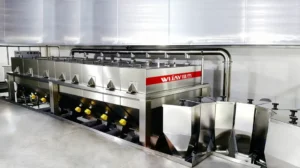
Vacuum conveying systems move materials pneumatically through enclosed pipelines using a pressure differential: a vacuum pump draws air through the system, carrying the product along. The principle is simple. The engineering implications are significant.
Because the transfer pathway is enclosed, dust cannot escape into the facility. The product is not exposed to open air, surfaces used for other materials, or manual handling. For a manufacturer with ten or twenty recipes on a single line, cleaning may take 20 minutes instead of 2 hours.
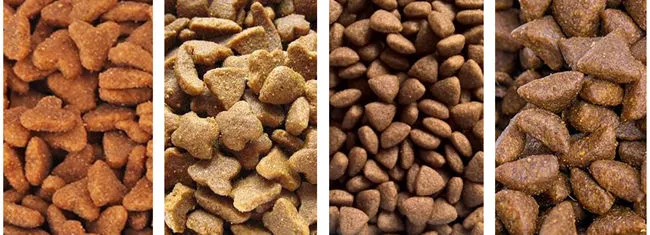
Dry Pet Food: Protecting The Product You Worked Hard To Make
- No product breakage. Dense-phase, low-velocity transfer moves fragile kibble and coated products with minimal mechanical contact. This keeps fines below 0.5% and preserves coating integrity.
- Dust elimination. 100% enclosed transfer removes airborne dust from the production process. This protects personnel, reduces cleaning, and meets FDA and international pet food standards.
- Recipe flexibility. Tool-free disassembly and smooth-bore pipework enable full cleaning between batches in minutes. Frequent recipe changeovers become operationally viable.
- Micro-ingredient precision. Loss-in-weight feeders and vacuum receivers combine to deliver gram-accurate doses of vitamins, minerals, enzymes, and functional additives—batch after batch.
- Ergonomic operation. Automating ingredient transfer removes the need for manual lifting, carrying, or tipping of heavy sacks. This reduces the risk of musculoskeletal injury and ensures sustained operator comfort during long shifts.
Dry kibble is the dominant pet food format globally. It presents a handling challenge. After extrusion, drying, and flavour coating, the product is more fragile than it appears. During conveying, impact damage and abrasion generate fines—small broken particles. These fines reduce palatability, alter texture, and cause dust in packaging.e.
Wijay Systems vacuum conveyors address this by combining low-velocity transfer, smooth pipeline geometry, and a gentle receiver design. Product travels with the airstream rather than being pushed or scraped, and directional changes in the pipeline use long-radius bends rather than sharp elbows. The result is a conveying system that handles even expanded, low-density kibble formats without the breakage rates seen in mechanical conveying alternatives.
Application note
For manufacturers producing multiple SKUs from a single line—adult, puppy, senior, weight management, and breed-specific—the ability to changeover rapidly, without cross-contamination, is as important as throughput speed. Wijay Systems conveyors are engineered for this multi-SKU mode.l.
Micro-Additives: The Grams That Define The Product
In nutritional terms, micro-ingredients in pet food are disproportionately important. For example, taurine in cat food, chondroitin in joint-health formulas, certain probiotic strains in digestive health products, and chelated minerals for enhanced bioavailability are added in quantities measured in grams per tonne. Yet, they are often the main reason consumers choose one brand over another.
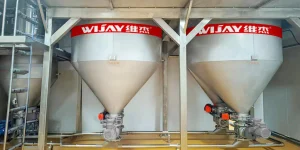
Manual handling of micro-ingredients introduces three interconnected risks: dosing inaccuracy, cross-contamination between runs, and occupational exposure to fine bioactive powders. Vacuum conveying systems eliminate all three. Ingredients are stored in isolated hoppers, transferred to precision feeders via enclosed vacuum lines, and dosed directly into the main blend stream under software control. The operator never touches the ingredient, and the ingredient never comes into contact with open air.
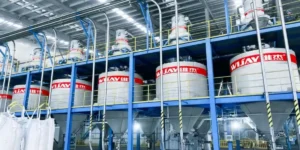
Mounting micro-additive handling equipment at height is particularly demanding. This may be above a blending mezzanine or integrated into a multi-floor production building. Wijay Systems installations have been commissioned at heights exceeding 8 metres. Transfer lines run vertically through the building without reducing dosing accuracy or system reliability.
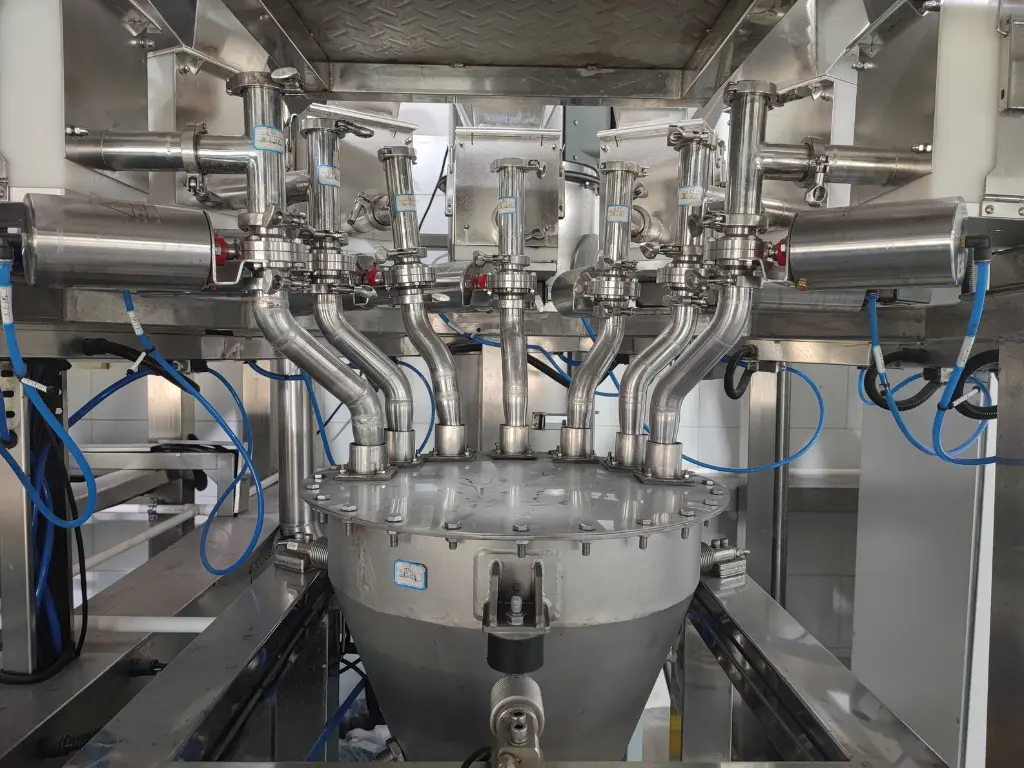
Pet pharmaceuticals: food-grade hygiene is only the beginning
The fastest-growing adjacent category to premium pet food is pet pharmaceuticals and nutraceuticals: prescription diets, veterinary-grade supplements, joint-health chews, dental hygiene products, and behavioural support formulations. This segment demands technology that extends beyond food-grade hygiene to pharmaceutical-grade material handling.
Active pharmaceutical ingredients (APIs) for veterinary use must reach the final product in the right quantity and unchanged form. Mechanical stress, heat, or contamination during conveying can degrade API efficacy. Wijay Systems conveyors use low-shear transfer modes, temperature-controlled pipework when needed, and validated cleaning procedures, all of which support regulatory documentation for veterinary drug manufacturing.
The same principles apply to the growing category of functional pet supplements — products where the active compounds are delicate, expensive, and present at low concentrations. Whether the ingredient is a live probiotic culture, an omega-3 oil powder, or a plant-based bioactive extract, the conveying system must protect it from the moment it leaves storage until it enters the blend.
Pet Pharmaceuticals: Food-Grade Hygiene Is Only The Beginning
Not every pet food manufacturer has a purpose-built greenfield facility with high ceilings and wide columns. Many leading factories operate in converted industrial buildings with tight floor plans and low clearance. Conveying system design must adapt to these realities.m.
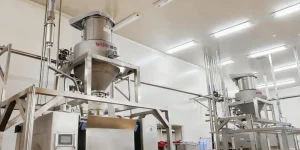
Wijay Systems vacuum conveyors are designed for compact installation. Receivers and vacuum units have small footprints and mount at low heights. Transfer lines run through existing ceiling voids and along structural steelwork, eliminating the need for dedicated conveying corridors. For retrofit installation—replacing an existing mechanical system without halting production—our engineering team minimises downtime by working with the facility layout during changeover.r.
- Low building height compatibility. Systems designed for facilities with 3–4m clear headroom, without compromising transfer capacity.
- Minimal footprint receivers. Compact filter receiver design integrates into existing line layouts without requiring structural modifications.
- Low noise operation. Vacuum conveying is significantly quieter than mechanical alternatives, reducing occupational noise exposure on the production floor.
- Scalable capacity. From micro-batching of a few kilograms to production runs measured in tonnes per hour, the same platform scales to the application.
Case Study: Precision At 8 Metres
A manufacturer of speciality animal nutrition products in Central Europe faced a textbook micro-additive handling challenge. Their blending equipment was located on a mezzanine approximately 8 metres above the main production floor, and operators manually carried measured quantities of enzyme and vitamin premixes up to the mezzanine for each batch. The process was labour-intensive, ergonomically hazardous, and prone to dosing variability.
Wijay Systems installed an elevated vacuum conveying system with ground-level storage hoppers, enclosed transfer lines running vertically through the mezzanine structure, and precision loss-in-weight receivers at the blending point. The system is controlled from the main production SCADA, with automatic cleaning cycles triggered between each product changeover.
The outcomes were measurable: dosing accuracy improved to within ±0.1% of target weight, manual handling incidents at height dropped to zero, and batch changeover time for the micro-additive system fell by over 60%. The production team could run more formulations per shift without increasing headcount or risk.
Key outcome
Dosing accuracy of ±0.1%, zero manual handling incidents at height, and a 60%+ reduction in changeover time — achieved within the existing facility structure, without any civil or structural modifications.
Choosing The Right System For Your Facility
No two pet food facilities are identical, and the right conveying system depends on a combination of factors: the range of materials being handled, the number of active recipes, throughput targets, available building height, cleaning and hygiene requirements, and the degree to which the production line needs to flex as the product portfolio evolves.
The starting point is always a detailed understanding of the materials. A fine vitamin powder and a large expanded kibble piece require fundamentally different conveying parameters — transfer velocity, pipeline bore, receiver filter specification, and cleaning protocol. Getting this right at the design stage is far less expensive than correcting it during commissioning.
Wijay Systems engineering teams work directly with manufacturers at the pre-design stage to map material properties, define system requirements, and specify the conveying configuration that will deliver consistent performance across the full range of intended products. That process — before a single piece of equipment is ordered — is where the real value is created.