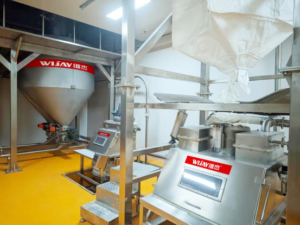
The most expensive ingredient in a formula is rarely the one that shows up as the biggest line item on the bill of materials. It’s usually the one being dosed by hand — a colorant, a stabilizer, a trace additive measured out in grams, weighed into a small container by an operator, staged for a batch, then carried over to a process vessel. That workflow depends entirely on operator technique, labeling discipline, sequence control, and consistency across every shift, and it works fine at low volume with a handful of recipes. It stops working as recipe counts grow, as more minor ingredients get added at smaller percentages, and as quality expectations tighten around exactly the ingredients that are hardest to measure precisely by hand.
That’s the direction most formulations are heading. Manufacturers are adding more minor ingredients to their recipes, often at smaller percentages and with tighter tolerance requirements than ever — and a handful of grams that looks negligible on paper can directly affect batch consistency, product performance, and total formulation cost when it’s off by even a small margin, batch after batch.
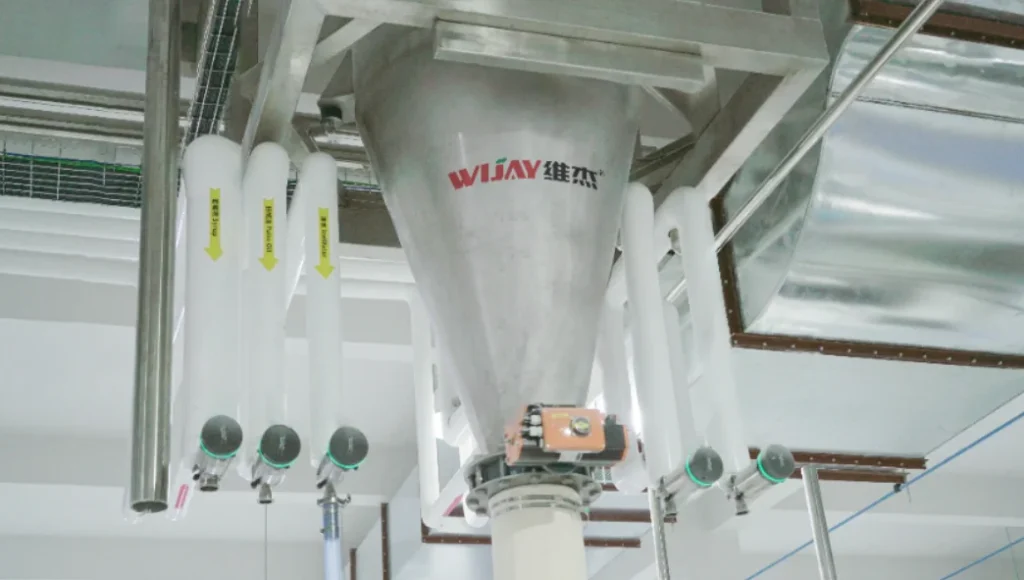
Why Manual Dosing of Minor Ingredients Gets Expensive Fast
Labor Tied Up in Weighing and Kitting
Every minor ingredient in a recipe that requires manual weighing and staging consumes operator time that scales directly with recipe complexity. As formulations add more minor additions, that labor cost compounds — not as one large expense, but as a steady accumulation across every batch run.
High-Value Ingredient Loss During Handling
Minor ingredients are frequently the most expensive material in a formula by unit cost, even when they’re a small fraction of total batch weight. Material lost during weighing, transfer, or cleanup on a high-value ingredient represents a disproportionate cost relative to its formula percentage — a loss that’s easy to overlook line by line but adds up meaningfully across a production run.
Batch Inconsistency From Manual Variation
Manual weighing introduces variation that’s difficult to eliminate through training alone — technique differences between operators, small measurement errors that compound across multiple ingredients in a single batch, and inconsistency that shows up downstream as product performance variability rather than as an obvious dosing error.
Dust Release During Fine Powder Handling
Handling nano, ultra-fine, and micro powders manually creates a real dust exposure problem, even when the total ingredient quantity is small. That dust affects housekeeping, weighing reliability, and operator exposure simultaneously — three separate problems from a single handling step.
Difficulty Managing Multiple Recipes With Small Additions
As the number of active recipes grows, each with its own set of minor ingredients at different percentages, manual dosing becomes an operational bottleneck. Sequencing, labeling, and staging multiple small ingredients across multiple recipes multiplies the opportunity for error in a way that a small handful of ingredients doesn’t.
Operator Exposure With Sensitive or Hazardous Powders
Some minor ingredients carry handling sensitivities — potency, reactivity, or health and safety considerations — that make manual weighing a real operator exposure concern, independent of the accuracy or cost issues already outlined above.
Any single factor from this list can justify a closer look at the dosing step. When several apply simultaneously — which is increasingly the norm as formulations grow more complex — the case for automating minor ingredient dosing through a properly engineered batching system becomes difficult to ignore.
What Precision Micro-Dosing Actually Requires
Getting minor ingredient dosing right at scale requires solving several distinct engineering problems at once, not just installing a smaller version of a standard feeder.
Gram-Level Accuracy Without Contact Contamination
Rather than relying on a single fixed discharge setting, a properly engineered micro-dosing mechanism approaches the target weight in stages — coarse, fine, and extra-fine dosing modes that progressively reduce discharge rate as the reading on the scale approaches setpoint. A flexible dosing element controlled by a precise actuator, rather than a rotating metal auger or screw, avoids metal-to-material contact entirely, which matters directly in any application where contamination from wear parts is a concern. That same flexible construction also holds up well against abrasive materials — quartz sand and titanium dioxide are common examples — that would otherwise wear a rigid metal mechanism quickly.
Handling Materials Prone to Bridging or Sticking
Accuracy alone doesn’t solve the dosing problem if the material itself won’t flow reliably. Fine powders can bridge inside a dosing funnel, stick to hopper walls, or discharge in inconsistent pulses rather than a stable stream. When material doesn’t reach the scale consistently, dosing time increases and the weight reading becomes unreliable regardless of how precise the underlying mechanism is. A supplementary mechanical agitation device — applied directly to the dosing funnel to break up deposits and reduce bridging — keeps difficult-flowing materials moving through the dosing point rather than accumulating and stalling.
Dust Containment at the Dosing Point
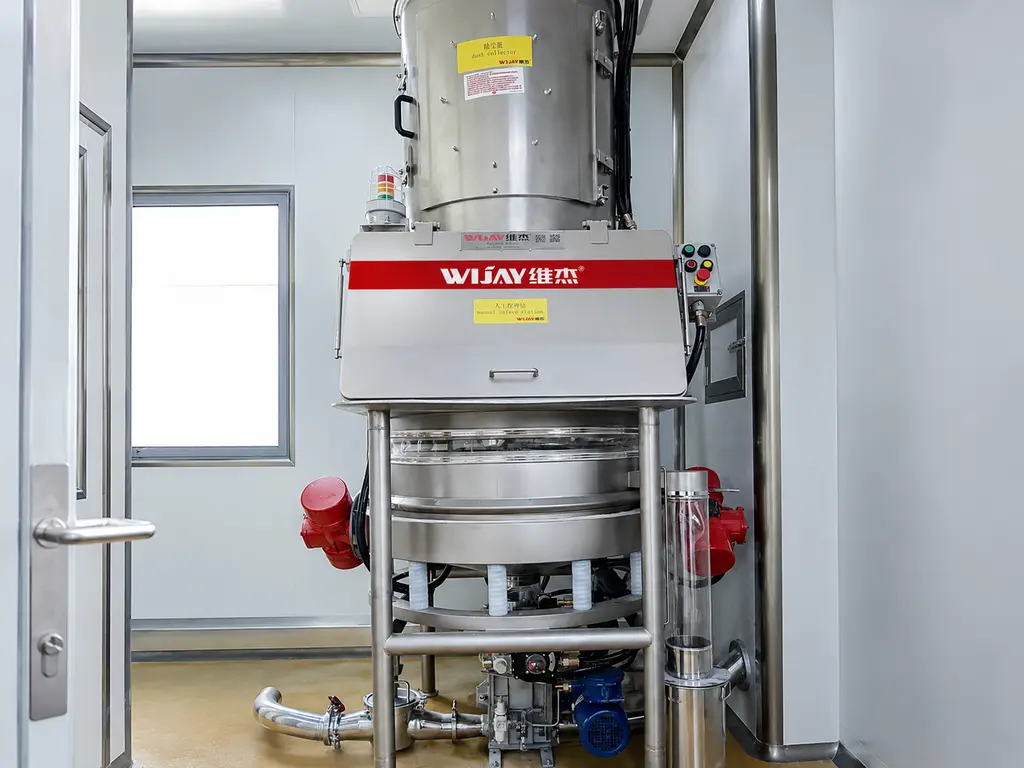
Dust is a related and often underestimated challenge. Even when total ingredient quantity per batch is small, nano, ultra-fine, and micro powders can generate dust that affects housekeeping, degrades weighing reliability, and creates operator exposure — all from a single dosing event. Targeted air extraction positioned near the dosing outlet addresses this directly: a focused nozzle extraction works for materials with contained discharge behavior, while a full-perimeter ring suction setup is needed for powders that disperse more broadly during discharge.
Accuracy Varies by Material — and That Variation Matters
Achievable dosing accuracy isn’t a fixed number across all materials; it depends on scale resolution, tare weight, vibration, settling time, and the specific flow characteristics of the material being dosed. Representative results from production dosing trials illustrate the range typically achieved:
| Material | Typical Dosing Accuracy |
|---|---|
| White sugar | ±1 g |
| Quartz sand | ±1 g |
| Citric acid | ±1 g |
| Maltodextrin | ±2 g |
| Calcined kaolin | ±2 g |
| Pearl soot | ±2 g |
| Wheat flour | ±3 g |
| Lactose | ±3 g |
| Titanium dioxide | ±3 g |
These figures are a reference point, not a guarantee for every application. A dosing trial with the specific material intended for production should confirm actual flow and accuracy behavior in the equipment before a system design is finalized — assuming performance based on a material name alone, without testing the actual lot and conditions, is one of the more common ways a micro-dosing project underperforms its spec sheet.
Where Micro-Dosing Belongs in a Batching System
Precision micro-dosing is built for controlled dosing of nano, ultra-fine, and minor ingredients where accuracy, cleanliness, and repeatability matter more than bulk throughput — it isn’t intended to replace feeders handling large-volume commodity ingredients or materials that can’t be conditioned to flow through a dosing funnel in the first place. The strongest fit is in industries working with higher-value ingredients, complex formulations, and tightening process expectations:
- Pharmaceutical and nutraceutical manufacturing — APIs, excipients, vitamins, and health-focused additives where dosing errors affect both batch documentation and regulatory compliance.
- Specialty chemical production — pigments, fillers, and functional additives requiring gram-level accuracy in the finished formulation.
- Plastics compounding — masterbatch additives, colorants, and stabilizers dosed into compounding or extrusion processes.
- Food and beverage production — colors, flavors, and powdered additives in applications where ingredient value or accuracy requirements justify a more controlled approach than standard bulk feeding.
Dosing units for these applications are available in food-approved and silicone-free configurations to meet product-contact requirements across each of these industries.
Deployment Models: Matching the System to Production Scale
A precision micro-dosing capability can be deployed in different configurations depending on production scale and recipe complexity:
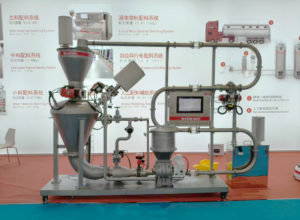
Stand-alone dosing stations suit focused dosing tasks, smaller ingredient sets, or specialty production runs, where a compact, self-contained unit with precise control is well suited to autonomous operation.
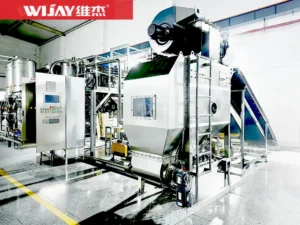
Integrated multi-point batching systems use a movable scale that travels between multiple feeding points according to the active recipe, with the precision dosing actuator riding on the scale itself rather than being duplicated at every station. Because the actuator is typically the most expensive component in the dosing mechanism, this architecture pays for itself faster as the number of dosing points increases — a single actuator serving many ingredient stations rather than one actuator per station.
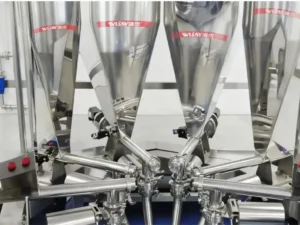
Robotic dosing arrangements use a central robotic arm to feed individual dosing stations arranged around it, with precision dosing devices at each station enabling fully automated small-quantity dosing across complex, multi-ingredient recipes without manual intervention at any point in the sequence.
Evaluating Fit Before Committing to a System
Before specifying a micro-dosing solution, manufacturers need to confirm the target dose, allowable tolerance, particle condition, moisture sensitivity, dust behavior, cleaning requirements, and whether the material is prone to bridging or compaction. These details determine whether precision micro-dosing is the right method for a given application, and none can be assumed from a material name alone—they must be confirmed against the actual material and process conditions.
WIJAY Systems integrates precision micro-dosing capability into its broader batching system designs for exactly this reason: minor ingredient accuracy, contamination control, and dust containment are engineered around the customer’s specific material and formulation requirements — validated through dosing trials rather than assumed from a spec sheet — and matched to a deployment model, stand-alone, multi-point, or robotic, that fits the plant’s actual recipe complexity and production volume.
FAQ
When should a manufacturer automate minor ingredient dosing instead of continuing manual weighing? Automation becomes worth evaluating when manual weighing and kitting create labor inefficiency, material loss, batch variability, dust exposure, or difficulty managing multiple recipes with small additions— especially when several of these factors apply at once. WIJAY assesses these factors together when recommending whether a batching system’s micro-dosing module fits a customer’s operation.
How accurate can a batching system’s micro-dosing module actually be? Dosing accuracy as tight as ±1 gram is achievable for many materials, though actual performance depends on the material’s flow characteristics, scale resolution, vibration, and process conditions. WIJAY confirms expected accuracy through material-specific dosing trials rather than quoting a single number across all applications.
What ingredients are best suited for precision micro-dosing versus standard bulk feeding? Precision micro-dosing is built for nano, ultra-fine, and minor ingredients where accuracy, cleanliness, and repeatability matter more than throughput — pharmaceutical ingredients, specialty chemical additives, pigments, colorants, stabilizers, flavors, and powdered food additives are common examples. WIJAY doesn’t recommend micro-dosing for large-volume commodity ingredients, where standard bulk feeding remains the better fit.
How does a micro-dosing system avoid contaminating sensitive ingredients? A flexible, non-metallic dosing element controlled by a precise actuator avoids the metal-to-material contact that a rotating auger or screw introduces, which matters directly for contamination-sensitive applications. WIJAY specifies this kind of contact-free dosing mechanism specifically where wear-part contamination is a concern in the customer’s formulation.
Can a batching system handle materials that bridge or stick during dosing? Yes, with the right supplementary equipment. A mechanical agitation device applied to the dosing funnel breaks up deposits and reduces bridging for difficult-flowing materials, keeping product moving through the dosing point rather than stalling. WIJAY includes this kind of flow-assistance equipment in batching system designs wherever the material profile calls for it.