Low-wear transport of glass fiber reinforced plastic pellets is one of the more demanding problems in pneumatic conveying design, and it’s a problem a lot of plants only discover after their system is already in production. Pneumatic conveying through enclosed pipework is a proven way to move bulk material — flexible routing, a small equipment footprint, and low maintenance compared to mechanical conveyors are all real advantages. But conventional dilute-phase systems, which move material at high air velocity, run into a hard limit when the material is glass fiber reinforced plastic pellets. That limit shows up as angel hair contamination, accelerated pipe wear, and — eventually — leaks that weren’t in anyone’s maintenance budget.
This article looks at why dilute-phase conveying struggles specifically with this material, and what changes when the system is engineered around low-velocity dense-phase transport instead.
Why Dilute-Phase Conveying Fails on Abrasive, Fiber-Reinforced Pellets
In dilute-phase conveying, pellets travel suspended in a fast-moving airstream — velocities high enough to keep material airborne through the length of the pipe run. That speed is exactly what causes the problems.
Angel hair formation. As pellets move at high velocity through the pipeline — and especially through bends, where they collide with the pipe wall at an angle — friction generates localized heat. For standard plastic pellets, that heat is often manageable. For glass fiber reinforced pellets moving at dilute-phase speeds, the combination of higher mass, higher surface friction from the fiber content, and sustained high-velocity impact is enough to melt a thin surface layer of the polymer. That melted material stretches into fine filaments — angel hair — which contaminates the product stream, clogs downstream equipment, and shows up as a quality defect that’s expensive to filter out after the fact.
Mechanical pipe wear. Glass fiber content typically runs 30 to 50 percent by weight in reinforced pellets, and glass fiber is abrasive by nature — considerably more so than the base polymer alone. At dilute-phase velocities, that abrasive material is repeatedly impacting pipe walls, and bends take the worst of it, since that’s where directional change concentrates the impact energy. Over time, this wears through pipe wall thickness, and in fielded systems, that wear eventually progresses to leaks — which means unplanned downtime, contamination risk, and a maintenance cost that recurs indefinitely as long as the system keeps running at the same velocity.
Both of these failure modes trace back to the same root cause: velocity. Reduce the speed at which material moves through the pipeline, and both angel hair formation and mechanical wear drop dramatically — which is exactly the principle dense-phase conveying is built around.
How Dense-Phase Conveying Addresses the Problem at the Source
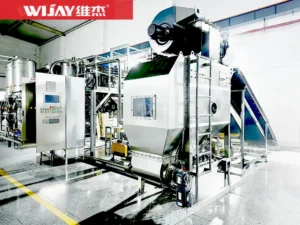
Dense-phase pneumatic conveying takes a fundamentally different approach to moving material through the line. Instead of suspending pellets in a fast airstream, a pressure vessel is used as the feeding device. The vessel doses product into the pipeline in a controlled, metered way and functions as a gas-tight valve between the low-pressure feed side and the pressurized conveying line — a distinction that matters because it’s what allows the system to run at low velocity without losing throughput control.
Inside the pipeline, material doesn’t travel suspended in air — it moves as a series of compact product plugs, pushed gently through the line by compressed air at velocities typically below 10 meters per second. That’s a substantial reduction compared to dilute-phase transport speeds, and it’s the direct mechanism behind the wear reduction: lower velocity means lower-energy impacts against the pipe wall, and lower-energy impacts mean significantly less frictional heat generation — which is what keeps angel hair formation from occurring in the first place.
The gas-tight pressure vessel feed also matters for a second reason beyond wear: it allows the system to handle abrasive or sensitive materials reliably, since the sealed feeding mechanism doesn’t depend on high air velocity to maintain product flow. Material is pushed through the pipeline in these compact plugs, which — somewhat counterintuitively — tends to improve throughput per unit of air consumed rather than sacrifice it, since the system isn’t spending energy keeping material airborne across the entire pipe run.
For longer conveying distances — runs beyond roughly 100 meters — additional air injection points (booster nozzles) can be integrated along the pipeline to maintain plug movement and process reliability over distance, without requiring a return to dilute-phase velocities to keep material moving.
What This Means for Pipe Protection and System Design
One of the more practical downstream effects of low-velocity dense-phase transport is that additional wear protection on pipe bends — hardened liners, ceramic inserts, or similar reinforcement that’s often standard practice on dilute-phase lines handling abrasive material — typically isn’t necessary. When the conveying velocity itself is low enough that impact energy at the bends stays below the threshold that drives meaningful wear, the system doesn’t need to compensate for velocity with hardware. That has a direct effect on both capital cost and long-term maintenance planning, since wear-protected bends are more expensive to install and eventually still need replacement on a schedule.
For plants running glass fiber reinforced pellets — automotive components, industrial composites, structural plastics, and similar applications — this shifts the wear conversation from “how do we protect the pipe from the material” to “how do we design the conveying velocity so the pipe doesn’t need protecting in the first place.” That’s a more durable answer, because it addresses the cause rather than managing the consequence.
Why This Matters Beyond a Single Pipe Run
Wear and angel hair contamination in pneumatic conveying rarely stay isolated to the conveying line itself. Angel hair contamination that makes it downstream can affect molding quality, and glass fiber content that’s supposed to remain uniformly distributed can be disrupted by aggressive high-velocity handling, which shows up later as inconsistent mechanical properties in the finished part — a problem that traces back to conveying long before anyone thinks to look there. Pipe wear that progresses to a leak doesn’t just cost the repair; it costs the unplanned stop, the cleanup, and — depending on the material and location — potential product loss and site cleanup requirements.
Specifying the conveying system correctly at the design stage is considerably cheaper than retrofitting wear protection or redesigning pipe routing after a plant has already experienced these problems in production. This is exactly the kind of decision that benefits from being made with real material data — actual glass fiber content, particle size and shape, bulk density, and required throughput — rather than a generic velocity recommendation applied across every pellet type.
FAQ
Why does glass fiber content specifically make pellets harder to convey? Glass fiber is more abrasive than the base polymer, and at 30–50% fiber content by weight, that abrasiveness dominates the material’s wear behavior. Combined with high conveying velocity, it accelerates mechanical wear on pipe walls — particularly at bends — far faster than unreinforced pellets would.
What causes angel hair, and why is it a quality problem, not just a nuisance? Angel hair forms when frictional heat from high-velocity pellet impacts melts a thin surface layer of the polymer, which stretches into fine filaments. Beyond clogging equipment, angel hair contaminates the product stream and can carry through into downstream processing, showing up as a defect in the finished product rather than staying contained to the conveying line.
Does reducing conveying velocity mean sacrificing throughput? Not necessarily. Dense-phase conveying moves material as compact plugs rather than suspending it in a high-velocity airstream, which — for abrasive or fiber-reinforced pellets — often improves throughput per unit of air consumed rather than reducing it, since less energy is spent maintaining airborne suspension across the pipe run.
Is dense-phase conveying suitable for long conveying distances? Yes, with the right design. For runs beyond roughly 100 meters, additional air injection points along the pipeline maintain plug movement and process reliability without requiring higher velocities that would reintroduce the wear problem dense-phase conveying is meant to solve.
Do dense-phase systems still need wear protection on pipe bends? Generally not, and that’s one of the practical benefits. Because impact energy at the bends stays low at dense-phase velocities, hardened liners or ceramic wear protection — common on dilute-phase lines handling abrasive material — are typically unnecessary, which reduces both capital cost and long-term maintenance.
WIJAY Systems engineers pneumatic conveying lines for abrasive and fiber-reinforced bulk materials as fully integrated systems — enclosed, low-wear, low-degradation transport specified around your actual material’s properties rather than a generic velocity setting. If your current conveying line is generating angel hair, wearing through pipe bends, or costing more in maintenance than it should, that’s worth a conversation with our process engineering team.