If your line has ever gone down because a screen blinded mid-batch, or a batch got flagged because a screen wasn’t rated for allergen changeover, you already know the real cost of getting this wrong. A food grade sifting machine isn’t a commodity purchase — the wrong spec shows up later as clogged mesh, inconsistent particle size, failed audits, or a product recall traced back to a control point nobody was watching closely enough.
Powder consistency, safety, and flow don’t come from sourcing alone — they come from how the material is handled, screened, and separated during processing. Sifting removes oversize particles, protects downstream equipment, and — done right — becomes one of the cleanest ways to hit HACCP, BRCGS, and EC 1935/2004 compliance without adding labor. Get the mesh, motion, and hygiene design wrong, and you’re managing a recurring maintenance and compliance problem instead of a solved one.
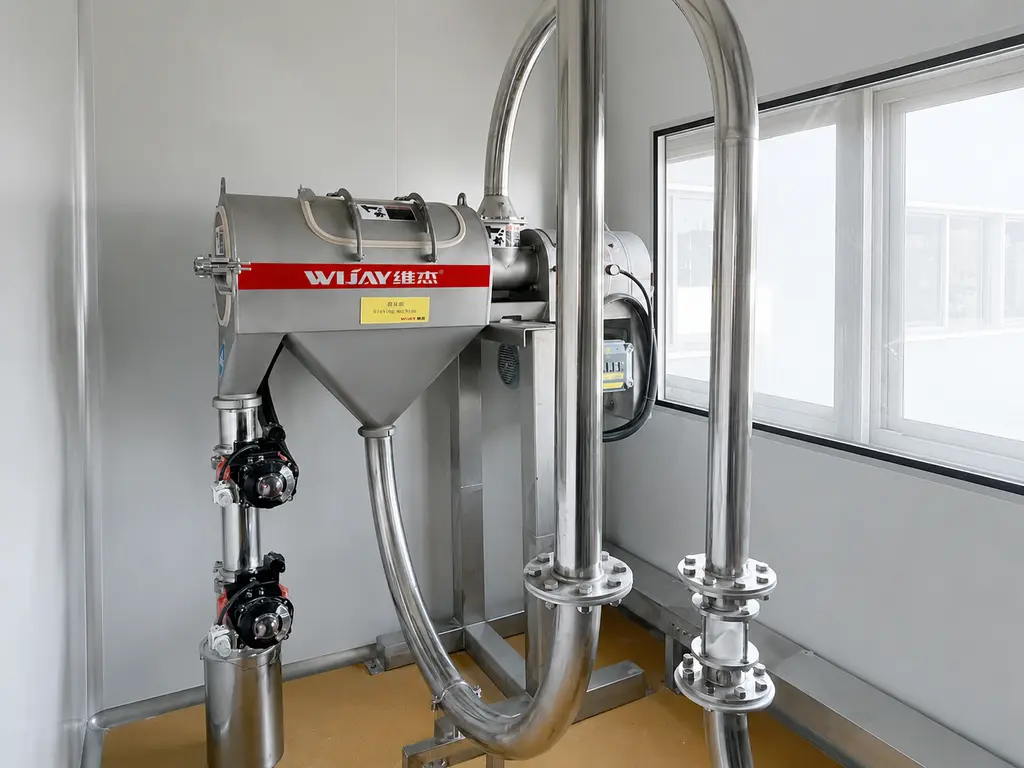
Why Sifting Equipment Is a Compliance Control Point, Not Just a Quality Step
Flour, sugar, starch, protein blends, and seasoning powders all carry the same underlying risk profile: they clump, absorb moisture, build static charge, or vary in particle size batch to batch. Left unscreened, any of these behaviors can blind a downstream mixer, produce inconsistent blends, or — worse — let a foreign object or cross-contaminated allergen particle through to packaging.
That’s why a properly specified sifting system usually functions as a Critical Control Point under HACCP, not a nice-to-have quality filter. In allergen-sensitive and high-hygiene environments, mesh choice, frame design, and cleanability directly affect whether your line can demonstrate traceability and pass a BRCGS or FDA food-contact audit. If your current screen specification was chosen on price alone, this is usually where it shows.
Powders That Actually Need Sifting — and Why Each One Fails Differently
Not every powder fails the same way, which is exactly why a single “standard mesh” rarely works across a plant:
- Flour (wheat, rye, rice, gluten-free) clumps readily and needs de-lumping before mixing or packaging.
- Sugar (granulated, powdered, brown) requires tight particle-size control for coating, baking, and confectionery applications.
- Starch (corn, potato, tapioca) runs dusty and can blind a screen quickly if the mesh isn’t matched to particle load.
- Cocoa powder is light, fine, and typically static-charged — a common cause of premature screen blinding.
- Milk and dairy powders (whey, casein, milk protein concentrate) are highly moisture-sensitive and generally need sealed, hygienic handling.
- Nutritional and protein powders — pea, soy, whey blends for supplements and RTD beverages — carry strict particle-uniformity requirements.
- Spice and seasoning blends often combine fine powder with coarse particles that need effective separation, not just filtration.
- Dry bakery mixes and premixes need uniformity across multiple blended components before further processing.
- Micro-ingredient fortificants (calcium, vitamins, iron) are added in small quantities and need precise, clump-free dispersion.
Each of these materials behaves differently under vibration or centrifugal force. Matching the sifter to the actual physical behavior of your powder — not a generic spec sheet — is the difference between a screen that lasts and one that blinds every shift.
How to Choose the Right Food Grade Sifting Machine: Four Factors That Actually Matter
1. Powder Characteristics
- Particle size and distribution. Finer powders blind screens faster; coarse or irregular particles may need more aggressive motion or larger apertures.
- Flowability. Poor-flowing ingredients often need mechanical assistance or a specific screen orientation to pass reliably.
- Moisture content and static. Hygroscopic or static-prone powders — cocoa, milk protein — often require ultrasonic anti-blinding or fully enclosed units.
2. Throughput and Batch Size
High-volume continuous lines typically call for centrifugal or larger vibratory screens rated for sustained duty. Small-batch or pilot-scale production usually benefits more from compact, fast-clean units built for frequent product changeover.
3. Hygiene and Cleanability
Food processing equipment has to be easy to clean and engineered to minimize contamination risk — especially for allergen-sensitive or high-hygiene product lines:
- Look for crevice-free construction, 304 or 316L food grade stainless steel, and polished welds.
- Where full teardown isn’t practical on every changeover, CIP (clean-in-place) compatibility matters more than most spec sheets emphasize.
- For allergen-sensitive operations, fast screen changeover and dedicated spare frames per product line materially reduce cross-contact risk.
4. Installation Point in the Process
Where the sifter sits in the line changes what it needs to do:
- Pre-blend sifting removes contaminants before mixing.
- Post-blend sifting confirms uniformity before packaging.
- In-line sifting screens product continuously as it moves through the line, rather than as a batch step.
Weigh these four factors together, and you get a spec that holds up in production — not just on paper.
Industrial Screen Types for Food Powders and Ingredients
Screen selection isn’t one-size-fits-all, and this is where a lot of competing guides stop short — they’ll list screen types without explaining which failure mode each one is actually solving for.
Check Screening (Safety Screening)
The most common sifting type in food production. Its job is straightforward: catch foreign material, break up clumps, and act as a final safety and quality checkpoint — frequently the HACCP Critical Control Point itself — before mixing or packaging. Typically installed pre-packaging or post-blend, where floor space is tight but hygiene and throughput both matter.
Grading Screening
More precise than check screening. Grading separates material into distinct particle-size fractions using up to four stacked decreasing-aperture screens, isolating fines, mid-range particles, and oversize material in one pass. Traditional stacked designs are compact and cover most grading needs; for high-volume or complex processes, a series of single-layer screens arranged in sequence can improve separation efficiency by optimizing flow and screen contact at each stage. Modular units also reduce cross-contamination risk between fractions — relevant for flour, starch, spice blends, and any functional ingredient where particle-size consistency drives product performance.
Centrifugal (Rotary) Screening
Uses an internal paddle rotating at high speed inside a cylindrical screen, forcing product outward under centrifugal force. This makes centrifugal screens especially effective for sticky or clumping powders like whey, casein, cheese powder, or cocoa. Throughput typically outpaces a vibratory screen of the same footprint, and the enclosed design helps control dust in dry-powder environments. The trade-off: aggressive paddle action can damage fragile particles or force oversize material through the mesh by breaking it apart — not a fit for delicate products.
Linear Screening
Moves product across a rectangular screen using linear, horizontal motion. Longer dwell time supports effective separation, particularly when oversize content or fine-particle ratio is high. Linear screens suit fragile or brittle materials — extruded snacks, sugar crystals — where gentler motion avoids product damage. They also handle high oversize loads without blinding as quickly, and can double as conveying (even elevating, if inclined) or as a dusting/alignment step, such as removing loose flour from biscuits.
Ultrasonic Screening
Not a standalone screen type — an add-on that layers high-frequency ultrasonic energy directly onto a standard vibratory screen. The added energy keeps fine or static-charged powder moving, which prevents blinding and improves flow. Best suited to sub-100µm powders — milk powder, spice dust, isolated proteins — and to static-prone or clumping materials like cocoa, starch, gums, and emulsifiers. Widely used in additive dosing and pre-weigh systems, particularly in dry-blend facilities handling minor ingredients, premixes, or allergens where pre-blend purity is critical.
Mesh Specification: The Detail That Determines How Much Product You Actually Recover
Screen type gets most of the attention, but mesh specification is what actually determines separation efficiency and recoverable yield.
Woven wire mesh is the standard choice for vibratory sifting — interwoven stainless steel, nylon, or other material forming a grid of apertures. It’s available in a wide range of aperture and wire-diameter combinations for precise particle separation, but it deforms or breaks under sustained high-volume or abrasive use, so scheduled inspection and replacement matter.
Perforated plate screening is a more durable alternative — precision-punched from solid metal sheet. Grading flexibility is limited and open area is lower (which can reduce throughput), but it holds up far better under rough, high-abrasion sifting conditions. Aperture sizes are typically standardized to whole or half-millimeter increments.
Wedge wire screening, common in centrifugal and some linear screens, is built from parallel wedge-shaped wires welded to support rods. This creates long, narrow slots that are highly resistant to blinding and deliver very consistent throughput over extended runs. Wedge wire costs more to manufacture but pays that back in durability and reliability for continuous or hard-to-screen materials.
When specifying mesh, weigh:
- Aperture size — the wire-to-wire gap that sets maximum particle size passed through; accurate particle-size data on your product is essential to get this right.
- Mesh count — openings per linear inch (e.g., 80 mesh); related to aperture but not interchangeable, since two screens can share a mesh count with different wire diameters and open areas.
- Wire diameter — thicker wire adds strength and durability but reduces open area; thinner wire improves throughput and fine-particle sensitivity at the cost of durability.
- Open area — the percentage of screen surface that’s aperture rather than wire; higher open area increases throughput but can reduce screen life or structural integrity.
- Pre-tensioned screen systems — hold mesh at constant tension within the frame, maintaining flatness and performance, with faster changeover and lower blinding risk.
Final mesh selection comes down to ingredient type (flour, starch, milk powder, sugar), required throughput, regulatory limits, and cleaning requirements. In allergen-sensitive operations or facilities running frequent product changeovers, tool-free screen frame removal cuts both downtime and cross-contact risk in ways a generic spec sheet won’t capture.
Getting the Screen Spec Right, Not Just the Machine
Choosing the right food grade sifting machine comes down to understanding your powder’s behavior, where the screen sits in the process, and how hygiene, allergen control, and certification requirements shape equipment design. Get the spec wrong, and you inherit reduced throughput, contamination exposure, and expensive unplanned downtime. Get it right, and sifting quietly does its job — protecting product quality, supporting compliance, and adding long-term efficiency to the line instead of becoming a recurring maintenance ticket.
FAQ
What’s the best screen type for sifting flour, sugar, or starch? For dry, free-flowing powders like flour and sugar, vibratory check screening is the standard choice — it maintains hygiene while confirming product purity and consistency before the next process step.
Can sifting reduce allergen cross-contamination risk? Yes. Screens play a key role in allergen control by improving product separation and, combined with proper cleaning and segregation procedures, preventing cross-contact. Look for models with quick-release clamps and tool-free screen changeover for fast cleaning between batches.
How do I choose the right mesh count for a food powder? Mesh count depends on your product’s particle size and the separation you need. Running an actual particle-size test on your material is the reliable way to balance throughput against separation efficiency — not a generic mesh chart.
Are ultrasonic screens worth it for food powders? For fine or hygroscopic powders that blind standard mesh quickly, yes — ultrasonic anti-blinding keeps flow consistent and cuts unplanned downtime, especially in additive dosing or pre-weigh applications.
How does sifting improve product texture and quality? Sifting removes clumps, foreign material, and inconsistent particles, which directly supports the smooth texture that blends, coatings, and baked products depend on.
Is centrifugal screening better for sticky or oily food ingredients? Yes — centrifugal screening handles oily, sticky, or compacted powders well, where vibration alone often isn’t enough. It’s less suited to fragile products that need gentler handling, where a linear screen is usually the better fit.
WIJAY Systems engineers food grade sifting machines as part of fully integrated, enclosed powder handling lines — dust-free, low-degradation conveying paired with sifting systems specified around your actual powder behavior, not a generic mesh chart. If you’re speccing a new sifting line or troubleshooting a screen that’s blinding, clogging, or failing audits more often than it should, that’s a conversation worth having with our process engineering team.