When a dust collection system underperforms, most maintenance teams start troubleshooting at the filter media or the fan. Rarely does anyone start at the discharge point — the rotary discharge valve sitting quietly at the bottom of the hopper. That’s usually a mistake. A dust collector can have a perfectly clean filter and a properly sized fan, and still leak differential pressure, re-entrain dust, or trip a combustible dust incident, because the discharge valve isn’t holding the seal it’s supposed to hold.
Airborne particulate isn’t a cosmetic housekeeping issue in pharmaceutical, food processing, fine chemical, or mining operations — it’s a health hazard, a safety liability, and, above a certain concentration, an explosion risk. Dust collection systems exist to capture that particulate and remove it from the work environment while staying in regulatory compliance. The rotary discharge valve is the component that determines whether the system does that consistently, or fails quietly over months of gradual wear.
What a Rotary Discharge Valve Actually Does
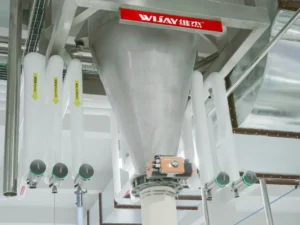
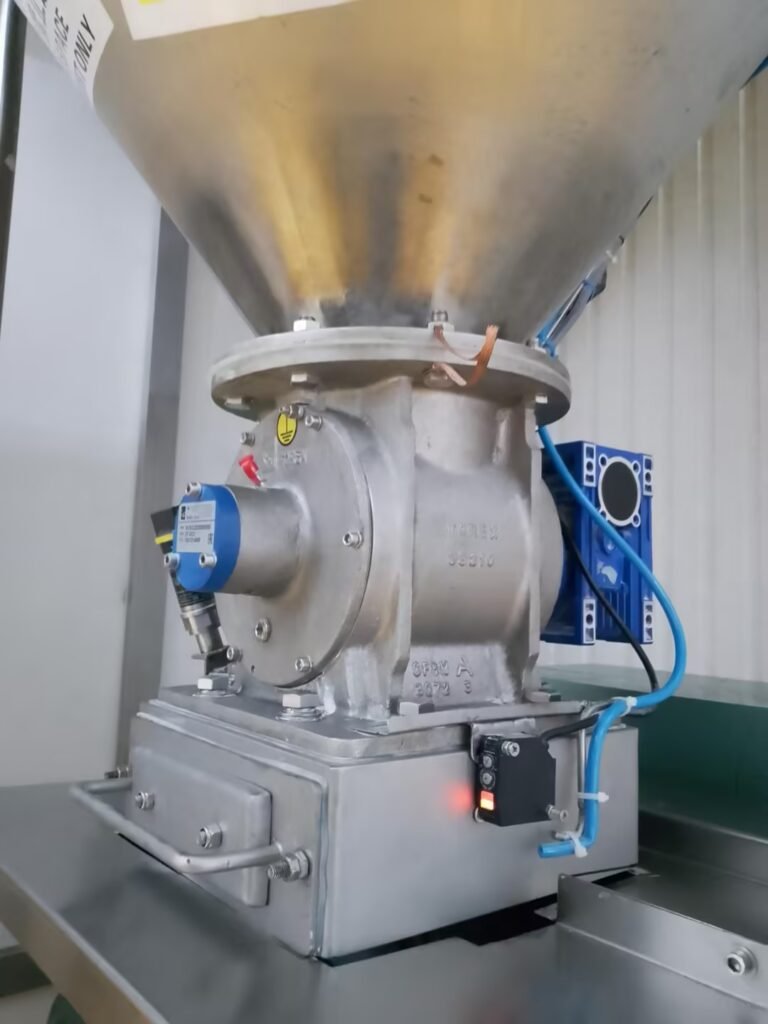
Mechanically, a rotary discharge valve looks simple: a cylindrical housing, a multi-vane rotor, an inlet, an outlet. As the rotor turns, each vane pocket captures a metered volume of bulk material — typically dust collected at the bottom of a baghouse or cyclone hopper — and carries it to the outlet, feeding a storage bin or conveyor. What makes it more than a mechanical gate is what happens between those pockets: the rotor maintains an air seal between the inlet and outlet sides at all times, which is the property that separates a rotary valve from a gravity chute or a simple slide gate.
That airlock function is the entire point. Without it, a discharge point is just a hole in a pressurized vessel.
How Dust Collection Systems Depend on That Seal
A dust collection system is built around controlled airflow — usually negative pressure — pulling dust-laden air through ductwork, into a baghouse or cyclone where particulate is separated out, and exhausting clean air. Dust accumulates in the collector’s hopper and has to be removed continuously without breaking that pressure differential.
This is where most systems fail in practice, not in theory. If the discharge point isn’t sealed, ambient air gets pulled backward into the hopper (or pressurized air pushes outward, depending on system design), and that pressure imbalance does three things at once: it reduces capture efficiency at the hood or duct inlets, it forces the fan to work harder to compensate, and in the worst case, it lets captured particulate re-enter the work area through the same point that’s supposed to remove it. None of those failure modes show up as an alarm. They show up as gradually rising energy consumption and gradually declining air quality — which is exactly why the discharge valve gets overlooked until someone investigates why collection efficiency has drifted.
Core Functions of the Rotary Discharge Valve in the System
Maintaining system pressure. A negative-pressure dust collector discharging directly into open air would immediately lose its pressure balance to backflow — collection efficiency drops, and in extreme cases dust escapes at the discharge point instead of being contained. The rotary valve acts as an airtight barrier, holding the pressure differential stable while material continues to discharge.
Controlling material flow. Dust accumulates in the collector hopper continuously. Without a metering device at the outlet, that accumulation either backs up and causes a blockage, or discharges unevenly and overwhelms whatever comes next in the process. A rotary valve with adjustable rotor speed delivers a controlled, consistent discharge rate, which keeps downstream operations — bagging, pneumatic conveying, further processing — running without surges.
Preventing dust re-entrainment. Captured dust that gets pulled back into the airstream at the discharge point undermines the entire collection effort. By isolating the discharge zone and minimizing turbulence at that interface, the valve keeps separated particulate from re-entering circulation — a detail that matters disproportionately for fine or hazardous powders where even a small re-entrainment rate is unacceptable.
Reinforcing explosion protection. In grain and food processing, lithium battery materials, fine chemicals, and mining — anywhere combustible dust is present — the discharge valve does double duty as a fire and explosion barrier. Its air seal keeps oxygen-rich ambient air from reaching the discharge zone, reducing the risk of a dust-air mixture reaching an ignitable concentration. Explosion-rated rotor and housing configurations exist specifically for this duty and are worth specifying by default in any combustible dust application, not added after an incident review.
Design and Operating Factors That Determine Real-World Performance
A rotary discharge valve’s on-paper spec sheet and its actual field performance are two different things. The gap between them almost always traces back to one of four variables:
| Factor | Why It Matters |
|---|---|
| Rotor configuration | Vane count, vane profile, and tip-to-housing clearance determine both sealing performance and throughput. Clearances set too tight to chase sealing performance are the single most common cause of premature rotor wear and jamming — it’s a trade-off, not a “tighter is always better” spec. |
| Material compatibility | Particle size, abrasiveness, and moisture content of the dust dictate housing and rotor material. Abrasive mineral or metal dust needs hardened steel or ceramic-lined components; food and pharmaceutical applications require stainless steel for cleanability and corrosion resistance. |
| Sizing and capacity | The valve has to match actual dust generation rate. Undersized, and it becomes the bottleneck for the whole collector. Oversized, and it wastes energy and footprint while running inefficiently at partial load most of the time. |
| Maintenance and durability | Rotor tips, bearings, and seals wear on a predictable schedule under normal use. Specifying components designed for accessible inspection and replacement — rather than requiring a full teardown — is what actually controls downtime over the equipment’s service life. |
Why This Component Affects Efficiency and Compliance, Not Just Uptime
Energy cost. A stable pressure differential means the fan isn’t fighting a leak. On systems that run continuously, that difference compounds into a measurable energy line item over a year, not a rounding error.
Regulatory compliance. Discharge valve performance feeds directly into whether a facility meets OSHA and EPA air quality and dust exposure standards, and NFPA combustible dust guidance explicitly calls out isolation devices like rotary valves as part of an explosion protection strategy — this isn’t an optional add-on for facilities handling combustible dust.
Risk exposure. Proper discharge control is part of demonstrating regulatory-compliant dust handling. Getting it wrong shows up as citations, fines, or unplanned downtime after an incident — costs that dwarf the price difference between a correctly specified valve and an undersized one.
Common Failure Modes and How They’re Addressed
Air leakage. Usually traced to worn seals, degraded rotor tip clearance, or a valve that was undersized or under-specified for the application from the start. The fix is precision-sealed components matched to the actual pressure differential the system runs at — not a generic catalog part.
Abrasive wear. High-abrasion dust — sand, mineral fines, metal particulate — accelerates rotor and housing wear well beyond published service intervals if the valve wasn’t specified with wear-resistant materials or ceramic lining from the start.
High-temperature operation. Standard valve seals and housings can fail outside their rated temperature range. Applications with hot process dust need valves engineered with heat-resistant materials or active cooling, specified at the design stage rather than retrofitted after a failure.
Specifying a Rotary Discharge Valve That Actually Fits Your Line
A rotary discharge valve is a small component on a P&ID, but it’s the point where system pressure, material flow control, dust re-entrainment, and explosion protection all converge into a single seal. Getting the rotor configuration, material selection, and sizing wrong doesn’t usually cause an immediate failure — it causes a slow efficiency drift that’s expensive to diagnose after the fact.
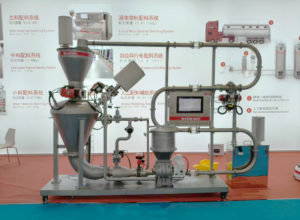
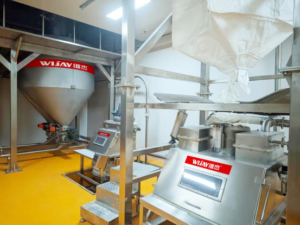
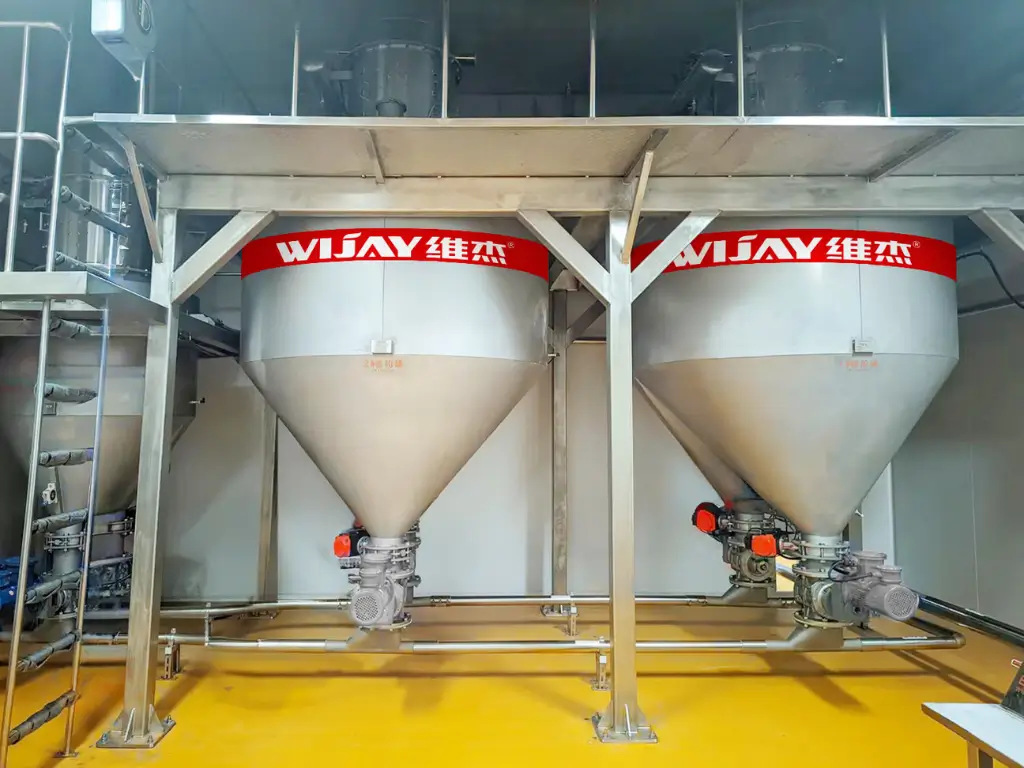
At WIJAY Systems, we specify and integrate rotary discharge valves as part of complete pneumatic conveying and dust collection lines — sized against actual dust characteristics and system pressure requirements, not a generic catalog match, and built into fully enclosed, low-loss material handling systems across food, pharmaceutical, chemical, and mineral processing applications.
If your dust collection system’s efficiency has been drifting and the filter and fan check out fine, talk to WIJAY’s process engineering team about auditing the discharge point first.
FAQ
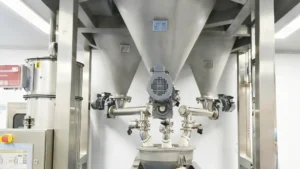
What is a rotary discharge valve used for in a dust collection system? It sits at the bottom of a baghouse or cyclone hopper, discharging collected dust to a bin or conveyor while maintaining the airtight seal that keeps the collector’s pressure differential stable.
Why does a rotary discharge valve matter for combustible dust safety? Its air seal prevents oxygen-rich ambient air from reaching the discharge zone, reducing the risk of an ignitable dust-air mixture forming at that point — a function explicitly referenced in NFPA combustible dust guidance.
What material should a rotary discharge valve be made from? It depends on the dust. Abrasive mineral or metal dust needs hardened steel or ceramic-lined rotors and housings; food and pharmaceutical applications require stainless steel for cleanability and corrosion resistance.
How do I know if my rotary discharge valve is undersized? Undersized valves become a bottleneck at the hopper outlet, often showing up as rising differential pressure, uneven discharge, or backup at the collector before any alarm triggers.